
UK buying guide · 8×42
Best binoculars for birdwatching in the UK
Five current 8×42 birdwatching binoculars compared by field of view, eye relief, close focus, weight and weather protection.
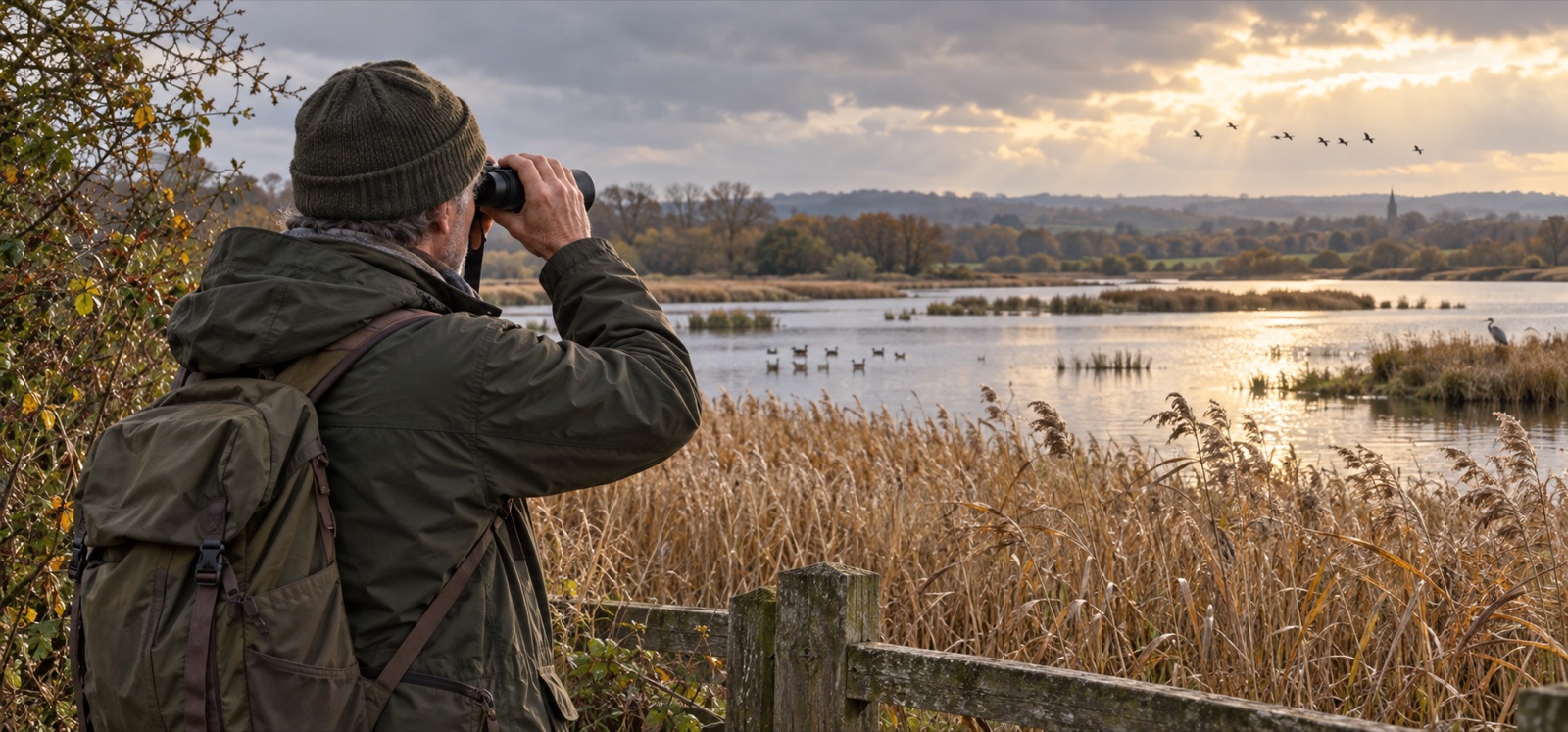
Choose 8× for a steadier, wider view that makes moving birds easier to find.
Treat stated eye relief as a shortlist measure; glasses wearers still need a fit check.
A 2–3m close focus is useful when birds, butterflies or insects appear nearby.
Quick picks
Choose by the detail that matters most
Links open the matching Amazon UK listing. Prices and sellers can change, so confirm the model name and ASIN before buying.
Swipe to compare all details →
| Model | Best reason to choose | Weight | Field of view | Eye relief | Close focus |
|---|---|---|---|---|---|
| Celestron Nature DX 8×42 | Credible accessible starting point | 629g | 129m at 1,000m | 17.5mm | 2m |
| Nikon PROSTAFF P7 8×42 | Balanced width fit and weight | 590g | 126m at 1,000m | 20.2mm | 3m |
| Celestron Nature DX ED 8×42 | ED glass and close subjects | 705g | 129m at 1,000m | 17.8mm | 2m |
| Vortex Diamondback HD 8×42 | Included carry harness | 618g | 7.5 degrees | 17mm | 1.5m |
| Nikon MONARCH M7 8×42 | Widest-field step-up | 670g | 145m at 1,000m | 17.1mm | 2.5m |
The detailed shortlist
Five useful 8×42 routes
Each choice has a current matching Amazon UK listing and an official manufacturer specification. We do not show live prices because seller, stock and price can change between visits.

Celestron Nature DX 8x42
Best for: First 8×42 and close garden viewing
A well-specified first birdwatching binocular with a wide 129m field, 2m close focus and phase-coated BaK-4 prisms without stepping up to ED-glass pricing.
What stands out
- 129m field of view at 1,000m
- 2m stated close focus
- Waterproof, nitrogen-filled body
Keep in mind
- 17.5mm eye relief offers less margin than the Nikon P7
- No ED glass in this standard Nature DX model
- 8×42
- 629g
- 129m / 1,000m
- 17.5mm eye relief

Nikon PROSTAFF P7 8x42
Best for: Wide viewing with glasses
A 590g all-round 8x42 with a wide 126m field, long stated eye relief and a locking dioptre ring that helps preserve a personal focus setting.
What stands out
- 126m field of view at 1,000m
- 20.2mm stated eye relief
- 590g waterproof body with locking dioptre
Keep in mind
- 3m close focus is useful rather than class-leading
- No ED glass in the published specification
- 8×42
- 590g
- 126m / 1,000m
- 20.2mm eye relief

Celestron Nature DX ED 8x42
Best for: Birds, butterflies and nearby detail
An ED-glass 8x42 with a 129m field and 2m close focus, making its published specification especially relevant to mixed bird, butterfly and garden viewing.
What stands out
- 2m stated close focus
- ED objectives and phase-coated BaK-4 prisms
- 17.8mm eye relief with multi-stop eyecups
Keep in mind
- 705g is the heaviest body in this shortlist
- The useful ED-glass claim still does not replace an in-person view
- 8×42
- 705g
- 129m / 1,000m
- 2m close focus

Vortex Diamondback HD 8x42
Best for: All-weather wildlife walks
A weather-sealed 8x42 with a broad published field, 17mm eye relief and an included harness, giving it a practical ready-to-carry package.
What stands out
- Wide 7.5-degree published field
- GlassPak harness included
- Waterproof, fogproof roof-prism body
Keep in mind
- 17mm eye relief may not suit every glasses wearer
- HD naming alone does not mean ED objective glass
- 8×42
- 618g
- 7.5° field
- 1.5m close focus

Nikon MONARCH M7 8x42
Best for: Finding and following moving birds
A step-up ED-glass 8x42 whose key distinction is an expansive 145m field, alongside a locking dioptre and protective external lens coatings.
What stands out
- 145m field of view at 1,000m
- ED glass and dielectric prism coating
- Locking dioptre and oil-repellent external coating
Keep in mind
- Costs materially more than capable starting models
- 17.1mm eye relief gives less margin than the PROSTAFF P7
- 8×42
- 670g
- 145m / 1,000m
- 17.1mm eye relief
There is no single best birdwatching binocular for every face, pair of hands and habitat. There is, however, a dependable first format: 8×42. It gives enough reach to see plumage and behaviour, a steadier image than higher handheld magnifications and an objective size that remains practical for a day outdoors.
The five records above are deliberately not ranked by a made-up score. Each has a different reason to exist on the shortlist, and the best choice depends on which compromise you notice most.
What matters more than the shortlist order
Field of view
A field specified as 126m at 1,000m means the scene is 126 metres wide at a distance of one kilometre. Wider is helpful when a bird moves unpredictably or when you are learning to lift the binocular to the right place. It is not a direct measure of edge sharpness or overall image quality.
Eye relief and eyecups
Eye relief is the distance behind the eyepiece where the complete image forms. Glasses create extra separation, so a longer figure is a useful starting filter. Frame shape, lens position, facial structure and eyecup design still change the result. If possible, try the exact model while wearing the glasses you use outdoors.
Close focus
Close focus is the nearest distance at which the binocular can form a sharp image. Around two metres is useful for butterflies, dragonflies and birds close to a window or hide. If almost all your viewing is across an estuary, the difference between two and four metres should carry less weight.
Weight and carrying method
A difference of 100g can become noticeable across a long walk. Think about the whole carry system: neck strap, cross-body strap, harness or case. A lighter binocular with awkward balance is not automatically more comfortable, which is another reason to handle one before committing.
Waterproofing and internal fog protection
Waterproof and nitrogen- or argon-filled construction is worth prioritising for British weather. It helps protect the internal optical system from moisture and internal condensation. It does not mean salt, grit or rainwater can be ignored on the outside; follow the manufacturer’s cleaning and storage instructions.
Good optics also let you watch without approaching a bird. See responsible birdwatching with binoculars for paths, nesting birds and disturbance limits.
Should you choose 10×42 instead?
Choose 10× when your subjects are usually distant, the habitat is open and you can hold the view steadily. The apparent reach can help on reservoirs, estuaries and open hills. The usual cost is a narrower field, more visible hand movement and a smaller exit pupil when the objective size stays at 42mm.
For woodland, gardens, mixed habitats and a first birdwatching pair, 8× remains the safer start. If possible, compare both magnifications on the same distant sign or bird-like target outdoors rather than across a brightly lit shop.
Before you buy
- Check the exact model code and ASIN, not just the family name and “8×42”.
- Put the eyecups in your normal position and look for a full circular field without dark crescents.
- Confirm the barrels close far enough for your interpupillary distance.
- Turn the focus wheel from near to far while holding the binocular normally.
- Lift it repeatedly to a target without looking down at the instrument.
- Check which strap, case and lens covers are included.
- Confirm the current seller, stock, returns and warranty before paying.
Frequently asked questions
Birdwatching binocular questions
Are 8×42 or 10×42 binoculars better for birdwatching?
An 8×42 is the better all-round choice for most birdwatchers because it is steadier, usually wider and easier to use in woodland or dull light. A 10×42 can help when most subjects are distant and the habitat is open.
How much should a beginner spend on birdwatching binoculars?
There is no essential minimum beyond buying a properly aligned model with usable focus and fit. Spend first on a comfortable 8× view, credible weather protection and a returns policy; premium glass is less useful if the eyecups or weight do not suit you.
What eye relief should birdwatchers with glasses look for?
Around 17mm is a sensible shortlist minimum, while 19–20mm gives more margin for thicker frames. Published eye relief is not a fit guarantee, so test whether you can see the complete circular field with your normal outdoor glasses.
Do birdwatching binoculars need to be waterproof?
Waterproofing is strongly recommended for regular use in British weather. A sealed, nitrogen- or argon-filled body helps protect the internal optics from moisture and internal fogging, although the exterior still needs sensible drying and cleaning.