
01 · Handheld viewing
Binoculars
The most versatile observation optic—provided the magnification, objective size, field of view and fit match what you watch.
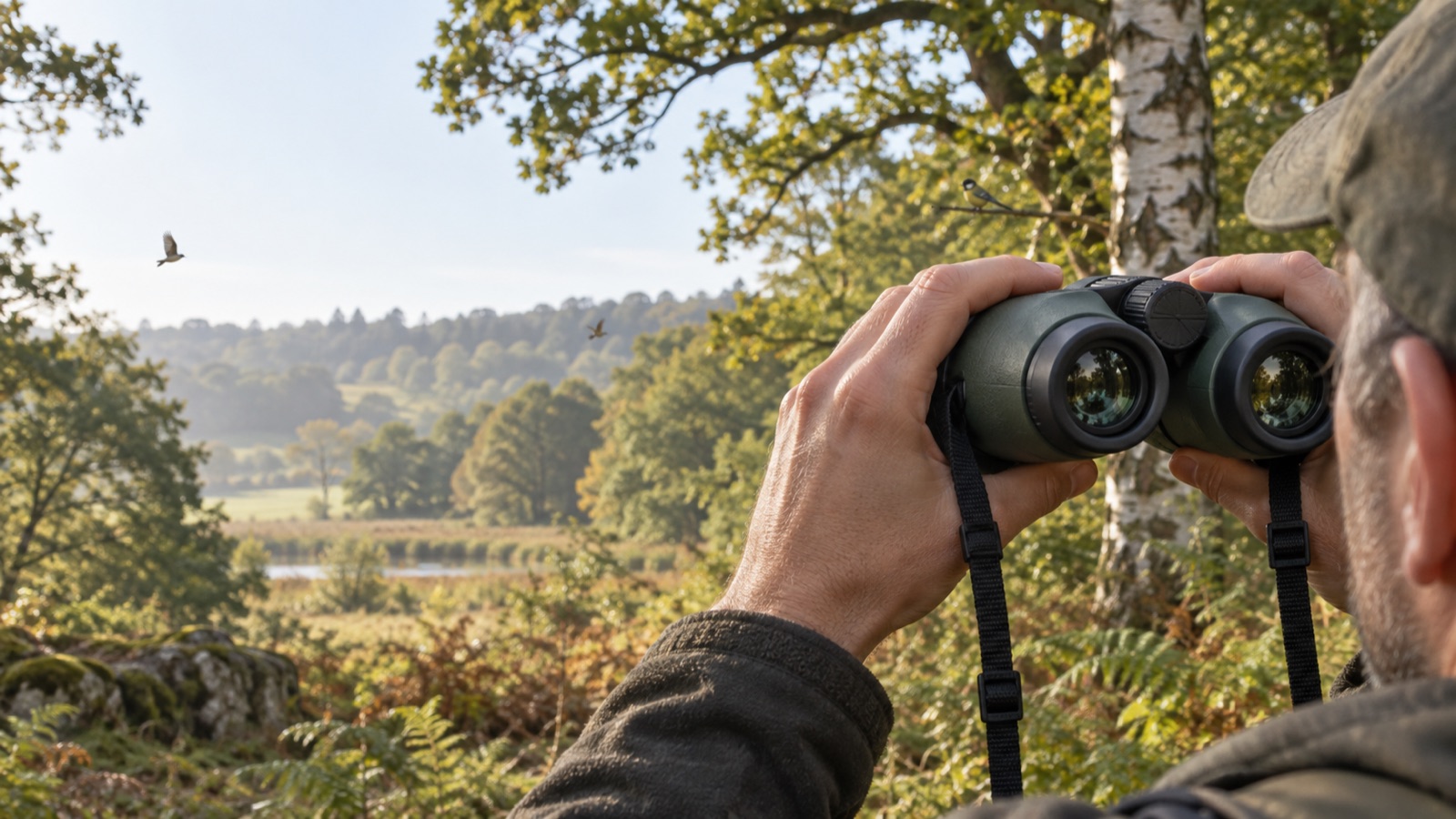
8× is usually steadier and easier to aim; 10× trades some width and stability for more apparent reach.
42mm objectives are a dependable all-round size; 30–32mm cuts carry weight; 50mm and above often need more support.
Eye relief and eyecup position need a real fit check, especially when you wear glasses.
For wildlife, walking, travel and sport, binoculars are normally the most flexible place to begin. The useful question is not simply “how powerful?” It is whether you can find the subject quickly, keep the image steady and hold the instrument comfortably for as long as you want to watch.
A dependable starting format
An 8×42 is a sensible reference point for general wildlife and birdwatching. Eight-times magnification is forgiving of hand movement, while a 42mm objective keeps the exit pupil generous without moving into very large binocular territory. That does not make every 8×42 equally good: field width, eye relief, close focus, coatings, mechanical feel and weight vary substantially.
Fit is part of the optical performance
A promising specification can still be awkward if the barrels do not match your interpupillary distance, the eyecups do not place your eyes comfortably, or the focus wheel is difficult to reach. Glasses wearers should treat the stated eye-relief figure as a shortlist tool, not a guarantee. Trying a pair in person remains the most reliable check.
Build the choice in the right order
If you are starting from scratch, read how to choose binoculars before opening the all-round UK comparison. If a number on a specification sheet is unclear, use what binocular numbers mean, eye relief explained or field of view explained to isolate that decision. If the instrument type itself is uncertain, start with binoculars or a monocular or binoculars or a spotting scope.
Explore this topic
Start here and set a budget
First-pair choices, family fit and buying within a limit.
Best binoculars UK
Start with your main use, then compare five exact models with clear trade-offs.
Read the guide →Budget guideBinoculars under £200
Three budget-conscious formats with a live-price checkout rule.
Read the guide →Family guideBinoculars for children
Fit the child's eye spacing and hands before comparing magnification.
Read the guide →Second-hand guideUsed or refurbished binoculars
Inspect alignment, focusing and internal condition before buying second-hand.
Read the guide →Start hereHow to choose binoculars
Start with magnification, objective size, fit and carry weight before comparing individual models.
Read the guide →Buying guideBest binoculars for beginners
Five forgiving 8×42 choices separated by field, eye relief, close focus and carry setup.
Read the guide →Buying guideBest binoculars under £100
Compare sealed roof models, wide-view Porro options and a genuinely pocketable pair.
Read the guide →Explore this topic
Birdwatching and habitats
Choose for the birds, light and distance you actually encounter.
Binoculars for garden birds
Match a near feeder or window view to close focus and eye comfort.
Read the guide →Buying guideBinoculars for birdwatching
Five current 8×42 options compared by view, fit, close focus, weight and weather protection.
Read the guide →Buying guideBinoculars for wildlife
A habitat-led shortlist for mammals, birds and mixed nature at close and distant ranges.
Read the guide →Habitat guideWoodland birdwatching binoculars
Wide 8× models for shaded, close and fast-moving subjects beneath a canopy.
Read the guide →Habitat guideWetland and estuary binoculars
Choose between wide 8× scanning and steadied 10× reach over mudflats and water.
Read the guide →Habitat guideSeawatching binoculars
Land-based coastal choices for passage, flight, wind and supported long-distance viewing.
Read the guide →Buying guideMarine binoculars
Three purpose-built 7×50 choices for boat use, low light, compass bearings and spray.
Read the guide →Explore this topic
Size, magnification and fit
Compare carry weight, field, eye comfort and the viewing format.
10×42 vs 10×50
Hold magnification constant and weigh extra light against carrying bulk.
Read the guide →Night-sky choice7×50 vs 10×50 for astronomy
Choose a steadier, wider sweep or more useful apparent reach.
Read the guide →Size comparison25mm vs 32mm compacts
Compare true pocket carry with a more forgiving small binocular view.
Read the guide →Fit guideBest binoculars for glasses
Start with long eye relief, then use the eyecup and full-field checks that determine real fit.
Read the guide →Buying guideBest lightweight binoculars
Five easy-carry options from pocket-sized 8×25 to a lighter full-size 8×42.
Read the guide →Format comparison8×42 vs 10×42
Decide whether steadiness and field width or additional apparent reach matters more.
Read the guide →Buying guideBest compact binoculars
Five 8×25, 8×30 and 8×32 choices separated by pocketability, field, close focus and dusk performance.
Read the guide →Format comparisonCompact vs full-size
Compare carrying certainty with the larger exit pupil and easier handling of an 8×42.
Read the guide →Format comparison8×32 vs 8×42
Decide whether a shorter carry or a more forgiving low-light view matters most.
Read the guide →Format guideBest 8×32 binoculars
Three daytime-first pairs for wide views, balanced value or glasses-friendly fit.
Read the guide →Format guideBest 8×42 binoculars
Five all-round models compared for field, eye relief, close focus and carry comfort.
Read the guide →Format guideBest 10×42 binoculars
Four distance-led models compared by field, ED glass, eye relief and steady handling.
Read the guide →Explore this topic
Travel, sport and specialist use
Find a format for a particular setting, from a theatre to the night sky.
Opera and theatre glasses
Why low power suits a stage better than a typical outdoor compact.
Read the guide →Aircraft viewingBinoculars for plane spotting
Track moving aircraft from a safe public viewpoint with the right field.
Read the guide →Technology choiceStabilised vs standard binoculars
Decide when electronic steadiness outweighs battery and handling costs.
Read the guide →Buying guideBinoculars for walking
Five lighter pairs for hill paths, coast routes and everyday rambles in changeable weather.
Read the guide →Buying guideSafari and travel binoculars
Compact, full-size and 10× choices for packing, vehicle use, humidity and dawn viewing.
Read the guide →Sport guideBinoculars for watching sport
Pocket, mid-size and stabilised choices for moving play, distant seats and evening fixtures.
Read the guide →Night skyBinoculars for stargazing
Choose between a handheld 8×42, a classic 10×50 and a mounted 15×70.
Read the guide →Format guide10×50 binoculars for astronomy
Four exact 10×50 models compared for field, glasses, sealing and support.
Read the guide →Light guideBinoculars for low light
Understand what 8×42, 10×50 and 7×50 actually give you at dusk.
Read the guide →Specialist formatImage-stabilised binoculars
Three Canon formats separated by carry size, reach, battery needs and light limits.
Read the guide →Explore this topic
Carry, mount and photograph
Check exact fit before adding a strap, support or phone adapter.
Binocular harnesses
Open carry versus a protective chest pouch, with lug and case-fit checks.
Read the guide →CarryingBinocular straps
Padded and detachable options matched to real strap-lug fittings.
Read the guide →Marine carryFloating straps
Model-specific marine clips, buoyancy and safe boat use.
Read the guide →ProtectionBinocular cases
Compact, medium and chest cases chosen by actual dimensions.
Read the guide →SupportTripod adapters
Front-hinge thread, barrel clearance and complete mounting kits.
Read the guide →SupportTripods for binoculars
Complete head-and-leg kits for stable field and sky views.
Read the guide →Vehicle viewingWindow mounts
Two parked-car clamps and the extra binocular adapter they may need.
Read the guide →PhotographyPhone adapters
Measure eyepiece and phone before choosing a two- or three-axis clamp.
Read the guide →Explore this topic
Model and optic comparisons
Make a close call between named models or different kinds of optic.
Nikon MONARCH M5 vs M7
The actual 8×42 difference in field, eye relief, coating and weight.
Read the guide →Model comparisonCelestron Nature DX vs DX ED
Is ED glass worth the extra weight when field and focus stay the same?
Read the guide →Format decisionBinoculars or a monocular?
Choose two-eyed comfort or one-hand portability for everyday observation.
Read the guide →Format decisionBinoculars or a spotting scope?
Balance immediate handheld views against high-power tripod observation.
Read the guide →Model comparisonNikon PROSTAFF P3 vs P7
The same core 8×42 figures, with important differences in prism coatings and field handling.
Read the guide →Model comparisonNikon PROSTAFF P7 vs MONARCH M5
Compare the P7's wider field with the M5's ED glass and closer focus.
Read the guide →