
UK buying guide · Wildlife watching
Best binoculars for wildlife
Five wildlife binoculars for mammals, birds and mixed nature, compared by field, close focus, weight, eye relief and open-habitat reach.
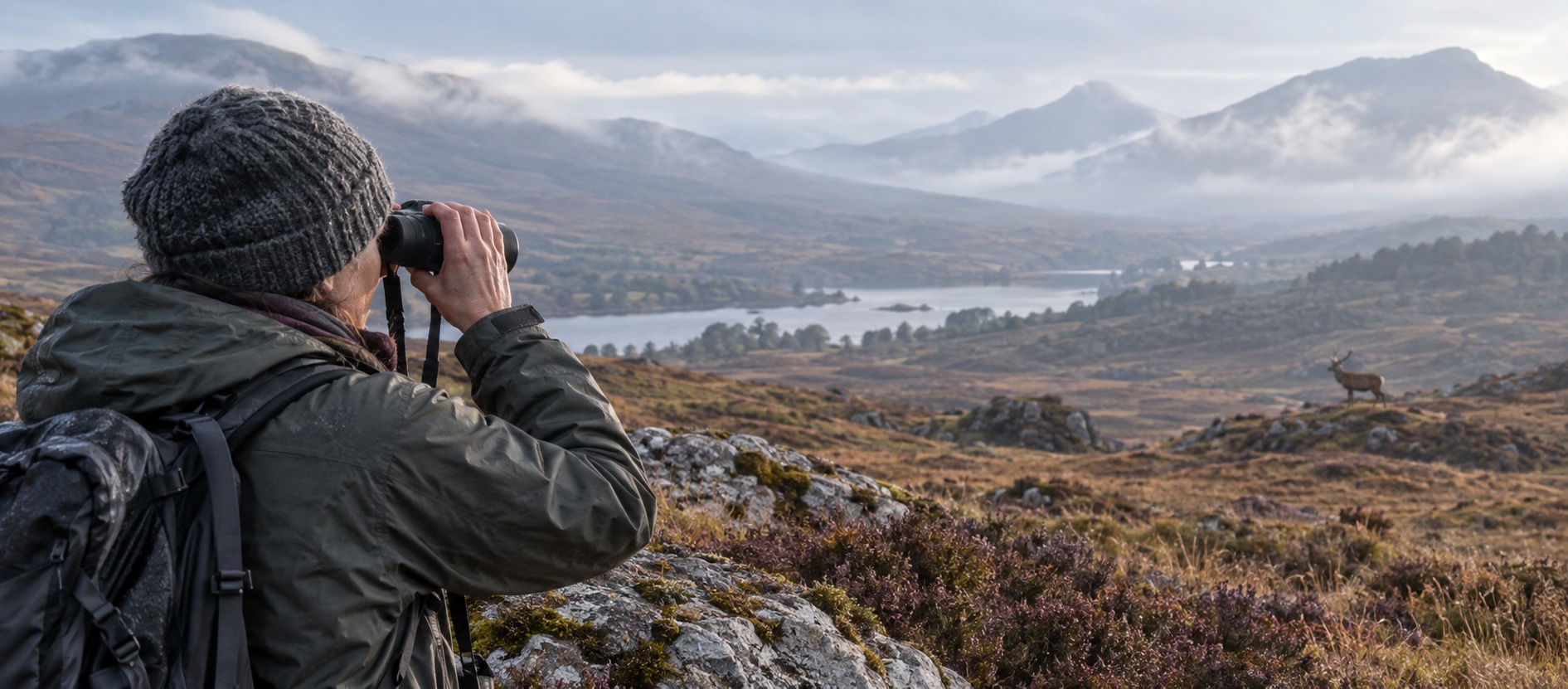
Eight-times magnification is steadier and faster for mixed wildlife.
Close focus matters for insects and garden subjects; field width matters for movement.
A 10×42 complements open-country viewing but is not an automatic upgrade.
Quick picks
Choose by the detail that matters most
Links open the matching Amazon UK listing. Prices and sellers can change, so confirm the model name and ASIN before buying.
Swipe to compare all details →
| Model | Best for | Weight | Field | Close focus | Eye relief |
|---|---|---|---|---|---|
| Nikon MONARCH M7 8×42 | Premium all-round wildlife | 670g | 145m / 1,000m | 2.5m | 17.1mm |
| Nikon PROSTAFF P3 8×42 | Accessible first wildlife pair | 575g | 126m / 1,000m | 3m | 20.2mm |
| Vortex Diamondback HD 8×42 | Close wildlife and harness | 618g | Approx. 131m / 1,000m | 1.5m | 17mm |
| Nikon PROSTAFF P7 10×42 | Open-country value | 600g | 122m / 1,000m | 3m | 15.7mm |
| Nikon MONARCH M7 10×42 | Premium distance | 680g | 121m / 1,000m | 2.5m | 16.5mm |
The detailed shortlist
Wildlife binoculars for genuinely different jobs
The three 8×42 models lead because they cover more habitats. The two 10×42 choices are included for distant mammals, estuaries and open country—not as universal upgrades.

Nikon MONARCH M7 8x42
Best for: Finding and following moving birds
A step-up ED-glass 8x42 whose key distinction is an expansive 145m field, alongside a locking dioptre and protective external lens coatings.
What stands out
- 145m field of view at 1,000m
- ED glass and dielectric prism coating
- Locking dioptre and oil-repellent external coating
Keep in mind
- Costs materially more than capable starting models
- 17.1mm eye relief gives less margin than the PROSTAFF P7
- 8×42
- 670g
- 145m / 1,000m
- 17.1mm eye relief

Nikon PROSTAFF P3 8x42
Best for: Beginners and glasses wearers
A relatively light 8×42 with 20.2mm eye relief, a 126m field and a waterproof, fog-free body.
What stands out
- 20.2mm stated eye relief
- 575g is light for an 8×42
- Waterproof and fog-free
Keep in mind
- 3m close focus is useful rather than exceptional
- No locking dioptre ring like the P7
- 8×42
- 575g
- 126m / 1,000m
- 20.2mm eye relief

Vortex Diamondback HD 8x42
Best for: All-weather wildlife walks
A weather-sealed 8x42 with a broad published field, 17mm eye relief and an included harness, giving it a practical ready-to-carry package.
What stands out
- Wide 7.5-degree published field
- GlassPak harness included
- Waterproof, fogproof roof-prism body
Keep in mind
- 17mm eye relief may not suit every glasses wearer
- HD naming alone does not mean ED objective glass
- 8×42
- 618g
- 7.5° field
- 1.5m close focus

Nikon PROSTAFF P7 10x42
Best for: Estuaries and open-country distance
A 600g 10×42 with a notably wide 122m field, 15.7mm eye relief and a locking dioptre for repeatable long-distance viewing.
What stands out
- 122m field is wide for a 10×42
- 600g waterproof body
- Locking dioptre and protective lens coating
Keep in mind
- 15.7mm eye relief offers limited margin for some glasses
- 10× shake is more visible than with 8×
- 10×42
- 600g
- 122m / 1,000m
- 15.7mm eye relief

Nikon MONARCH M7 10x42
Best for: Detailed open-habitat viewing
A premium 10×42 with ED glass, a wide 121m field, 2.5m close focus and a 680g waterproof body.
What stands out
- 121m field is broad for a 10×42
- ED glass and dielectric prism coating
- 2.5m close focus and locking dioptre
Keep in mind
- Costs substantially more than the PROSTAFF P7
- 680g and 10× magnification demand steadier technique
- 10×42
- 680g
- 121m / 1,000m
- 16.5mm eye relief
Wildlife watching spans quick garden visits, deer at dusk, butterflies on a path and distant mammals across open ground. No single specification is best at every distance, but a wide 8×42 solves the broadest set of problems.
It is steady enough for movement, bright and forgiving in dull conditions, and large enough for comfortable controls. Ten-times models belong in the shortlist when open habitat is the normal case rather than the occasional trip.
Why the Nikon MONARCH M7 8×42 is the premium all-rounder
The MONARCH M7 publishes a 145m field at 1,000m, 2.5m close focus and 17.1mm eye relief in a 670g body. The wide field is its strongest practical advantage: it gives more surrounding habitat when a mammal breaks cover or a bird moves between branches.
ED glass, dielectric prism coatings and protective external coatings strengthen the specification for regular field use. Choose it when wildlife watching is a sustained hobby and the premium does not stop you taking it into ordinary weather.
Why the Nikon PROSTAFF P3 8×42 is the accessible first choice
At 575g, the P3 is notably light for an 8×42. Its 126m field is not as expansive as the M7, but 20.2mm stated eye relief gives glasses wearers more room and the waterproof, fog-free body is suited to routine outdoor use.
It is the safer starting point for mixed mammals, birds and reserve visits. The 3m close focus covers most garden subjects but is less useful for nearby insects than the Vortex.
Why the Vortex Diamondback HD 8×42 suits close and mobile wildlife
The Vortex combines an approximately 131m field at 1,000m with a 1.5m close focus and included GlassPak harness. That pairing works well for butterflies near the path, birds in scrub and longer walks where the binocular should remain ready without pulling on the neck.
Its 17mm eye relief may work with glasses but offers less margin than the P3. Choose it for the field, close focus and carry package, not for the HD label in isolation.
Why the Nikon PROSTAFF P7 10×42 is the value distance option
The P7 10×42 is unusually wide for its magnification at 122m per 1,000m. It weighs 600g and includes the P7 range's locking dioptre and protective coating. For deer across open fields or wildlife on distant slopes, it gives more apparent scale without becoming excessively heavy.
Ten-times still shows more shake and calls for more precise focusing. Its 15.7mm eye relief is also a less comfortable starting point for glasses than the 8× P7 or P3.
Why the MONARCH M7 10×42 is the premium open-habitat pick
The 10×42 M7 adds ED glass, 2.5m close focus and a 121m field. It is the model for a steady user who regularly watches distant wildlife and wants a refined 10× rather than simply the largest number on the box.
At 680g, it is both heavier and less forgiving than an 8× compact. For extended fixed observation, a tripod adaptor or supported position can recover more detail than trying to hold harder.
Choose magnification by habitat
Woodland and scrub
Use 8×. A wide field and deeper perceived focus help when subjects appear at unpredictable distances and vanish behind cover. A larger exit pupil supports the flat light beneath trees. Our woodland birdwatching guide goes deeper into that decision.
Fields, moorland and mountains
Eight-times remains the easiest scanning tool. Ten-times makes sense when the typical subject is already distant and you can brace against a gate, wall or vehicle. Heat shimmer and haze may limit detail regardless of magnification.
Wetlands and coast
Choose a wide 8×42 for flight and broad scanning, or 10×42 for static distant subjects. A spotting scope becomes the better tool for prolonged identification at the far edge of water.
Gardens and close nature
Prioritise close focus and a broad field. The Vortex's 1.5m figure is useful for butterflies and insects, while an 8×32 may be easier to keep near a back door than a full-size model.
The specifications that change the experience
- Field of view: determines how much habitat you see and how quickly you find movement.
- Close focus: important below 3m; irrelevant to a deer 300m away.
- Eye relief: affects whether glasses wearers see the complete field.
- Weight and balance: decide whether long scanning remains steady.
- Weather sealing: protects a field tool from rain and temperature changes.
- Tripod adaptability: useful for supported 10× viewing and long sessions.
A one-pair decision
Choose an 8×42 if this will be your only wildlife binocular. Move to 8×32 if walking and travel regularly outweigh dawn or woodland use. Select 10×42 only after confirming that open-distance observation is the recurring need.
For birds specifically, use the birdwatching shortlist. For the underlying magnification trade-off, compare 8×42 vs 10×42.
Frequently asked questions
Wildlife-binocular questions
What magnification is best for wildlife watching?
Eight-times is the best all-round magnification because it is steady, wide and fast to aim. Ten-times is useful for distant wildlife in open habitats when you can hold it comfortably.
Are 8×42 binoculars good for mammals as well as birds?
Yes. The format combines a useful field for locating movement with a 5.25mm exit pupil for dawn, dusk and woodland. It is the strongest one-pair choice for mixed wildlife.
How important is close focus for wildlife binoculars?
It matters if your wildlife interest includes butterflies, dragonflies, reptiles or garden subjects. A 1.5–2.5m close focus is versatile; for distant mammals it is much less important.
Do I need ED glass for wildlife watching?
No. ED glass can reduce colour fringing and improve fine contrast in a well-designed binocular, but field, fit, focus and stability matter first. A comfortable non-ED model is better than an ED model you dislike using.