
Format comparison · 42mm binoculars
8×42 vs 10×42 binoculars
Compare 8×42 and 10×42 binoculars for birdwatching, wildlife, distance, low light and hand shake, with a clear choice by situation.
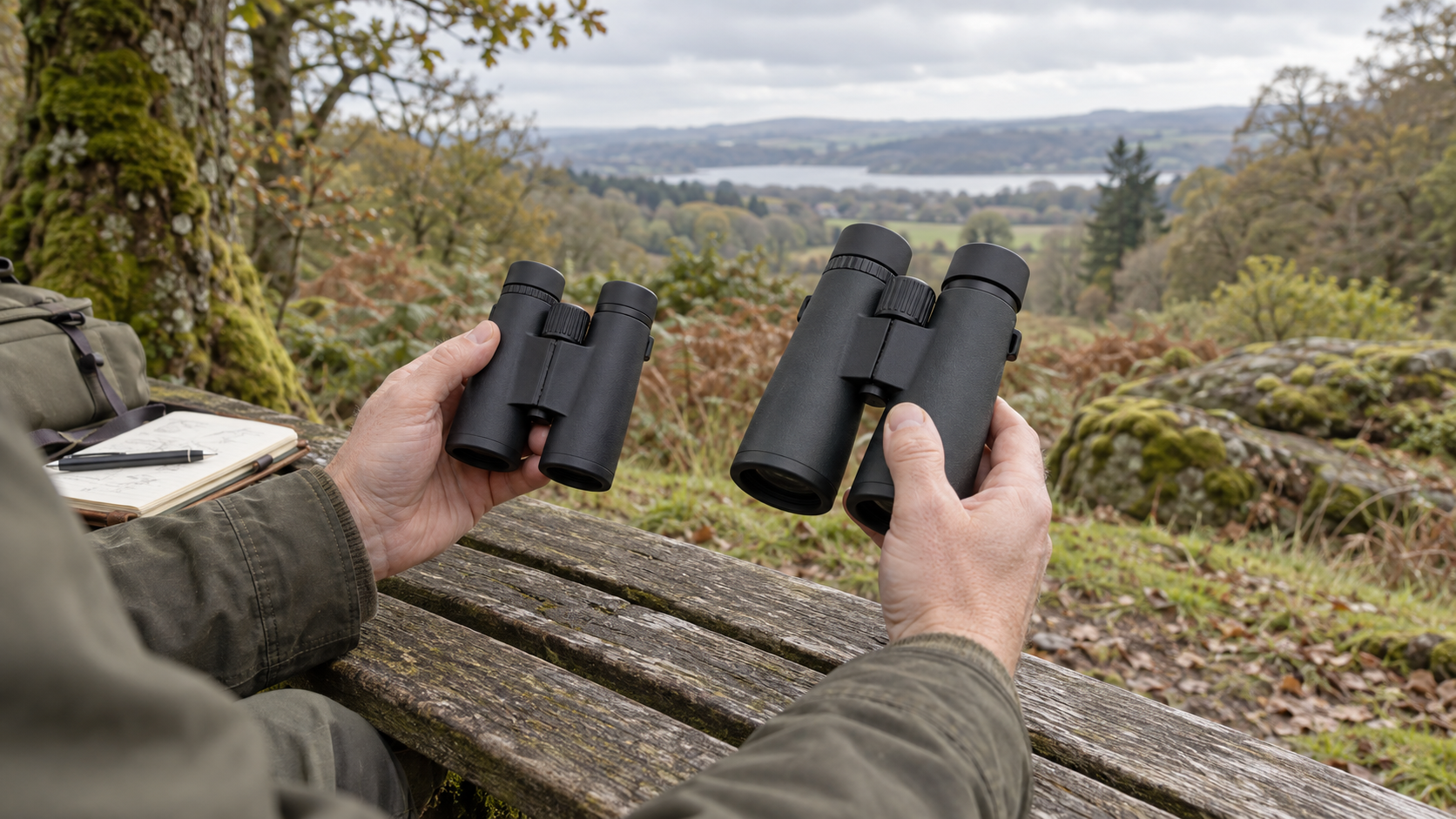
Both have 42mm objectives; the magnification changes stability, field and exit pupil.
8×42 gives a 5.25mm exit pupil; 10×42 gives 4.2mm.
A real outdoor comparison is more revealing than looking across a bright shop.
The difference between 8×42 and 10×42 is not simply “less power” versus “more power”. Keeping the same 42mm objective while increasing magnification changes how easily you find a subject, how much hand shake you see and how forgiving the view feels as light fades.
For most first-time buyers, mixed-habitat birdwatchers and general wildlife users, 8×42 is the stronger default. A 10×42 becomes worthwhile when the extra apparent reach solves a regular problem rather than an occasional one.
The differences at a glance
Swipe to compare both formats →
| Decision | 8×42 | 10×42 |
|---|---|---|
| Apparent reach | Lower | 25% more magnification |
| Handheld stability | Easier | More shake visible |
| Field of view | Usually wider | Usually narrower |
| Exit pupil | 5.25mm | 4.2mm |
| Finding moving subjects | Easier | More demanding |
| Typical strength | Mixed habitats and general use | Distant subjects in open habitats |
These are format-level tendencies, not promises. A particularly wide 10× model can overlap with a narrow 8× model, and balance can make one binocular easier to hold than its weight suggests.
What two matched model pairs reveal
Comparing 8×42 and 10×42 within the same range isolates the magnification choice more usefully than comparing unrelated products. Nikon publishes specifications for both the PROSTAFF P7 8×42 and 10×42 and the MONARCH M7 8×42 and 10×42. The table below puts the maker's field, eye-relief and weight figures side by side; the field-width changes that follow are our calculations from those figures.
Swipe to compare all specifications →
| Model | Field at 1,000m | Eye relief | Weight |
|---|---|---|---|
| PROSTAFF P7 8×42 | 126m | 20.2mm | 590g |
| PROSTAFF P7 10×42 | 122m | 15.7mm | 600g |
| MONARCH M7 8×42 | 145m | 17.1mm | 670g |
| MONARCH M7 10×42 | 121m | 16.5mm | 680g |
The P7 loses just 4m of field at 1,000m when moving from 8× to 10×: 126 − 122 = 4m, or about 3% of the 8× width. The M7 loses 24m: 145 − 121 = 24m, or about 17%. Both 10× models give 25% more magnification than their 8× partners, yet the width trade-off is very different. Magnification alone cannot predict it; eyepiece design matters too.
The glasses-fit trade-off also varies. P7 eye relief falls by 4.5mm between its 8× and 10× versions, whereas M7 falls by only 0.6mm. Those are published measurements, not a promise about the field visible through your particular glasses. The four bodies differ by only 10g within each pair, so weight is unlikely to decide between the two powers in either range. This is why the exact model's field and eye relief deserve attention before the format-level rule of thumb.
Magnification: what does the extra 2× achieve?
A 10× binocular makes a subject appear 25% larger than an 8× binocular because 10 is 1.25 times 8. At long distances, that difference can help with reading colour patterns, watching ships or inspecting a bird already located on open water.
It is less transformative than the numbers can imply. The atmosphere, focus accuracy, optical quality and your ability to hold the image steady may limit the extra detail. Heat shimmer over mudflats or a trembling view can erase the theoretical gain.
Stability: the argument for 8×
Every movement of your hands is magnified along with the subject. Ten-times binoculars therefore show more apparent shake. Some people hold 10× comfortably; others find the view tiring or lose fine detail.
Eight-times binoculars are usually easier to use one-handed for a moment, easier from an unstable hide floor and kinder during a long scan. If you choose 10×, brace your elbows against your body, lean against a solid support or use a tripod adaptor for sustained viewing.
Do not judge stability from a few seconds. Hold each format on a distant detailed target for several minutes and see which lets you read or resolve more consistently.
Field of view: finding matters before identifying
Field of view is the width of the scene visible through the binocular. Comparable 8×42 models usually show more of the landscape than 10×42 models. This makes a flying bird, deer moving through scrub or player crossing a pitch easier to acquire and follow.
A narrow field can feel like searching through a tube. Experienced users may compensate with good pointing technique, but the wider 8× view is valuable for beginners and fast action. Compare each model’s stated metres at 1,000m rather than assuming all 8× or 10× designs are alike. Our field-of-view guide explains the figures.
Low light and exit pupil
Divide objective diameter by magnification to calculate exit pupil:
- 42 ÷ 8 = 5.25mm
- 42 ÷ 10 = 4.2mm
The larger 8×42 exit pupil gives more latitude in eye position and can deliver more light to a dilated eye. That makes 8×42 the more forgiving format in woodland, dull weather and around dawn or dusk.
This does not mean every 8×42 is optically brighter than every 10×42. Transmission, coatings, contrast and your own pupil matter. In bright daylight, both exit pupils are likely larger than your eye requires.
Depth of field and focusing
Lower magnification generally provides greater perceived depth of field. With 8×, subjects at slightly different distances may remain acceptably sharp with less focus-wheel movement. Ten-times viewing often calls for more precise focusing, especially at closer distances.
That difference can matter in woodland, where birds move between branches. On an estuary, where subjects sit at broadly similar long distances, it may matter much less.
Which is better for birdwatching?
Woodland, gardens and feeding stations: 8×42
The wider, steadier view helps you locate birds among branches and follow quick movements. The larger exit pupil is useful under a canopy and in dull winter light.
Wetlands and estuaries: it depends
Choose 8×42 when you scan widely, follow birds in flight or regularly move between near reeds and distant water. Choose 10×42 when the subjects that matter are habitually far away and you can hold the image steadily. A spotting scope is a better next step when you need prolonged high-magnification study.
Seawatching: often 10×42, with support
Extra apparent reach can help with distant birds and vessels, but shake becomes punishing in wind. A supported 10× or spotting scope can be more productive than a handheld 10× used continuously.
Insects and close nature: usually 8×42
Magnification alone is not decisive here; the model’s close-focus distance matters more. Eight-times binoculars are easier to keep on a moving butterfly and tend to feel less cramped nearby.
See our birdwatching binocular shortlist for current 8×42 examples.
Which is better for sport, travel and astronomy?
For daytime sport, 8×42 suits broad action and nearer seating; 10×42 can help from distant stands when the field remains wide enough. For general travel, an 8×32 or lightweight binocular is often more useful than either full-size option.
For casual astronomy, 10×42 reveals more apparent detail, but 10×50 offers a larger 5mm exit pupil and greater light-gathering area at the cost of weight. A reclined or supported position makes a bigger difference than chasing power while standing.
What about glasses?
Magnification does not determine glasses compatibility. Compare the model’s stated eye relief and, crucially, its eyecup design. A 10×42 with 18mm of usable eye relief may fit better than an 8×42 advertised with 16mm.
Glasses wearers should also care about field: poor eye placement can prevent you seeing the full published width. Start with binocular eye relief explained and then use our glasses-wearer shortlist.
A practical decision rule
Choose 8×42 if two or more of these describe you:
- this is your first serious binocular;
- you watch birds or wildlife in mixed or wooded habitats;
- you value a wide, relaxed view;
- your hands are not consistently steady;
- you often observe in dull light;
- you follow flying or fast-moving subjects.
Choose 10×42 if two or more of these describe you:
- most important subjects are genuinely distant;
- you view mainly across open water, coast or hills;
- you can hold 10× steadily for several minutes;
- you accept a narrower field to gain apparent scale;
- this will complement, rather than replace, a wider 8× binocular.
When uncertain, choose 8×42. Its advantages appear in more everyday situations, while truly distant observation eventually benefits more from a stable spotting scope than from another step in handheld magnification.
Frequently asked questions
8×42 and 10×42 questions
Which is better for birdwatching, 8×42 or 10×42?
An 8×42 is better for most birdwatching because it is steadier, normally wider and more forgiving under trees or in dull weather. Choose 10×42 when birds are regularly distant and the habitat is open.
Do 10×42 binoculars always show more detail?
No. They make a subject appear larger, but hand shake, atmospheric shimmer, focus accuracy and optical quality can cancel the theoretical gain. A steadier 8×42 can reveal more usable detail in difficult conditions.
Is 8×42 better than 10×42 in low light?
Usually, when other factors are comparable. An 8×42 has a 5.25mm exit pupil, while a 10×42 has a 4.2mm exit pupil, giving the 8×42 more forgiving eye placement and potentially more usable light to a dilated eye.
Does wearing glasses change the choice between 8×42 and 10×42?
Glasses do not decide the magnification, but they make usable eye relief and eyecup design especially important. Compare the exact model specifications and confirm that you can see the complete field with your glasses on.