
UK buying guide · Eyeglass-friendly fit
Best binoculars for glasses wearers
Five binoculars with useful eye relief compared for glasses wearers, plus the eyecup and fit checks that matter more than a single millimetre figure.
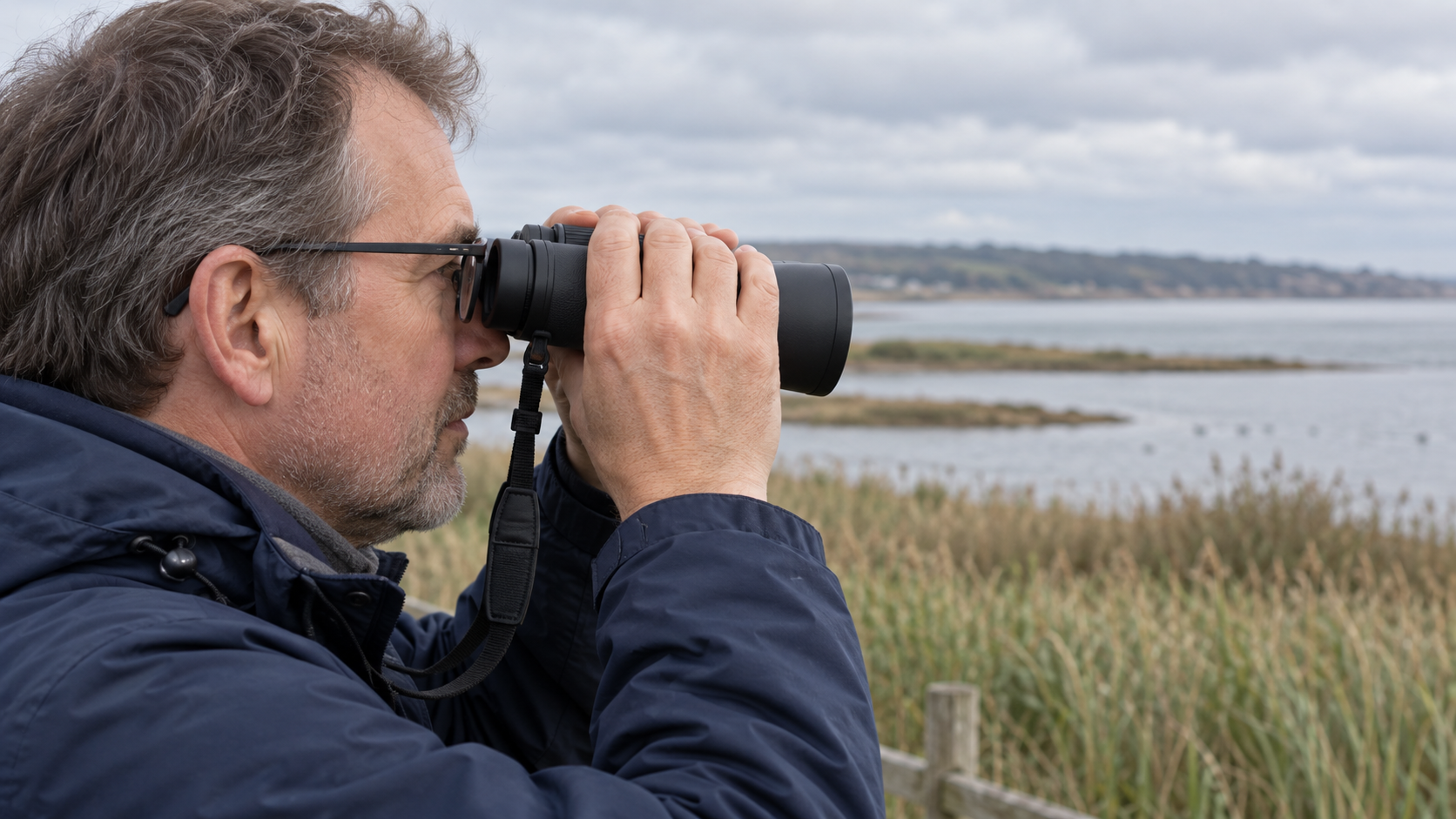
Start around 17mm stated eye relief; 19–20mm gives more margin.
Retract twist-up eyecups when wearing glasses and look for one complete circle.
Frame thickness, lens position and facial shape mean no published number guarantees fit.
Quick picks
Choose by the detail that matters most
Links open the matching Amazon UK listing. Prices and sellers can change, so confirm the model name and ASIN before buying.
Swipe to compare all details →
| Model | Best for | Eye relief | Weight | Field of view | Close focus |
|---|---|---|---|---|---|
| Nikon PROSTAFF P3 8×42 | Light full-size start | 20.2mm | 575g | 126m at 1,000m | 3m |
| Nikon PROSTAFF P7 8×42 | Locking personal setup | 20.2mm | 590g | 126m at 1,000m | 3m |
| Opticron Adventurer II WP PC 8×32 | Compact long eye relief | 20mm | 571g | 108m at 1,000m | 5m |
| Celestron Outland X 8×42 | Lower-cost sealed 8×42 | 17.8mm | 670g | 122.8m at 1,000m | 4m |
| Celestron Nature DX 8×32 | Close-focus compact | 17.5mm | 510g | 129m at 1,000m | 2m |
The detailed shortlist
Five credible glasses-friendly routes
Eye relief is a screening tool rather than proof of comfort. Buy only where you can return a binocular that does not show you the complete field with your normal outdoor glasses.

Nikon PROSTAFF P3 8x42
Best for: Beginners and glasses wearers
A relatively light 8×42 with 20.2mm eye relief, a 126m field and a waterproof, fog-free body.
What stands out
- 20.2mm stated eye relief
- 575g is light for an 8×42
- Waterproof and fog-free
Keep in mind
- 3m close focus is useful rather than exceptional
- No locking dioptre ring like the P7
- 8×42
- 575g
- 126m / 1,000m
- 20.2mm eye relief

Nikon PROSTAFF P7 8x42
Best for: Wide viewing with glasses
A 590g all-round 8x42 with a wide 126m field, long stated eye relief and a locking dioptre ring that helps preserve a personal focus setting.
What stands out
- 126m field of view at 1,000m
- 20.2mm stated eye relief
- 590g waterproof body with locking dioptre
Keep in mind
- 3m close focus is useful rather than class-leading
- No ED glass in the published specification
- 8×42
- 590g
- 126m / 1,000m
- 20.2mm eye relief

Opticron Adventurer II WP PC 8x32
Best for: Glasses-friendly day walks
A waterproof 8×32 notable for its 20mm eye relief and phase-corrected roof prisms, aimed squarely at compact viewing with glasses.
What stands out
- 20mm stated eye relief
- Waterproof and nitrogen-filled
- Phase-corrected BAK4 roof prisms
Keep in mind
- 108m field is narrower than the other 8×32 options here
- 5m close focus limits nearby nature viewing
- 8×32
- 571g
- 108m / 1,000m
- 20mm eye relief

Celestron Outland X 8x42
Best for: Affordable all-weather use
A sub-£100-shaped 8×42 option with a waterproof, nitrogen-filled body, 17.8mm eye relief and a useful 122.8m field of view.
What stands out
- Waterproof and nitrogen-filled
- 17.8mm stated eye relief
- Tripod adaptable
Keep in mind
- 670g is not especially light
- 4m close focus is less useful for nearby insects
- 8×42
- 670g
- 122.8m / 1,000m
- 17.8mm eye relief

Celestron Nature DX 8x32
Best for: Nature walks and insects
A compact 8×32 with phase-coated BaK-4 prisms, 2m close focus and weather protection in a 510g body.
What stands out
- 2m stated close focus
- Waterproof and nitrogen-filled
- Phase-coated BaK-4 prisms
Keep in mind
- 129m field is good rather than class-leading for an 8×32
- 510g is compact rather than pocket-light
- 8×32
- 510g
- 129m / 1,000m
- 17.5mm eye relief
Glasses create distance between your eyes and the eyepieces. If a binocular does not provide enough usable eye relief, the outer part of the view disappears and the result feels like looking through a tunnel. Long eye relief helps, but the right choice still depends on how your frames, face and eyecups meet.
The models above are not guaranteed to fit every glasses wearer. They are useful places to begin because their published specifications create a credible chance of seeing the full field.
What the published numbers actually separate
The Nikon P3 and P7 specifications both list 20.2mm eye relief and a 126m field at 1,000m. The Opticron Adventurer II WP PC 8×32, code 30840, lists 20mm and about 108m. That Opticron is a shorter-bodied alternative, not a meaningful weight-saving one: its stated 571g is only 4g less than the P3's 575g. Its 5m close focus also makes it a weaker nearby-garden choice.
The Celestron Nature DX 8×32 reverses part of that trade: 17.5mm eye relief, but a 129m field, 2m close focus and 510g weight. This is why sorting a shortlist by eye-relief millimetres alone can miss the best fit for a close-nature buyer. First exclude models whose full field you cannot see with your glasses; then compare the remaining field, focus and carry differences. The figures identify candidates, not a universal facial-fit winner.
Best full-size starting point: Nikon PROSTAFF P3 8×42
The P3 states 20.2mm eye relief—generous by the standards of general 8×42 binoculars. Its 126m field is usefully broad, the body weighs 575g and the waterproof, fog-free construction suits ordinary wildlife use.
It is the first model to compare when you want the forgiving exit pupil of an 8×42 without an especially heavy body. Its 3m close focus is adequate but not the best option for butterflies or birds immediately outside a window.
Best for keeping one person’s setup: Nikon PROSTAFF P7 8×42
The P7 has the same published 20.2mm eye relief and 126m field, with a slightly heavier 590g body. The notable addition is a locking dioptre ring, which helps preserve the adjustment made for the difference between your eyes.
Choose it when one wearer uses the binocular regularly and wants the dioptre to stay put. If several people share the pair, the lock is less valuable because the setting will be changed frequently.
Best compact long-eye-relief option: Opticron Adventurer II WP PC 8×32
Opticron states 20mm eye relief for this waterproof, nitrogen-filled 8×32. That makes it unusual among compact options and a credible choice when a full-size body feels cumbersome.
The trade-off is a narrower 108m field and a 5m close focus. It is better suited to distant daytime viewing and walking than nearby insects. At 571g it is smaller, but scarcely lighter than the Nikon P3, so compact dimensions—not minimum grams—are the reason to choose it.
Best lower-cost full-size alternative: Celestron Outland X 8×42
The Outland X states 17.8mm eye relief, which may be enough for many glasses wearers, and combines it with a waterproof, nitrogen-filled body. It is a sensible lower-cost full-size model to try.
It weighs 670g and has a narrower 122.8m field plus a 4m close focus. Choose it when price and sealing matter, but keep a strict fit-and-return check because it offers less eye-relief margin than the 20mm-class options.
Best for close nature: Celestron Nature DX 8×32
The compact Nature DX states 17.5mm eye relief and focuses to 2m, making it the specialist choice here for insects and nearby garden subjects. It also has a useful 129m field and weighs 510g.
The eye-relief figure is plausible rather than generous. Thick or strongly curved frames may keep your eyes too far back, so this is a model to test carefully rather than buy on the number alone.
How much eye relief do glasses wearers need?
There is no universal minimum, but these are sensible filters:
- Under 15mm: unlikely to show most glasses wearers the full field.
- 15–16.9mm: may work with close-fitting frames, but offers limited margin.
- 17–18.9mm: a practical shortlist range for many users.
- 19–20mm and above: a strong starting point for thicker frames or greater separation.
Manufacturers can measure from different reference points, and the eyepiece may be recessed below the eyecup rim. The usable distance can therefore be shorter than the headline figure. Learn the measurement in binocular eye relief explained.
How to test binoculars with glasses
- Wear the same glasses you use for observation, including varifocals if relevant.
- Twist or fold the eyecups fully down.
- Set the hinge until the two images merge into one clean circle.
- Look straight ahead without pressing the eyepieces hard against the lenses.
- Check that the complete field stop is visible around the edge.
- Move the binocular slightly and look for sudden black crescents or kidney-shaped shadows.
- Raise it to a target repeatedly and confirm that the view appears quickly.
If you cannot see the entire circle, try one eyecup position above fully down. That can improve eye placement when very long eye relief causes blackouts. If it reduces the field further, the model is not a good fit.
Varifocals, astigmatism and when to keep glasses on
The central focus and dioptre can compensate for ordinary near- or far-sightedness within their adjustment range, so some people remove glasses. They do not normally correct astigmatism. Keep glasses on if they correct astigmatism, if you need to switch rapidly between the binocular and the unaided scene, or if removing them is inconvenient.
With varifocals, look through the distance portion of the spectacle lens. Tilting your head to use another zone can disturb alignment and make blackouts more likely.
Protecting spectacle lenses
Do not force hard eyecup rims against coated spectacle lenses. Keep both surfaces free of grit, because trapped particles can mark either lens. Soft rubber eyecups are reassuring, but a comfortable viewing position should not require pressure.
Do glasses change the best magnification?
Not directly. An 8× binocular remains the forgiving choice because its wider field and steadier view make alignment easier. A well-fitting 10× can still suit distant viewing, but it combines more visible shake with more demanding eye placement.
For a first pair, prioritise an 8× model with genuinely usable eye relief. Then choose 8×32 or 8×42 according to weight, size and low-light needs. The beginner guide and lightweight shortlist provide those next comparisons.
Frequently asked questions
Binocular questions for glasses wearers
How much eye relief do glasses wearers need?
Around 17mm is a sensible shortlist minimum, while 19–20mm gives more margin for thick or strongly curved frames. The usable result still depends on eyecup design, frame position and facial shape.
Should you keep your glasses on when using binoculars?
Keep them on if they correct astigmatism, protect your eyes or let you switch quickly between the binocular and the wider scene. Some near- or far-sighted users can remove glasses and compensate with focus and dioptre adjustment.
Should binocular eyecups be up or down with glasses?
Start with twist-up eyecups fully down or folding rubber cups folded back. If the image blacks out because your eyes are too close, raise the cups by one stop and test again.
Can binocular eyecups scratch spectacle lenses?
Hard rims or trapped grit can mark lens coatings, so do not press the binocular against your glasses. Keep both surfaces clean and choose a stable viewing position that does not require pressure.