
Binocular basics · Eye position
Binocular eye relief explained
Learn what binocular eye relief means, how many millimetres glasses wearers need, how eyecups affect the usable distance and how to test fit.
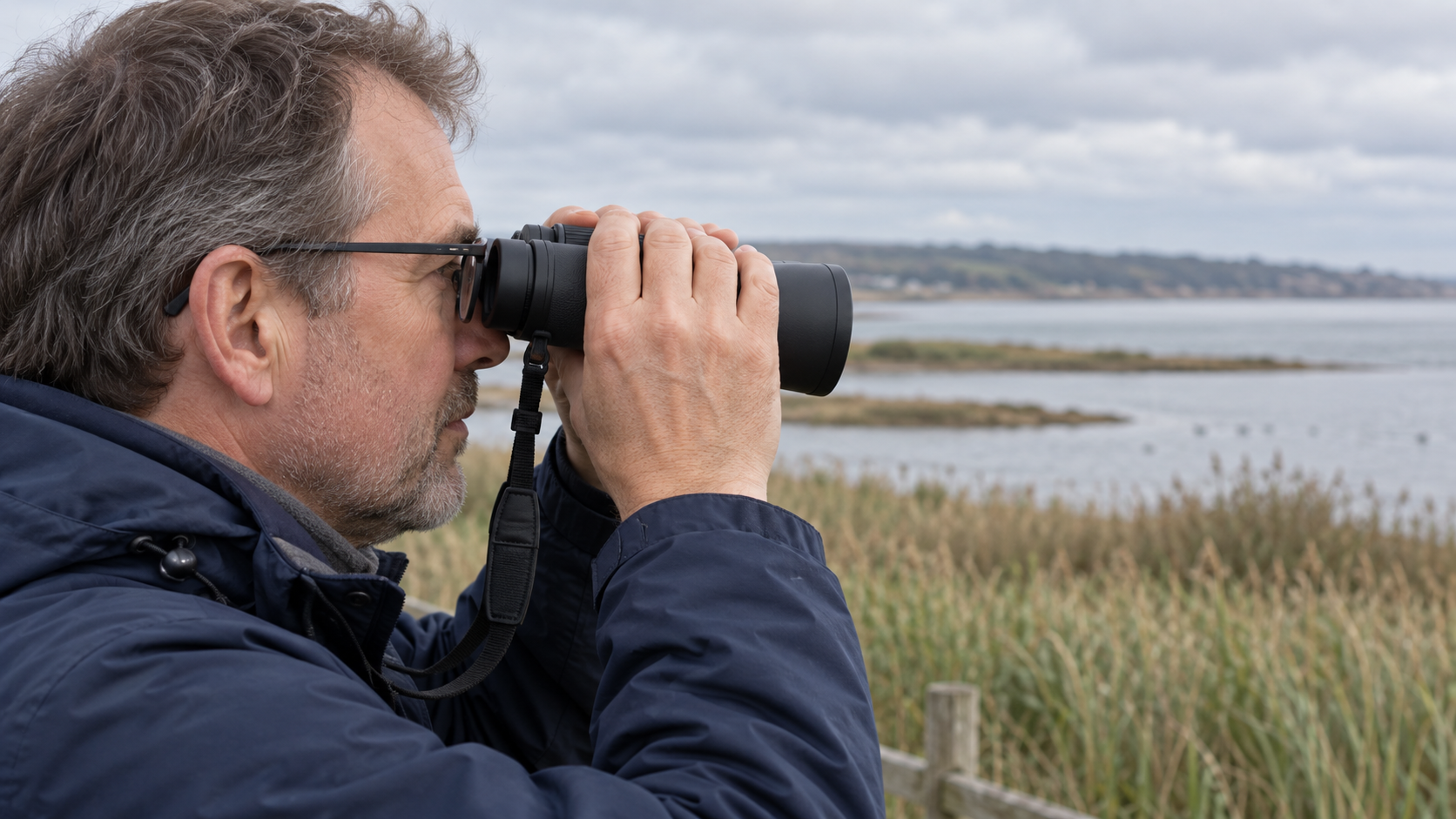
Too little usable eye relief cuts off the outer view and creates a tunnel effect.
Too much proximity can cause black crescents or kidney-shaped shadows.
The published figure and the usable distance are not always identical.
Eye relief is the distance behind a binocular eyepiece at which the complete image forms. Manufacturers usually state it in millimetres. If your eye sits too far back, you lose the outer part of the field. If it sits too close, the view may black out as you move.
The measurement matters to everyone, but especially to people who keep prescription or protective glasses on while viewing.
What eye relief looks like in practice
Hold a binocular several centimetres from your face and look towards the eyepieces from a safe angle. You will see a small bright disc floating behind each eyepiece. That disc is the exit pupil. The correct viewing position is where your pupils meet those light beams and the full circular field becomes visible.
Eye relief describes the distance to that position. Twist-up or fold-down eyecups do not create eye relief; they help place your eyes at the distance the optical design requires.
Why glasses need more eye relief
Without glasses, the eyecup can sit around the eye socket and position the eye close to the eyepiece. Spectacle lenses and frames add a physical gap. A binocular with short eye relief may then put the full-view position somewhere in front of your actual eye.
The centre of the image remains visible, but the edge disappears. The result is a reduced field that can feel like looking down a tube. This matters most when field width is one of the reasons you chose the model.
How much eye relief is enough?
There is no number that works for every face and frame. As a practical shortlist:
| Stated eye relief | What it usually means for glasses |
|---|---|
| Under 15mm | Unlikely to show the complete field |
| 15–16.9mm | Possible with slim, close-fitting frames |
| 17–18.9mm | A useful starting range for many wearers |
| 19mm and above | More margin for thicker frames or greater separation |
These ranges are deliberately cautious. Some people see a full field at 16mm; others struggle at 18mm. The eye lens may sit below the rim, so the usable distance from the physical eyecup can be less than the optical figure.
Published eye relief versus usable eye relief
Manufacturers do not always measure from the same point. One may quote from the last optical surface, while another design recesses that surface inside the eyepiece housing. The shape and minimum height of the eyecup also consume some of the nominal distance.
This is why a 19mm model can fit worse than a well-designed 17.5mm model. Published eye relief is excellent for removing obviously unsuitable options, but it cannot replace a fit test or a returns policy.
How to set the eyecups
With glasses
Start with twist-up eyecups fully retracted or folding rubber eyecups folded down. Bring the binocular towards the spectacle lenses without pressing. If the view blacks out because your eyes are too close, raise the cups by one stop.
Without glasses
Start with the eyecups extended. If you cannot see the complete field, lower them gradually. The correct position holds the binocular comfortably against the face while preserving one stable circular image.
People with deeper-set eyes may need lower eyecup positions even without glasses. Asymmetry between eyes or face shape can also make the ideal position less obvious.
What blackouts tell you
Black crescents, kidney-shaped shadows or a view that disappears with tiny movements usually indicate that the pupils are not aligned with the exit pupils. Possible causes include:
- eyes too close to the eyepieces;
- eyes too far away;
- the hinge set to the wrong interpupillary distance;
- eyecups at the wrong height;
- binoculars tilted relative to the face;
- a small exit pupil that demands precise placement.
Adjust one thing at a time. Begin with hinge width, then eyecup height, then the pressure and angle of your hold.
Eye relief is not exit pupil
The terms are related but different. Eye relief is a distance, measured in millimetres. Exit pupil is a diameter, calculated by dividing objective size by magnification.
An 8×42 has a 5.25mm exit pupil; an 8×25 has a 3.125mm exit pupil. The larger disc is more forgiving of small alignment movements, but it does not guarantee enough eye relief for glasses. A binocular can have a large exit pupil and short eye relief, or the reverse.
Eye relief is not interpupillary distance
Interpupillary distance is the spacing between your pupils. The binocular’s hinge must move the two eyepieces to match it. If the barrels do not close far enough or open wide enough, the two circles will not merge cleanly regardless of eye relief.
This is particularly important for children and adults with a narrow interpupillary distance. Check the manufacturer’s adjustment range where it is published.
Can you remove your glasses?
The main focus and dioptre adjustment can often compensate for near- or far-sightedness within their range. They do not normally correct astigmatism. Keep glasses on if they correct astigmatism, if you need protective lenses outdoors or if you regularly switch between the binocular and the unaided scene.
Removing glasses may reveal more field on a short-eye-relief binocular, but it is not a good solution when it makes finding the subject or reading a field guide inconvenient.
Testing eye relief in five steps
- Wear your normal outdoor glasses and retract the eyecups.
- Adjust the hinge until you see one circle.
- Focus on a detailed, well-lit subject at a realistic distance.
- Confirm that the hard edge of the complete field is visible all the way around.
- Move and re-raise the binocular several times to test how easily the view returns.
Repeat outdoors if possible. A bright shop encourages a small eye pupil, which can make alignment appear easier than it is at dusk.
If you want current models already filtered by this measurement, continue to best binoculars for glasses wearers. For the other numbers around the eyepiece, read what binocular numbers mean.
Helpful products
Three examples with long stated eye relief
These are reference points for the measurement: two full-size 8×42 options at 20.2mm and a compact 8×32 at 20mm. An in-person fit check is still essential.

Nikon PROSTAFF P3 8x42
Best for: Beginners and glasses wearers
A relatively light 8×42 with 20.2mm eye relief, a 126m field and a waterproof, fog-free body.
What stands out
- 20.2mm stated eye relief
- 575g is light for an 8×42
- Waterproof and fog-free
Keep in mind
- 3m close focus is useful rather than exceptional
- No locking dioptre ring like the P7
- 8×42
- 575g
- 126m / 1,000m
- 20.2mm eye relief

Nikon PROSTAFF P7 8x42
Best for: Wide viewing with glasses
A 590g all-round 8x42 with a wide 126m field, long stated eye relief and a locking dioptre ring that helps preserve a personal focus setting.
What stands out
- 126m field of view at 1,000m
- 20.2mm stated eye relief
- 590g waterproof body with locking dioptre
Keep in mind
- 3m close focus is useful rather than class-leading
- No ED glass in the published specification
- 8×42
- 590g
- 126m / 1,000m
- 20.2mm eye relief

Opticron Adventurer II WP PC 8x32
Best for: Glasses-friendly day walks
A waterproof 8×32 notable for its 20mm eye relief and phase-corrected roof prisms, aimed squarely at compact viewing with glasses.
What stands out
- 20mm stated eye relief
- Waterproof and nitrogen-filled
- Phase-corrected BAK4 roof prisms
Keep in mind
- 108m field is narrower than the other 8×32 options here
- 5m close focus limits nearby nature viewing
- 8×32
- 571g
- 108m / 1,000m
- 20mm eye relief
Frequently asked questions
Eye-relief questions
Is 15mm eye relief enough for glasses?
It can work with slim frames that sit close to the eyes, but it offers little margin and often cuts off part of the field. Around 17mm is a safer shortlist starting point for most glasses wearers.
Can binoculars have too much eye relief?
Very long eye relief can cause blackouts if your eyes sit too close, but adjustable eyecups normally solve this by moving the binocular slightly forward. The goal is stable alignment at the full-view position, not the largest possible number.
Can eye relief be adjusted?
The optical eye relief is fixed by the eyepiece design. Twist-up or folding eyecups adjust your physical eye position so that it matches the binocular’s available eye relief.
What is the difference between eye relief and exit pupil?
Eye relief is the distance behind the eyepiece where the complete view forms. Exit pupil is the diameter of the light beam leaving the eyepiece, calculated by dividing objective diameter by magnification.