
Habitat guide · Woodland birds
Best binoculars for woodland birdwatching
Five binoculars for woodland birdwatching compared for field of view, low-light ease, close focus, weight and eye relief.
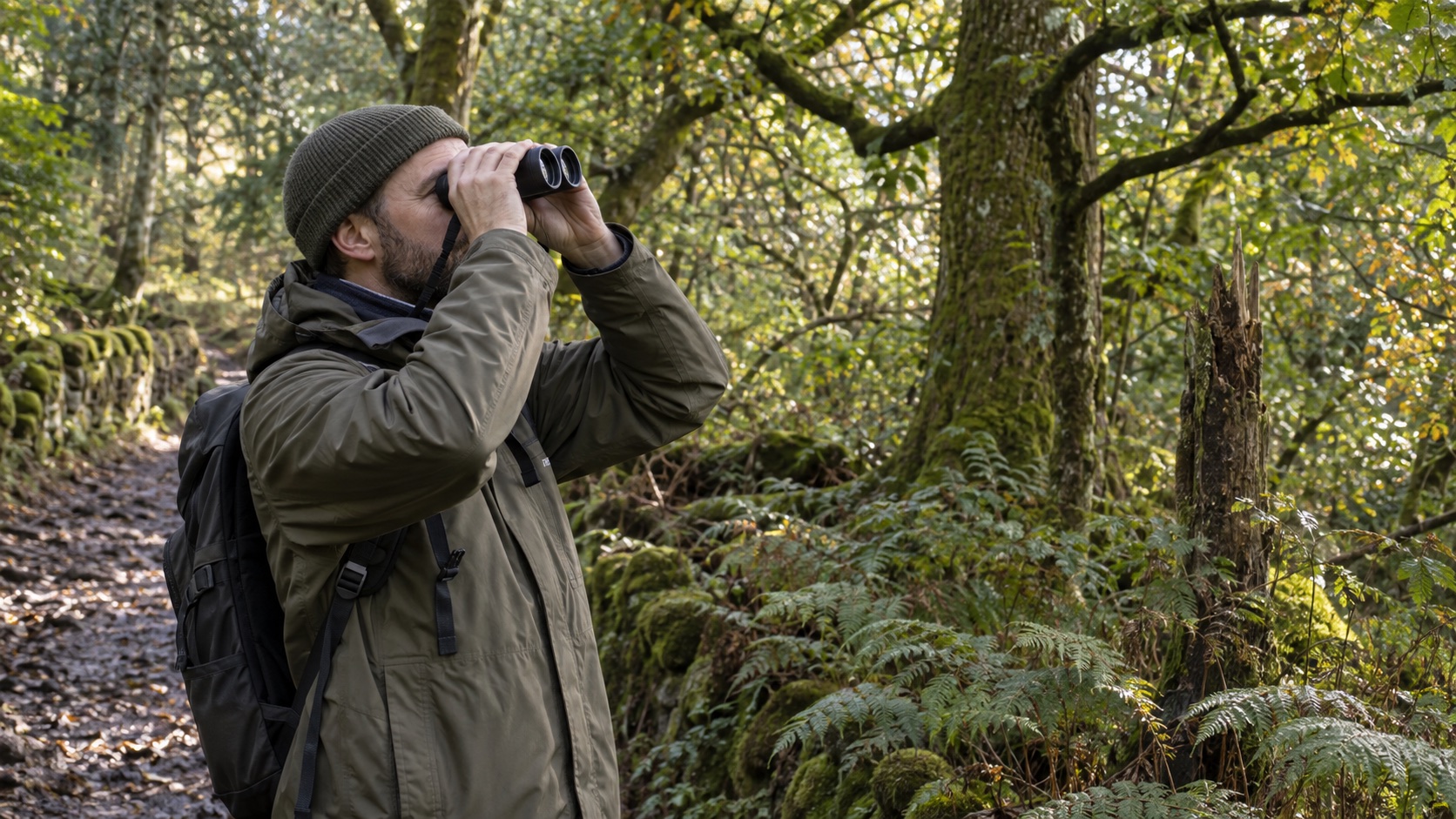
A wide field helps find birds before they disappear behind foliage.
Eight-times magnification is steadier and needs less exact focusing than 10×.
A 42mm objective is more forgiving under canopy, but a carried 30–32mm pair beats one left at home.
Quick picks
Choose by the detail that matters most
Links open the matching Amazon UK listing. Prices and sellers can change, so confirm the model name and ASIN before buying.
Swipe to compare all details →
| Model | Best for | Weight | Field | Close focus | Eye relief |
|---|---|---|---|---|---|
| Nikon MONARCH M7 8×42 | Premium wide view | 670g | 145m / 1,000m | 2.5m | 17.1mm |
| Celestron Nature DX ED 8×42 | Close woodland detail | 705g | 129m / 1,000m | 2m | 17.8mm |
| Nikon PROSTAFF P7 8×42 | Glasses and easy eye placement | 590g | 126m / 1,000m | 3m | 20.2mm |
| Nikon PROSTAFF P7 8×30 | Long woodland walks | 485g | 152m / 1,000m | 2.5m | 15.4mm |
| Vortex Diamondback HD 8×32 | Close focus and low weight | 451g | Approx. 142m / 1,000m | 1.5m | 16mm |
The detailed shortlist
Woodland binoculars that make finding easier
These models prioritise field width, eye placement and close-to-middle-distance use. Product links open exact Amazon UK listings; check model size and ASIN before buying.

Nikon MONARCH M7 8x42
Best for: Finding and following moving birds
A step-up ED-glass 8x42 whose key distinction is an expansive 145m field, alongside a locking dioptre and protective external lens coatings.
What stands out
- 145m field of view at 1,000m
- ED glass and dielectric prism coating
- Locking dioptre and oil-repellent external coating
Keep in mind
- Costs materially more than capable starting models
- 17.1mm eye relief gives less margin than the PROSTAFF P7
- 8×42
- 670g
- 145m / 1,000m
- 17.1mm eye relief

Celestron Nature DX ED 8x42
Best for: Birds, butterflies and nearby detail
An ED-glass 8x42 with a 129m field and 2m close focus, making its published specification especially relevant to mixed bird, butterfly and garden viewing.
What stands out
- 2m stated close focus
- ED objectives and phase-coated BaK-4 prisms
- 17.8mm eye relief with multi-stop eyecups
Keep in mind
- 705g is the heaviest body in this shortlist
- The useful ED-glass claim still does not replace an in-person view
- 8×42
- 705g
- 129m / 1,000m
- 2m close focus

Nikon PROSTAFF P7 8x42
Best for: Wide viewing with glasses
A 590g all-round 8x42 with a wide 126m field, long stated eye relief and a locking dioptre ring that helps preserve a personal focus setting.
What stands out
- 126m field of view at 1,000m
- 20.2mm stated eye relief
- 590g waterproof body with locking dioptre
Keep in mind
- 3m close focus is useful rather than class-leading
- No ED glass in the published specification
- 8×42
- 590g
- 126m / 1,000m
- 20.2mm eye relief

Nikon PROSTAFF P7 8x30
Best for: Walking and fast-moving wildlife
A compact 485g 8×30 with an unusually broad 152m field, a locking dioptre and a waterproof, fog-free body.
What stands out
- 152m field of view at 1,000m
- 485g compact body
- Waterproof with a locking dioptre
Keep in mind
- 15.4mm eye relief may be marginal with some glasses
- 30mm objectives are less forgiving than 42mm at dusk
- 8×30
- 485g
- 152m / 1,000m
- 2.5m close focus

Vortex Diamondback HD 8x32
Best for: Walks, travel and close viewing
A compact weather-sealed 8×32 that combines a 451g carry weight with a very wide 142m field and 1.5m close focus.
What stands out
- Approximately 451g
- Approximately 142m field of view at 1,000m
- Waterproof, fogproof and 1.5m close focus
Keep in mind
- 16mm eye relief may be marginal with some glasses
- Smaller 32mm objectives give up some low-light ease to 42mm models
- 8×32
- 451g
- 142m / 1,000m
- 16mm eye relief
Woodland birdwatching is an acquisition problem before it is a detail problem. A bird calls, crosses a gap and disappears into leaves; the binocular must reach the right patch of canopy quickly and settle without excessive focus hunting.
That is why wide 8× binoculars dominate this guide. Ten-times can make a perched subject larger, but its narrower, shakier view is often slower in the habitat where seconds matter.
Why the Nikon MONARCH M7 8×42 is our premium woodland choice
The MONARCH M7 8×42 publishes a 145m field at 1,000m, among the widest full-size views in this batch. Its 5.25mm exit pupil gives relaxed eye placement beneath a canopy, while 2.5m close focus covers nearby birds and woodland-edge insects.
The ED-glass specification can help control colour fringing around dark branches against bright gaps. More important day to day, the locking dioptre and protective external coatings preserve setup and simplify cleaning after damp use.
Why the Celestron Nature DX ED 8×42 suits close woodland detail
The Nature DX ED focuses to a stated 2m and combines ED objectives with a 129m field. It is a strong choice for someone whose woodland interest overlaps with butterflies, fungi-side movement and garden birds at close range.
At 705g it is the heaviest model here. Use a harness or broad strap for longer routes, and choose it for close-focus versatility rather than assuming ED glass cancels the weight difference.
Why the Nikon PROSTAFF P7 8×42 is the glasses-friendly route
The P7's 20.2mm stated eye relief provides more margin for glasses than the other full-size choices, while its 590g body is comparatively light. The 126m field is adequate, though not as expansive as the MONARCH M7.
Choose it when obtaining the complete view behind glasses matters more than maximising field width. The locking dioptre is also useful when one regular observer owns the pair.
Why the PROSTAFF P7 8×30 is the long-walk alternative
At 485g, the 8×30 P7 removes 105g and meaningful bulk from the full-size version. Its published 152m field is excellent for finding movement, and the 2.5m close focus remains woodland-friendly.
The 3.75mm exit pupil is less forgiving than an 8×42 as light fades. For daytime walks through mixed or open woodland, that compromise can be worthwhile; for a hide under dense conifers in winter, choose 42mm.
Why the Vortex Diamondback HD 8×32 works at the woodland edge
The Vortex 8×32 combines a 451g body with approximately 142m field and 1.5m close focus. Its included case protects it in a bag; use a separate compatible harness if the route is steep or muddy and you want the binocular ready on your body.
It is the strongest option here for nearby mixed nature. Eye relief is a stated 16mm, so glasses wearers should verify the full field before choosing it over the P7 8×42.
Field width changes the first second
When a bird moves, look at it with unaided eyes first and raise the binocular without looking down. A broad field gives more tolerance if your pointing is imperfect. It also leaves useful visual context around a bird hopping through branches.
Field width is not dictated by objective size. The P7 8×30 is wider on paper than the full-size models here. Compare each exact specification rather than assuming all 8×42 binoculars share one view.
Why 8× usually beats 10× under trees
Eight-times magnification shows less apparent hand shake and usually needs less exact refocusing as a bird changes distance. Ten-times narrows the slice of habitat and magnifies branches as readily as the subject. In open mature woodland with distant canopy views, 10× can work, but it is the specialist choice.
If magnification is unresolved, read 8×42 vs 10×42. The steadier format often reveals more usable detail than the larger but constantly moving image.
Light, contrast and silhouette
Woodland contains high-contrast scenes: a shaded bird against a bright sky gap, or sunlight striking leaves behind a dark branch. Good glare control and a correctly set eyecup matter here. Shield stray side light with a hand and reposition rather than assuming loss of contrast is always a defect.
The larger 8×42 exit pupil helps in shade, but transmission and optical quality still matter. An 8×32 can be entirely effective at midday and has the advantage of being less tiring to carry.
Set up before entering the trees
Set the hinge, eyecups and dioptre in open light before the first sighting. Keep the focus parked at a typical middle distance rather than infinity. In mixed woodland, that shortens the turn needed when a bird appears nearby.
Use a plain strap or quiet harness without loose plastic parts that knock against the body. In damp conditions, keep a clean microfibre cloth protected inside a sealed pocket and dry the binocular after the walk.
For a broader all-habitat shortlist, see best binoculars for birdwatching. In woodland, the best model is the one that gets on the bird quickly, not the one that promises the greatest reach.
Frequently asked questions
Woodland-binocular questions
Is 8× or 10× better for woodland birdwatching?
Eight-times is usually better. It gives a wider, steadier view and greater perceived depth of field, which helps when birds move quickly between branches at changing distances.
Are 8×32 binoculars bright enough for woodland?
A good 8×32 is effective in normal daytime woodland and is easier to carry. An 8×42 becomes more forgiving under dense canopy, in grey winter weather and around dawn or dusk.
What field of view is good for woodland binoculars?
For an 8× binocular, around 130m or more at 1,000m is a useful starting point, with 140m-plus especially helpful. Comfort and edge quality still matter alongside the headline width.
Does close focus matter in woodland?
Yes. Birds, butterflies and other subjects can appear only a few metres away. A close focus around 1.5–2.5m makes a binocular more versatile along paths and woodland edges.