
Binocular basics · Start here
How to choose binoculars
Choose binoculars by magnification, lens size, field of view, eye relief, weight and weather protection—with clear advice for each kind of use.
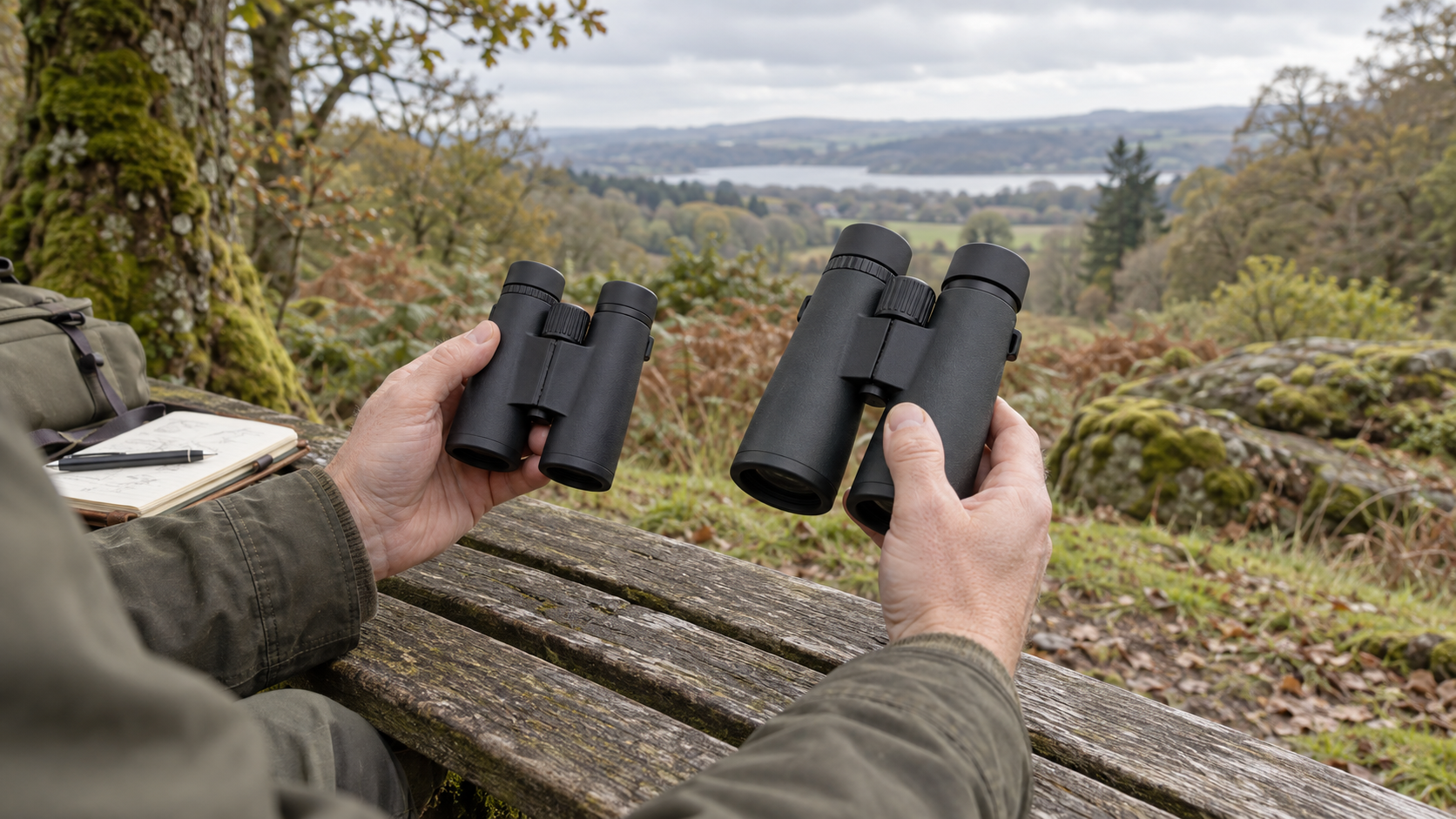
8× is the forgiving default: steadier to hold and normally wider than an equivalent 10×.
The objective size changes bulk and low-light ease; it does not tell you the whole optical quality.
Glasses wearers should shortlist by eye relief, then confirm the eyecup fit in person.
Choosing binoculars becomes much easier when you stop looking for the highest number and decide where the binocular will be used. A pair for woodland birds needs fast aiming and a broad view. A pair for a long walking holiday must earn its place in the bag. A pair for a reservoir or coastline may benefit from more reach.
The four decisions that narrow the field fastest are magnification, objective size, fit and carry weight. Image quality, close focus and weather protection then separate models within the same format.
Choose magnification first
The first number in 8×42 or 10×42 is the magnification. An 8× binocular makes a distant subject appear roughly eight times larger than it does to the unaided eye.
Choose 8× for most handheld viewing
Eight-times magnification is normally easier to keep steady and gives a wider field than a comparable 10× model. That helps when a bird moves through branches, when you raise the binocular quickly at a sporting event, or when you are still learning to acquire a subject.
For gardens, woodland, mixed countryside, travel and a first pair, 8× is the safest starting point.
Choose 10× for deliberate distant viewing
Ten-times magnification gives more apparent scale to a distant subject, but small hand movements also look larger. The field is commonly narrower and the exit pupil smaller when objective diameter stays the same. It can make sense for estuaries, reservoirs, open hills and aviation, especially if you can brace your elbows or use support.
Do not assume 10× reveals more in every situation. A steadier, brighter-feeling 8× view can show detail more readily in woodland or fading light. Our 8×42 versus 10×42 guide works through the trade-off by habitat.
Pick the objective size by how you carry
The second number is the diameter of each front lens in millimetres. Larger objectives can gather more light, but they also require a larger body.
42mm: the all-round reference point
An 8×42 has a 5.25mm exit pupil, calculated by dividing 42 by 8. It is a forgiving full-size format for varied daylight, dull weather and the edges of the day. Typical models are too large for a coat pocket but still practical on a strap or harness.
30–32mm: less weight without becoming tiny
An 8×32 is often the useful middle ground for day walks and travel. It can be hundreds of grams lighter than a large Porro model and fits a smaller bag, while retaining controls that are easier to use than those on many pocket binoculars. The smaller 4mm exit pupil gives up some tolerance and low-light ease to an 8×42.
20–25mm: choose it because it will be carried
Compact binoculars are at their best on holidays, at daytime events and as a pair kept close at hand. Their smaller exit pupil demands more precise eye placement, especially in dim light. Hinges and focus wheels may also feel fiddlier. A good 8×25 carried every day is more useful than an excellent 8×42 left at home.
50mm and larger: a more specialised choice
Large objectives suit astronomy, marine use and supported observation, but their weight can undermine ordinary handheld use. Check whether a tripod adaptor is available and budget for stable support when needed.
Treat field of view as a usability specification
Field of view tells you how wide a scene is visible. It may be stated in metres at 1,000 metres or as an angle. Wider fields make it easier to find a subject, follow motion and understand where an animal sits in the landscape.
Compare field width only at the same magnification. An 8× model with a 140m field at 1,000m is meaningfully wider than an 8× model with a 108m field. That does not guarantee sharper edges, but it does change how spacious and easy to navigate the view feels. Read binocular field of view explained before treating a single number as a quality score.
Check eye relief if you wear glasses
Eye relief is the distance behind the eyepiece at which the complete image forms. Glasses hold your eyes farther away, so longer stated eye relief is helpful. Around 17mm is a sensible shortlist threshold; 19–20mm gives more margin, but there is no universal pass mark.
Eyecup shape, how far it retracts, frame thickness and facial structure can all change the usable result. Test with the glasses you actually wear outdoors. You should see one clean circular field without black crescents, a tunnel effect or the need to press the binocular hard into the lenses. See our eye-relief guide or the best binoculars for glasses wearers shortlist.
Decide how close you want to focus
Close focus is the nearest distance at which the binocular can form a sharp image. Two metres is useful for butterflies, dragonflies, garden birds and details seen from a hide. Four to six metres is less flexible nearby but may be irrelevant for ships or distant sport.
Published close-focus figures are best used comparatively. Your eyesight and the individual instrument can alter the practical limit.
Make weather protection a requirement, not decoration
For regular outdoor use in the UK, look for an explicitly waterproof body and internal nitrogen or argon filling. This reduces the risk of moisture entering and internal fog forming as temperature changes. “Water resistant” is a weaker claim and should not be read as submersible.
Weather sealing does not remove the need for care. Rinse salt spray only as the manufacturer directs, let a damp binocular dry before sealing it in a case, and remove grit with a blower or soft brush before touching the lenses.
Roof prism or Porro prism?
Roof-prism binoculars have straight barrels and are commonly slimmer and easier to seal. Porro-prism binoculars have offset barrels, can offer a broad view and good value, but occupy more bag space. Neither shape is automatically optically superior at every price.
For walking and frequent wet-weather use, a sealed roof model is often the practical choice. For garden use or a tightly controlled budget, a well-specified Porro model can be entirely sensible.
Use weight as a real-world filter
Compare the published weight before buying. Around 300g is genuinely pocketable; roughly 450–575g is comfortable compact or light full-size territory; 650–750g becomes more noticeable on a neck strap. Balance and grip matter too, so weight alone cannot predict comfort.
A wider strap spreads the load. A harness keeps a heavier binocular controlled on long walks but adds its own straps and adjustment. Consider the full carried package, including case and lens covers.
A five-minute fit test
- Set the hinge until you see one circle, not two overlapping views.
- Put the eyecups down if you wear glasses; extend them if you do not.
- Focus on a detailed target, then set the dioptre for the difference between your eyes.
- Move your gaze around the field and check for blackouts or a tunnel-like view.
- Raise the binocular to the same target several times without looking at it first.
- Reach the focus wheel while maintaining a relaxed grip.
- Hold it for several minutes, not several seconds.
The simplest recommendation by use
- First wildlife or birdwatching pair: waterproof 8×42 with at least a reasonably wide field and comfortable eye relief.
- Walking and travel: 8×32 if you still want an easy view; 8×25 when minimum size is decisive.
- Glasses: start around 17mm eye relief and prioritise a real fit test.
- Distant open-country subjects: compare 8×42 and 10×42 outdoors before choosing reach over stability.
- Low budget: choose a known 8×40 or 8×42 with clear specifications; accept bulk before sacrificing basic usability.
- Children or very small hands: prioritise low weight, a hinge that closes sufficiently and an easy-to-reach focus wheel rather than high magnification.
If you want a worked shortlist, compare all-round binoculars, beginner choices, models under £100 or our use-specific birdwatching guide. For a younger viewer, start with the child fit and safety checks before considering an adult compact.
Helpful products
Three formats to make the choice concrete
These current examples show what changes as you move from pocket-sized 8×25 to compact 8×32 and full-size 8×42. Use the specifications as reference points, not a universal ranking.

Nikon SPORTSTAR EX II 8x25
Best for: Travel and all-day carry
A genuinely pocketable 310g binocular with a wide 8.3-degree field and a waterproof, nitrogen-filled body.
What stands out
- Only 310g
- Wide 8.3-degree field
- Waterproof and nitrogen-filled
Keep in mind
- 25mm objectives are less forgiving at dusk
- Compact controls can be fiddlier with gloves
- 8×25
- 310g
- 8.3° field
- Waterproof

Celestron Nature DX 8x32
Best for: Nature walks and insects
A compact 8×32 with phase-coated BaK-4 prisms, 2m close focus and weather protection in a 510g body.
What stands out
- 2m stated close focus
- Waterproof and nitrogen-filled
- Phase-coated BaK-4 prisms
Keep in mind
- 129m field is good rather than class-leading for an 8×32
- 510g is compact rather than pocket-light
- 8×32
- 510g
- 129m / 1,000m
- 17.5mm eye relief

Nikon PROSTAFF P3 8x42
Best for: Beginners and glasses wearers
A relatively light 8×42 with 20.2mm eye relief, a 126m field and a waterproof, fog-free body.
What stands out
- 20.2mm stated eye relief
- 575g is light for an 8×42
- Waterproof and fog-free
Keep in mind
- 3m close focus is useful rather than exceptional
- No locking dioptre ring like the P7
- 8×42
- 575g
- 126m / 1,000m
- 20.2mm eye relief
Frequently asked questions
Questions about choosing binoculars
What is the best all-round binocular size?
An 8×42 is the most dependable all-round format for wildlife, birdwatching and general outdoor use. Choose 8×32 when lower weight matters more than dusk performance, or 8×25 when pocketability is the deciding factor.
What binocular magnification should a beginner choose?
Start with 8× magnification. It is easier to hold steady, normally provides a wider field and makes moving subjects easier to find than a comparable 10× or higher-power binocular.
Are roof-prism binoculars better than Porro binoculars?
Neither design is automatically better. Roof-prism models are usually slimmer and easier to weather-seal, while Porro designs can offer a broad view and good optical value if extra bulk is acceptable.
Should you try binoculars before buying?
Yes, whenever possible. A short fit test reveals whether the hinge, eyecups, eye relief, focus wheel and balance suit your face and hands—details that a specification sheet cannot guarantee.