
Format comparison · 10× binoculars
10×42 vs 10×50 binoculars
Hold 10× magnification constant and compare the 42mm and 50mm formats for dusk viewing, eye placement, field and carrying weight.
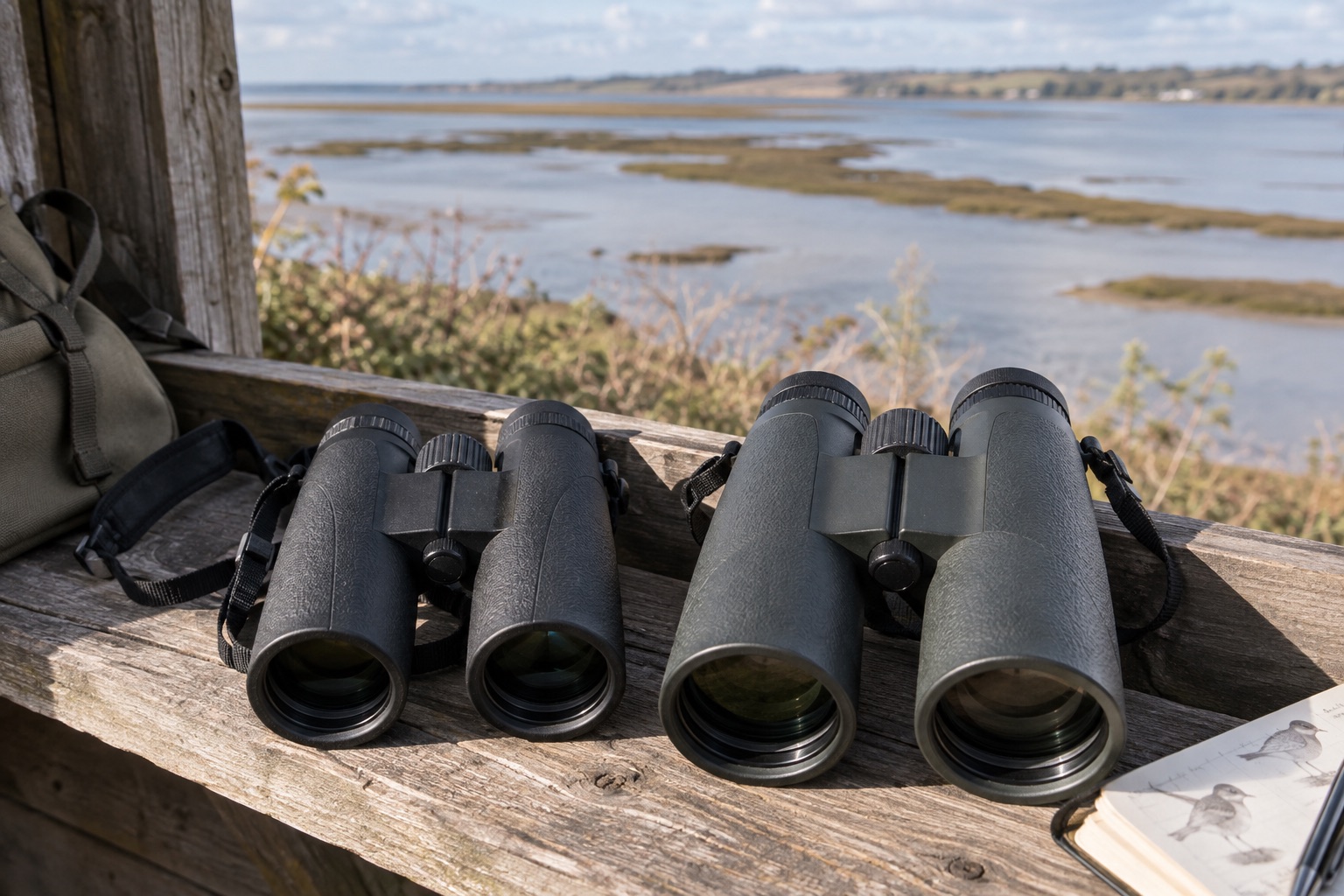
Objective diameter changes; magnification stays at 10×.
A larger lens collects more light but does not guarantee a proportionally brighter perceived view.
Compare field, eye relief and weight on exact models.
The appeal of a 10×50 is simple: it keeps the 10× scale of a 10×42 while admitting light through larger front lenses. The cost is equally real—more glass, body volume and mass. Neither format is automatically sharper. The decisive question is whether you observe often enough in poor light, from a settled position, to use the extra aperture.
Swipe to compare both sizes →
| Factor | 10×42 | 10×50 |
|---|---|---|
| Magnification | 10× | 10× |
| Exit pupil | 4.2mm | 5mm |
| Carry | Usually easier | Usually heavier |
| Dim light | Capable | More latitude |
| Good default | Long walks and mixed use | Fixed viewpoints and dusk |
The light calculation—and its limit
Each 50mm objective has about 42% more geometric area than a 42mm objective. At the same 10× magnification, the calculated exit pupil increases from 4.2mm to 5mm. That can make it easier to hold the full view as you move and can supply more light when your own pupil opens beyond 4.2mm. It does not mean the image looks 42% brighter: your pupil, coatings, prism losses and optical design determine how much of that light reaches you. In bright daylight, the eye pupil may be narrower than either beam.
A useful same-range example
The Nature DX 10×42 weighs 629g and has 14mm stated eye relief; the Nature DX 10×50 is 806g with 17.5mm. That is 177g more weight for 3.5mm more stated eye relief, plus the calculated exit-pupil gain from 4.2mm to 5mm. The larger model may therefore be more promising for some glasses wearers, though eyecup fit still decides.
There is a useful specification trap here. Celestron lists 304ft at 1,000yd and 5.8° for both models. On the 10×50 page it also shows 92.66m, which is simply 304ft expressed in metres at the same 1,000-yard distance. Scaling that width to 1,000m gives about 101m (92.66 × 1,000 ÷ 914.4). The two models have essentially the same published field, not an 8m difference. This corrected comparison does not prove equal edge quality or brightness; it isolates what aperture, mass and eye relief actually change.
When to pick each format
Choose 10×42 for long coast or hill routes, open-country wildlife in daylight and an instrument you will lift repeatedly. It also leaves more space in a daypack for layers and water. Choose 10×50 for static dusk watching, night-sky use or a reserve hide where the weight is no obstacle. For astronomy, support and sky darkness may be more valuable than this 8mm diameter difference; see our 10×50 shortlist.
If the view is shaky at 10×, extra objective area will not remove movement. Brace your elbows or consider a tripod adapter. If your real uncertainty is the magnification rather than the size, use 8×42 versus 10×42 instead. Never point either format towards the Sun.
Helpful products
The same range in both sizes
Celestron Nature DX 10×42 and 10×50 make the size trade-off concrete, without treating their published figures as a universal rule for every manufacturer.
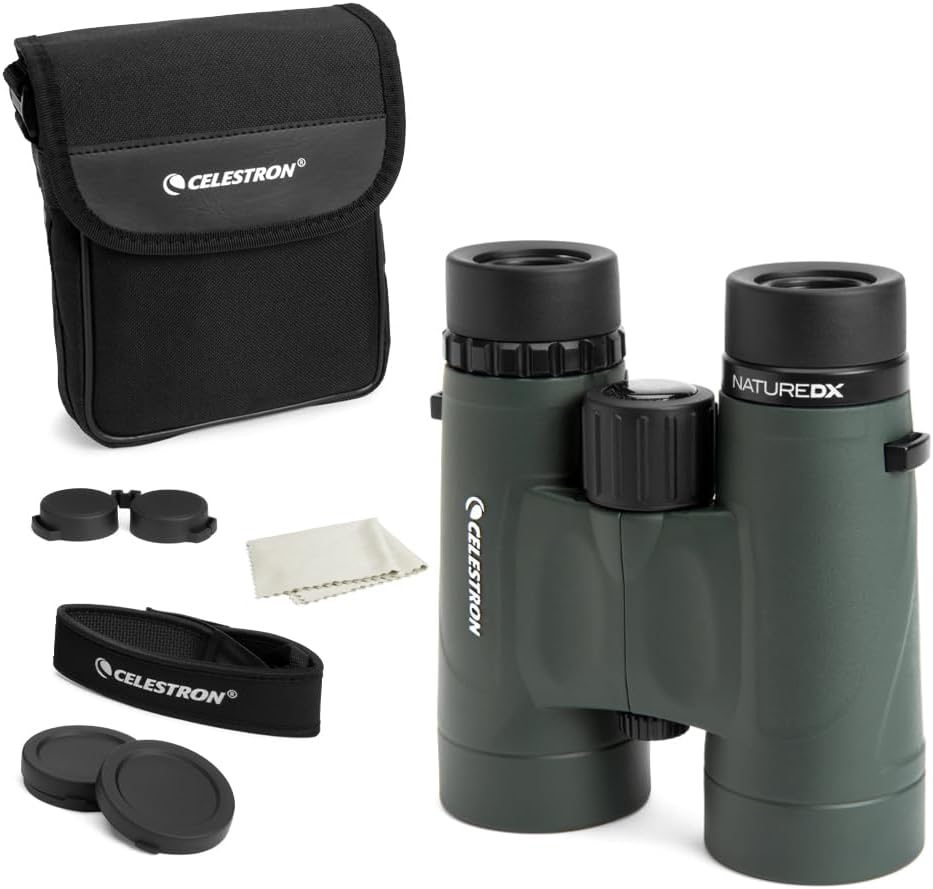
Celestron Nature DX 10x42
Best for: Distant daytime wildlife
A waterproof nitrogen-filled 10×42 with a 101m field and 2.2m close focus, but only 14mm stated eye relief.
What stands out
- 2.2m close focus
- Waterproof nitrogen-filled body
- Phase-coated BaK-4 prisms
Keep in mind
- 14mm eye relief limits some glasses users
- 101m field is narrower than Nikon P7
- 10×42
- 629g
- 101m / 1,000m
- 14mm eye relief
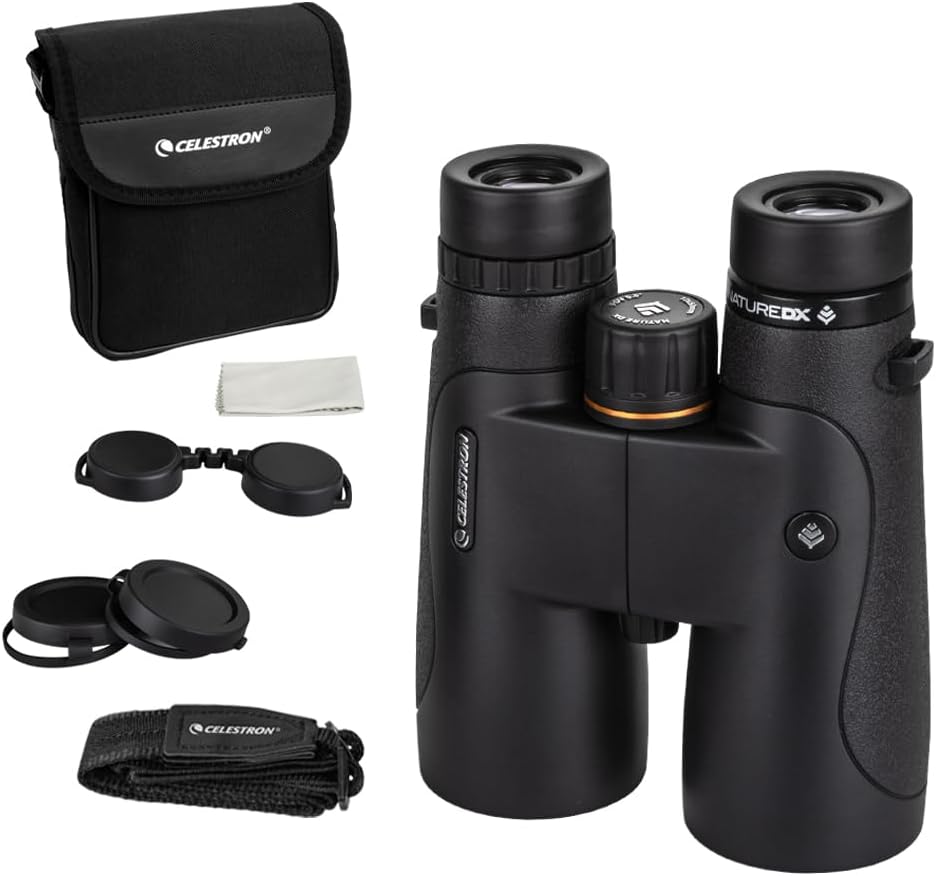
Celestron Nature DX 10x50
Best for: Wildlife and night-sky crossover
A 10×50 with waterproof nitrogen-filled construction, 17.5mm eye relief and an approximately 101m field at 1,000m.
What stands out
- 5mm exit pupil
- Waterproof and nitrogen filled
- 2.5m close focus
Keep in mind
- 806g is heavy for all-day carrying
- Field is narrower than the UpClose G2's
- 10×50
- 806g
- ≈101m / 1,000m
- 17.5mm eye relief
Frequently asked questions
10×42 and 10×50 questions
Does 10×50 magnify more than 10×42?
No. Both magnify ten times; the second number is the diameter in millimetres of each front objective lens.
Is 10×50 always brighter?
Its larger objectives and 5mm exit pupil can help when your eye pupil exceeds 4.2mm, but coatings, transmission, fit and conditions also matter.
Which is better for birdwatching?
For long walking routes, 10×42 is usually easier to carry. For stationary, dull-light observation, 10×50 may be more forgiving if its extra mass is acceptable.
Do either need a tripod?
Not necessarily for short views, but 10× amplifies hand shake in both. Bracing elbows or using a mount can make a larger difference than objective size alone.