
Buying guide · Aircraft watching
Best binoculars for plane spotting
Pick plane-spotting binoculars for moving aircraft by field width, steadiness and viewing distance, with location and solar-safety checks.
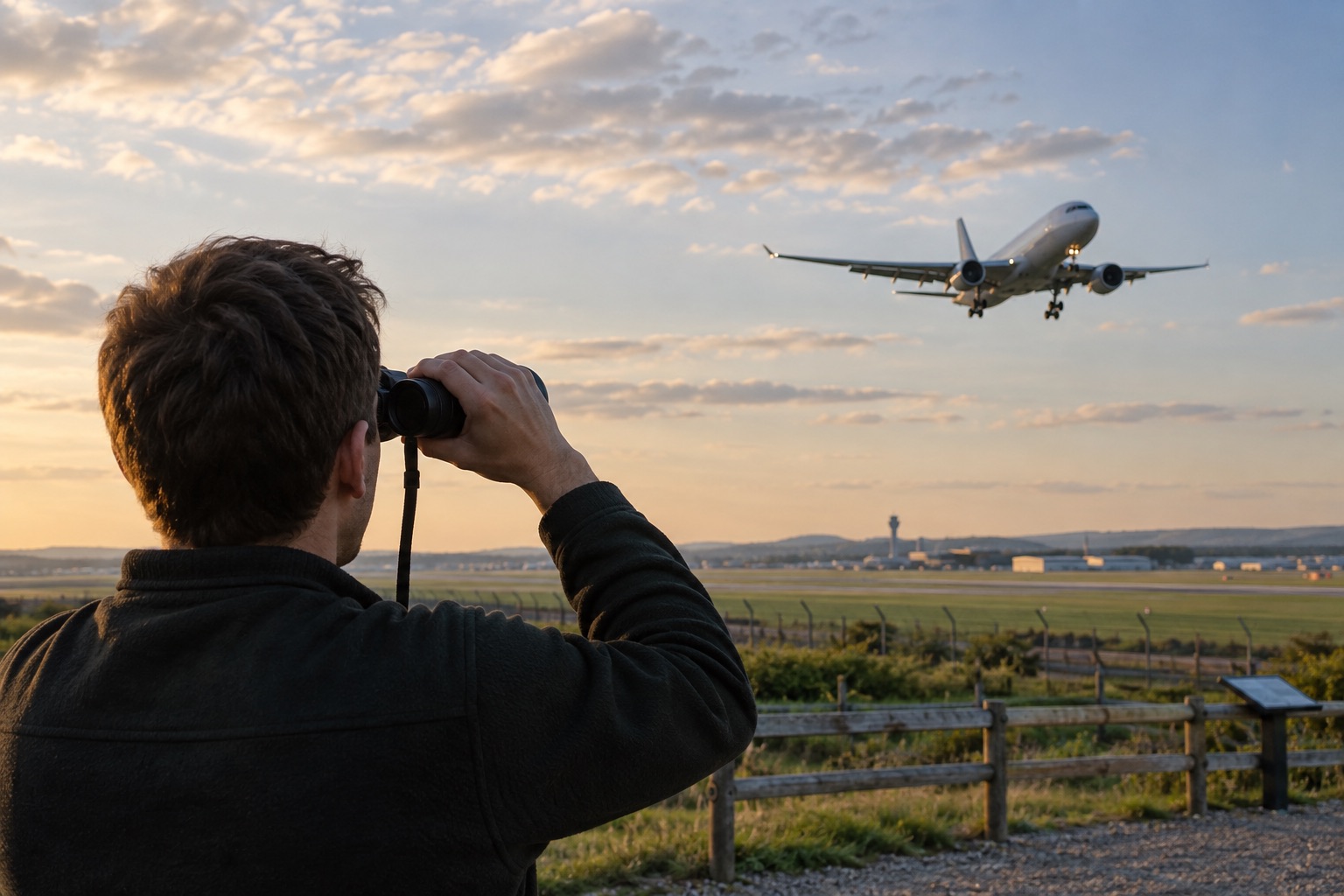
Choose a permitted public location and follow its current rules.
Never follow an aircraft through or near the Sun.
A stable position often helps more than another 2×.
Quick picks
Choose by the detail that matters most
Links open the matching Amazon UK listing. Prices and sellers can change, so confirm the model name and ASIN before buying.
The detailed shortlist
Three plane-spotting setups
These exact models have Amazon UK cards and product images; the editorial aircraft scene is not a product depiction. Check public-site access separately.

Nikon PROSTAFF P7 8x42
Best for: Wide viewing with glasses
A 590g all-round 8x42 with a wide 126m field, long stated eye relief and a locking dioptre ring that helps preserve a personal focus setting.
What stands out
- 126m field of view at 1,000m
- 20.2mm stated eye relief
- 590g waterproof body with locking dioptre
Keep in mind
- 3m close focus is useful rather than class-leading
- No ED glass in the published specification
- 8×42
- 590g
- 126m / 1,000m
- 20.2mm eye relief

Nikon SPORTSTAR EX II 8x25
Best for: Travel and all-day carry
A genuinely pocketable 310g binocular with a wide 8.3-degree field and a waterproof, nitrogen-filled body.
What stands out
- Only 310g
- Wide 8.3-degree field
- Waterproof and nitrogen-filled
Keep in mind
- 25mm objectives are less forgiving at dusk
- Compact controls can be fiddlier with gloves
- 8×25
- 310g
- 8.3° field
- Waterproof

Nikon PROSTAFF P7 10x42
Best for: Estuaries and open-country distance
A 600g 10×42 with a notably wide 122m field, 15.7mm eye relief and a locking dioptre for repeatable long-distance viewing.
What stands out
- 122m field is wide for a 10×42
- 600g waterproof body
- Locking dioptre and protective lens coating
Keep in mind
- 15.7mm eye relief offers limited margin for some glasses
- 10× shake is more visible than with 8×
- 10×42
- 600g
- 122m / 1,000m
- 15.7mm eye relief
Aircraft are large but move quickly across a wide sky. That makes finding and holding the subject at least as important as magnification. A plane passing close to a public approach viewpoint may fill much of a 10× field; a distant aircraft can be lost in shimmer no matter what the number on the binocular says.
Near an approach path: Nikon PROSTAFF P7 8×42
The P7 8×42 combines 126m field at 1,000m with 590g weight and 20.2mm published eye relief. The wider, steadier view makes it easier to bring the optic to your eyes after seeing a plane unaided. The waterproof body helps at a British outdoor viewpoint, while the locking dioptre preserves a personal setting during repeated lifts. If you watch for hours, a comfortable strap or harness matters more than a headline power increase.
Light daytime carry: Nikon SPORTSTAR EX II 8×25
At 310g the SPORTSTAR is an easier addition to a camera bag. Its wide 8.3° real field is useful when reacquiring movement, and waterproofing is welcome outdoors. The 25mm objectives are less forgiving when an evening scene darkens; the 10mm eye relief is also a glasses warning. It is a carry-first choice, not an equal low-light replacement for 8×42.
More distant fixed viewpoint: Nikon PROSTAFF P7 10×42
The 10×42 version makes a distant plane appear larger but compresses the scanning field and shows more hand movement. Brace elbows on a rail only where it is safe and permitted. Haze from runways and warm ground may erase the apparent gain in fine detail. Our 8×42 vs 10×42 comparison explains the trade in more depth.
Watch from the right place
Airport boundaries, car parks, paths and photography policies vary. Check the current guidance for your chosen site; never cross fences or obstruct access. Keep binoculars below eye level while walking. Most importantly, do not follow a plane through or near the Sun—ordinary binoculars can cause serious eye injury in an instant. Read the solar-viewing warning before an outdoor spotting session.
Match the instrument to the viewpoint
At a public viewing area close to a flight path, finding and following the aircraft matters more than making it look maximally large. Start with a wide, steady 8× view and practise lifting the binocular to a plane already located with your eyes. Farther from the action, 10× can reveal more apparent detail on a settled target, but can make reacquisition harder as the aircraft crosses the field. The field-of-view guide explains why two binoculars with the same 8× label may still frame different amounts of sky.
Think about viewing duration as well as reach. A pocket 8×25 is easy to bring for an occasional look on a bright day. A fuller-grip 8×42 is easier to hold steadily for repeated tracking and more forgiving as light changes, though it occupies more bag space. Neither binocular can overcome heat shimmer near a runway or resolve detail beyond atmospheric conditions. If you also photograph planes, keep the camera and binocular roles separate rather than expecting a handheld phone-through-eyepiece setup to track fast flight reliably.
A safe viewing sequence
Choose a legal stationary position with a clear view away from the Sun. Find the aircraft without optics, raise the binocular while keeping your head still, then follow it with your torso rather than making abrupt wrist movements. Lower the binocular before moving to a different spot. Do not watch through glass while walking, cross a road with it raised or sweep toward the Sun as a plane changes direction. A stable wide view that you can use safely is more valuable than maximum magnification.
Frequently asked questions
Plane-spotting binocular questions
Are 10× binoculars better for planes?
Only when the aircraft is far enough away and you can hold the view steady. Eight-times is often easier for acquisition and tracking.
Can I use binoculars near an airport?
Use a lawful public viewpoint, heed signs and staff directions, and check the specific airport's current spotting guidance. Do not enter restricted land.
Will binoculars let me read registrations?
Sometimes on a close, well-lit aircraft, but distance, angle, haze and shake often limit legibility. Do not buy on a guarantee of reading every registration.
What about watching towards the Sun?
Never track an aircraft into or near the Sun with binoculars. Lower the optic and use unaided eyes to reacquire it elsewhere.