
Format comparison · Carry size
Compact vs full-size binoculars
Compare compact and full-size binoculars for brightness, weight, stability, field use, glasses and travel, with a clear choice by situation.
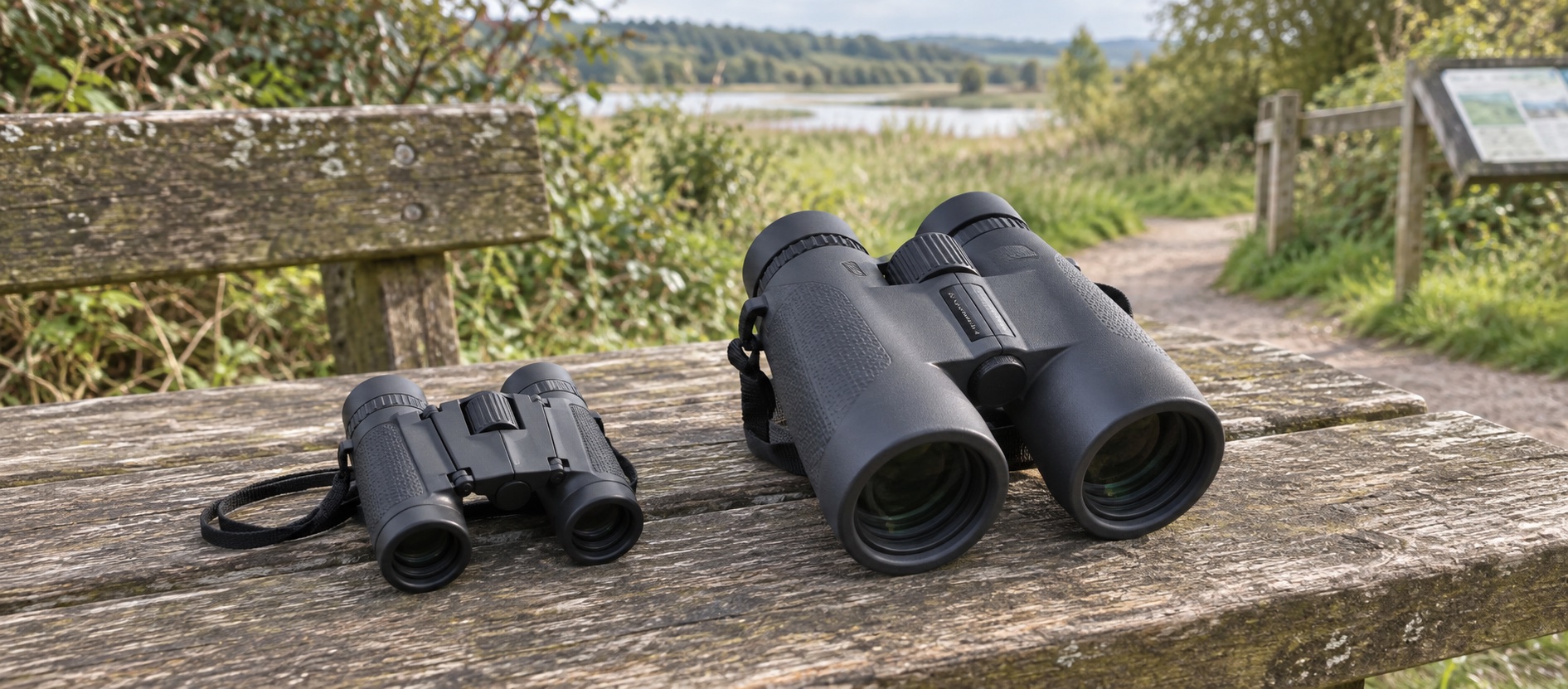
Compact usually means 20–32mm objectives; full-size commonly means 40–42mm.
Objective size changes exit pupil and handling, not magnification by itself.
A 500g compact is not dramatically lighter than the lightest 8×42 models, so compare dimensions too.
Compact and full-size binoculars solve different inconveniences. A compact reduces the friction of carrying optics; a full-size model reduces the friction of looking through them. The right choice depends on which inconvenience stops you using binoculars more often.
The most useful comparison is not a tiny 8×21 against a huge 10×50. It is the everyday decision between a pocket 8×25, a compact 8×30 or 8×32, and a full-size 8×42.
The differences at a glance
Swipe to compare all three formats →
| Decision | 8×25 | 8×30/32 | 8×42 |
|---|---|---|---|
| Typical carry | Coat pocket | Daypack or large pocket | Strap, harness or bag |
| Exit pupil | 3.125mm | 3.75–4mm | 5.25mm |
| Dull-light ease | Lowest | Balanced | Highest |
| Controls | Smallest | Conventional | Roomiest |
| Best fit | Travel and events | Walking and daytime nature | Woodland and all-round wildlife |
These are format tendencies. An especially light 8×42 can approach the weight of a heavy 8×32, while a double-hinge compact can fold much smaller than its objective diameter suggests.
Brightness and exit pupil
Divide objective diameter by magnification to find exit pupil. At 8×, an 8×25 gives 3.125mm, an 8×32 gives 4mm and an 8×42 gives 5.25mm.
A larger exit pupil does two things. It can deliver more usable light when your own pupil is wide enough, and it gives your eye more room to move before the view blacks out. This second benefit is often felt even in daytime: a full-size 8×42 can seem easier to bring to the eyes quickly.
Glass quality and coatings still matter, so size alone cannot rank two unrelated models. But within a comparable range, the larger objective is the safer option for woodland, winter afternoons and dawn or dusk.
Weight is only half the carrying story
The headline weight difference can be smaller than expected. Nikon lists the PROSTAFF P7 8×30 at 485g and 125mm long, while the P7 8×42 is 590g and 152mm long. Going smaller saves 105g and 27mm of body length. Surprisingly, the 8×30 has the wider published field: 152m versus 126m at 1,000m. The full-size model instead gives 20.2mm rather than 15.4mm eye relief and a calculated 5.25mm rather than 3.75mm exit pupil. This is a choice between carry size, field and eye-placement margin—not a ladder on which every figure improves as the objective gets larger.
At the pocket end, a 310g folding 8×25 changes the decision completely. It can live in a coat or small day bag rather than demanding a dedicated strap. Compare the binocular, case, strap and lens covers as a complete carry system.
Handling and stability
Tiny binoculars are not automatically steadier because they are light. Short barrels leave less support for the fingers, narrow hinges can feel cramped, and a small focus wheel may be harder to control in gloves. A 42mm body provides more contact area and can settle naturally into both hands.
Balance matters as much as mass. Try holding a distant sign or branch detail for two minutes. The model that reveals the lettering or texture consistently is more useful than the one that feels lighter for ten seconds.
Field of view and optical design
Objective size does not determine field of view. A well-designed 8×30 can be wider than many 8×42 binoculars; the PROSTAFF P7 8×30, for example, is specified at 152m at 1,000m. Always compare the actual field figure.
Compact optical designs may impose other trade-offs. Eye relief can be shorter, edge performance can be harder to manage and the eyecups may leave less physical room for glasses or a broad nose. None is inevitable, but each must be checked model by model.
Which size works for each use?
Day walks and holidays
Choose an 8×30 or 8×32. It is small enough to carry without negotiation and large enough for normal controls and a useful 3.75–4mm exit pupil. Start with our best compact binoculars or the more specific walking guide.
Woodland and garden wildlife
Choose an 8×42 when observation is the purpose of the outing. The larger exit pupil and roomier eyecups make rapid viewing under a canopy more forgiving. Close focus and field width still need checking.
Safari and long-distance travel
An 8×30 or 8×32 packs well and suits vehicle-based daylight viewing. A full-size 8×42 earns its space when dawn drives, shaded forest or prolonged viewing are central to the trip. Avoid choosing 10× solely because the destination is expansive; shake remains shake.
Theatre, sport and city breaks
A pocket 8×25 is the easy answer. The binocular needs to pass venue and luggage rules, and use will usually be in adequate light. A broad field is more helpful than excessive magnification.
Glasses
Do not assume full-size means glasses-friendly. Published eye relief and eyecup shape are decisive. Many pocket models have short eye relief, but some 32mm binoculars are designed with 17–20mm. Use our eye-relief guide before comparing labels.
A simple decision rule
Choose 8×25 if the binocular must fit a coat pocket or tiny travel bag. Choose 8×30 or 8×32 if you want one pair for daylight walks, wildlife and trips. Choose 8×42 if viewing comfort, dull light and long sessions matter more than saving roughly 100–300g.
If you are still split between the middle and full-size options, the next useful comparison is 8×32 vs 8×42. That is where the portability-versus-forgiveness trade-off becomes most finely balanced.
Helpful products
Three formats to anchor the comparison
These exact products illustrate a pocket 8×25, an 8×30 compromise and a full-size 8×42. They are examples of the format differences, not a claim that one size wins every situation.

Nikon SPORTSTAR EX II 8x25
Best for: Travel and all-day carry
A genuinely pocketable 310g binocular with a wide 8.3-degree field and a waterproof, nitrogen-filled body.
What stands out
- Only 310g
- Wide 8.3-degree field
- Waterproof and nitrogen-filled
Keep in mind
- 25mm objectives are less forgiving at dusk
- Compact controls can be fiddlier with gloves
- 8×25
- 310g
- 8.3° field
- Waterproof

Nikon PROSTAFF P7 8x30
Best for: Walking and fast-moving wildlife
A compact 485g 8×30 with an unusually broad 152m field, a locking dioptre and a waterproof, fog-free body.
What stands out
- 152m field of view at 1,000m
- 485g compact body
- Waterproof with a locking dioptre
Keep in mind
- 15.4mm eye relief may be marginal with some glasses
- 30mm objectives are less forgiving than 42mm at dusk
- 8×30
- 485g
- 152m / 1,000m
- 2.5m close focus

Nikon PROSTAFF P7 8x42
Best for: Wide viewing with glasses
A 590g all-round 8x42 with a wide 126m field, long stated eye relief and a locking dioptre ring that helps preserve a personal focus setting.
What stands out
- 126m field of view at 1,000m
- 20.2mm stated eye relief
- 590g waterproof body with locking dioptre
Keep in mind
- 3m close focus is useful rather than class-leading
- No ED glass in the published specification
- 8×42
- 590g
- 126m / 1,000m
- 20.2mm eye relief
Frequently asked questions
Compact and full-size questions
Are full-size binoculars always brighter than compact binoculars?
In low light, a comparable 8×42 is usually more forgiving than an 8×25 or 8×32 because it has a larger exit pupil and objective area. In bright daylight, the visible difference may be smaller because your eye cannot use all the extra light.
What counts as a compact binocular?
Pocket compacts usually have 20–25mm objectives and a folding hinge. Models with 30–32mm objectives are compact for birdwatching and walking but are normally daypack or large-jacket-pocket instruments rather than trouser-pocket binoculars.
Are compact binoculars harder to hold steady?
They can be. A small body gives the hands less contact area and a low mass can transmit fine movement. Full-size binoculars are heavier, but their larger barrels may brace more naturally against the face and hands.
Should a beginner buy compact or full-size binoculars?
Choose a full-size 8×42 if wildlife viewing is the main hobby and you accept the carry weight. Choose an 8×30 or 8×32 if walking or travel is equally important. An 8×25 is best when true pocketability is the priority.