
UK buying guide · Walking binoculars
Best binoculars for walking
Five binoculars for hillwalking, coast paths and everyday rambles, compared for weight, field, weather protection, close focus and carry comfort.
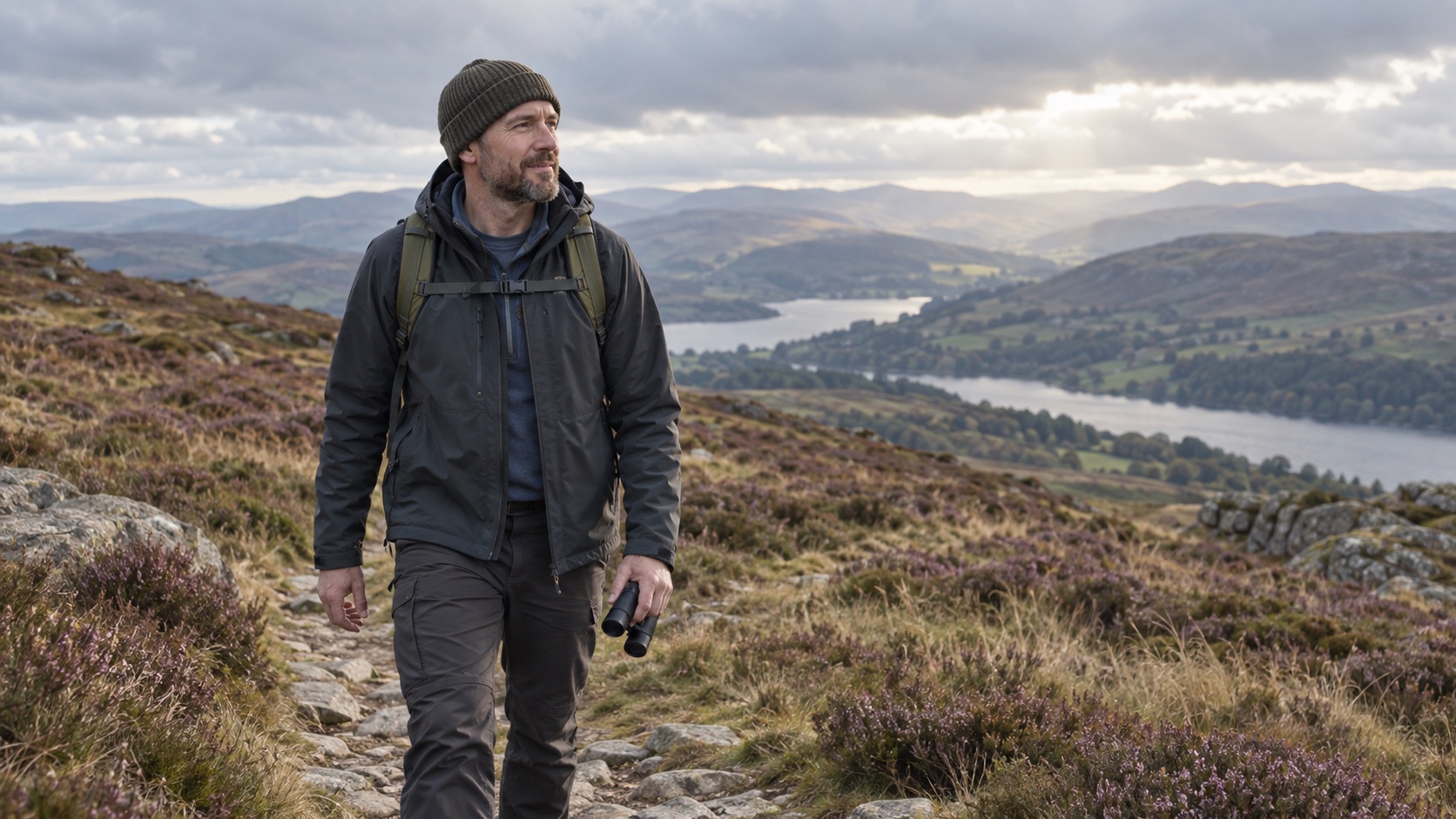
For long routes, the carry system can matter as much as a 100g weight difference.
Eight-times magnification stays steadier in wind and on uneven ground.
Waterproofing is worth prioritising even when the forecast is dry.
Quick picks
Choose by the detail that matters most
Links open the matching Amazon UK listing. Prices and sellers can change, so confirm the model name and ASIN before buying.
Swipe to compare all details →
| Model | Best for | Weight | Field | Weather protection | Main compromise |
|---|---|---|---|---|---|
| Nikon PROSTAFF P7 8×30 | Best walking balance | 485g | 152m / 1,000m | Waterproof and fog-free | 15.4mm eye relief |
| Nikon SPORTSTAR EX II 8×25 | Pocket carry | 310g | 8.3° | Waterproof and nitrogen-filled | Less forgiving at dusk |
| Vortex Diamondback HD 8×32 | Close nature | 451g | Approx. 142m / 1,000m | Waterproof and fogproof | 16mm eye relief |
| Nikon MONARCH M7 8×30 | Premium compact | 465g | 145m / 1,000m | Waterproof and fog-free | Premium price |
| Nikon PROSTAFF P3 8×42 | Dull-light walks | 575g | 126m / 1,000m | Waterproof and fog-free | Larger pack volume |
The detailed shortlist
Binoculars that earn their place in a daypack
These models are shortlisted for actual carry decisions: grams, packed size, field width, close focus and weather protection. Product links open exact Amazon UK listings.

Nikon PROSTAFF P7 8x30
Best for: Walking and fast-moving wildlife
A compact 485g 8×30 with an unusually broad 152m field, a locking dioptre and a waterproof, fog-free body.
What stands out
- 152m field of view at 1,000m
- 485g compact body
- Waterproof with a locking dioptre
Keep in mind
- 15.4mm eye relief may be marginal with some glasses
- 30mm objectives are less forgiving than 42mm at dusk
- 8×30
- 485g
- 152m / 1,000m
- 2.5m close focus

Nikon SPORTSTAR EX II 8x25
Best for: Travel and all-day carry
A genuinely pocketable 310g binocular with a wide 8.3-degree field and a waterproof, nitrogen-filled body.
What stands out
- Only 310g
- Wide 8.3-degree field
- Waterproof and nitrogen-filled
Keep in mind
- 25mm objectives are less forgiving at dusk
- Compact controls can be fiddlier with gloves
- 8×25
- 310g
- 8.3° field
- Waterproof

Vortex Diamondback HD 8x32
Best for: Walks, travel and close viewing
A compact weather-sealed 8×32 that combines a 451g carry weight with a very wide 142m field and 1.5m close focus.
What stands out
- Approximately 451g
- Approximately 142m field of view at 1,000m
- Waterproof, fogproof and 1.5m close focus
Keep in mind
- 16mm eye relief may be marginal with some glasses
- Smaller 32mm objectives give up some low-light ease to 42mm models
- 8×32
- 451g
- 142m / 1,000m
- 16mm eye relief

Nikon MONARCH M7 8x30
Best for: Frequent travel and nature walks
A premium 465g compact with ED glass, a broad 145m field and 2m close focus in a sealed 8×30 body.
What stands out
- 145m field of view at 1,000m
- ED glass in a 465g body
- 2m close focus and locking dioptre
Keep in mind
- Premium price for a 30mm binocular
- 15.1mm eye relief is not the safest choice for all glasses wearers
- 8×30
- 465g
- 145m / 1,000m
- 2m close focus

Nikon PROSTAFF P3 8x42
Best for: Beginners and glasses wearers
A relatively light 8×42 with 20.2mm eye relief, a 126m field and a waterproof, fog-free body.
What stands out
- 20.2mm stated eye relief
- 575g is light for an 8×42
- Waterproof and fog-free
Keep in mind
- 3m close focus is useful rather than exceptional
- No locking dioptre ring like the P7
- 8×42
- 575g
- 126m / 1,000m
- 20.2mm eye relief
Walking binoculars must be judged for the hours when you are not looking through them. A superb view is little help if the pair stays in the boot because it is awkward on a rucksack strap or too bulky for the planned route.
For most UK rambles and hill days, 8×30 or 8×32 is the useful middle ground. The format is light enough to carry deliberately, yet large enough for a proper focus wheel, secure grip and reliable daytime nature viewing.
Why the Nikon PROSTAFF P7 8×30 is our first choice
The P7 8×30 weighs 485g and publishes a 152m field at 1,000m. That broad view is helpful when locating a distant raptor, following a bird across a valley or checking movement without stopping for a long search. The 2.5m close focus also covers butterflies and nearby birds beside the path.
Its waterproof body, protective lens coating and locking dioptre suit repeated outdoor use. The 15.4mm eye-relief figure needs testing with glasses, but for most non-glasses wearers the overall mix is unusually strong.
Why the SPORTSTAR EX II is easiest to take anywhere
The SPORTSTAR's 310g weight and folding 8×25 body make it the sensible choice for a fast walk, a small hydration pack or a trip where binoculars are secondary. The wide 8.3-degree field prevents the view feeling unnecessarily cramped, and waterproofing is welcome at this size.
Choose it when a bigger pair would be left behind. The 25mm objectives and small controls are the accepted compromise: the view is less relaxed in dim woodland, and cold fingers may find the focus less convenient.
Why the Vortex Diamondback HD 8×32 suits natural-history walks
The Vortex combines a 451g body with approximately 142m field and a 1.5m close focus. That makes it the most versatile choice here for routes where the interest includes insects, flowerside movement and birds at varying distances.
The included harness can be more valuable than a small difference in weight. It keeps the binocular close to the chest on uneven ground and avoids pressure on the neck. Check how the harness interacts with your rucksack straps before a long outing.
Why the MONARCH M7 8×30 is the premium walking pick
At 465g, the MONARCH M7 is lighter than the P7 and adds ED glass, dielectric prism coatings and a 2m close focus. Its 145m field is still broad, and the oil- and water-repellent coating helps when drizzle or fingerprints reach the external glass.
The premium is justified for frequent use rather than occasional trips. A costly compact can also create more anxiety when it is packed beside poles, food and waterproofs, so decide whether you will actually carry it freely.
Why the Nikon PROSTAFF P3 8×42 earns a full-size place
The P3 weighs 575g, only 90g more than the P7 8×30. Its 42mm objectives create a 5.25mm exit pupil, and the stated 20.2mm eye relief is a safer starting point for glasses. It is the better choice for shaded woodland, winter light and slow wildlife walks where viewing takes priority over absolute compactness.
The body occupies more bag space and swings more on a strap. Use a broad strap or harness if the walk includes steep ground.
What matters on a real route
Carry position
A binocular in the main compartment is protected but rarely used for a five-second sighting. Keep it accessible in a harness, hip-belt pouch or pack-lid pocket. Make sure lens covers cannot fall away and the focus wheel is not constantly turned by clothing.
Rain and condensation
British walking creates rapid changes between cold air, warm cars and damp clothing. A waterproof, gas-filled binocular reduces internal fog risk. After a wet day, wipe the body, leave the case open and let everything dry at room temperature before storage.
Wind and exertion
Ten-times magnification looks attractive across open hills, but every pulse and gust is enlarged. Eight-times gives a steadier view after a climb and a wider scene for finding the subject. If distant identification is the main aim, stop, brace against a gate or wall and use a scope when practical.
Gloves and controls
Test the focus wheel and eyecups in the gloves you actually wear. Pocket binoculars save space but may force more precise fingertip control. A small 8×32 can be easier in winter than a folding 8×25 even when it weighs more.
Choose by the kind of walk
- Fast local walk: SPORTSTAR EX II 8×25.
- All-day hill or coast path: PROSTAFF P7 8×30.
- Butterflies and mixed nature: Vortex Diamondback HD 8×32.
- Frequent premium travel and walking: MONARCH M7 8×30.
- Woodland, dusk and glasses: PROSTAFF P3 8×42.
Compare compact vs full-size binoculars if the carry threshold is unclear. If the lightest possible shortlist matters more than the walking-specific details, see best lightweight binoculars.
The best walking binocular is not the absolute lightest. It is the lightest pair that still gives you a steady, easy view in the conditions where you normally stop and look.
Frequently asked questions
Walking-binocular questions
What binocular size is best for walking?
An 8×30 or 8×32 is the best balance for most walks. It is lighter and shorter than an 8×42 but keeps normal controls and a useful 3.75–4mm exit pupil.
How heavy should walking binoculars be?
Below about 500g feels meaningfully light for conventional nature binoculars. A well-fitted harness can make a 575–650g model comfortable, while a narrow neck strap can make even a lighter pair irritating.
Are 10× binoculars good for hillwalking?
They can help with distant details, but wind, exertion and unstable footing make 10× shake more obvious. Eight-times magnification is the stronger default for handheld scanning on a route.
Do walking binoculars need to be waterproof?
Yes if they will be used regularly outdoors. Waterproof sealing and internal gas filling provide sensible protection against rain, mist and temperature changes, although binoculars should still be dried before storage.