
Format comparison · 8× binoculars
8×32 vs 8×42 binoculars
Compare 8×32 and 8×42 binoculars for weight, low light, eye placement, walking, birdwatching and glasses, with a clear choice by use.
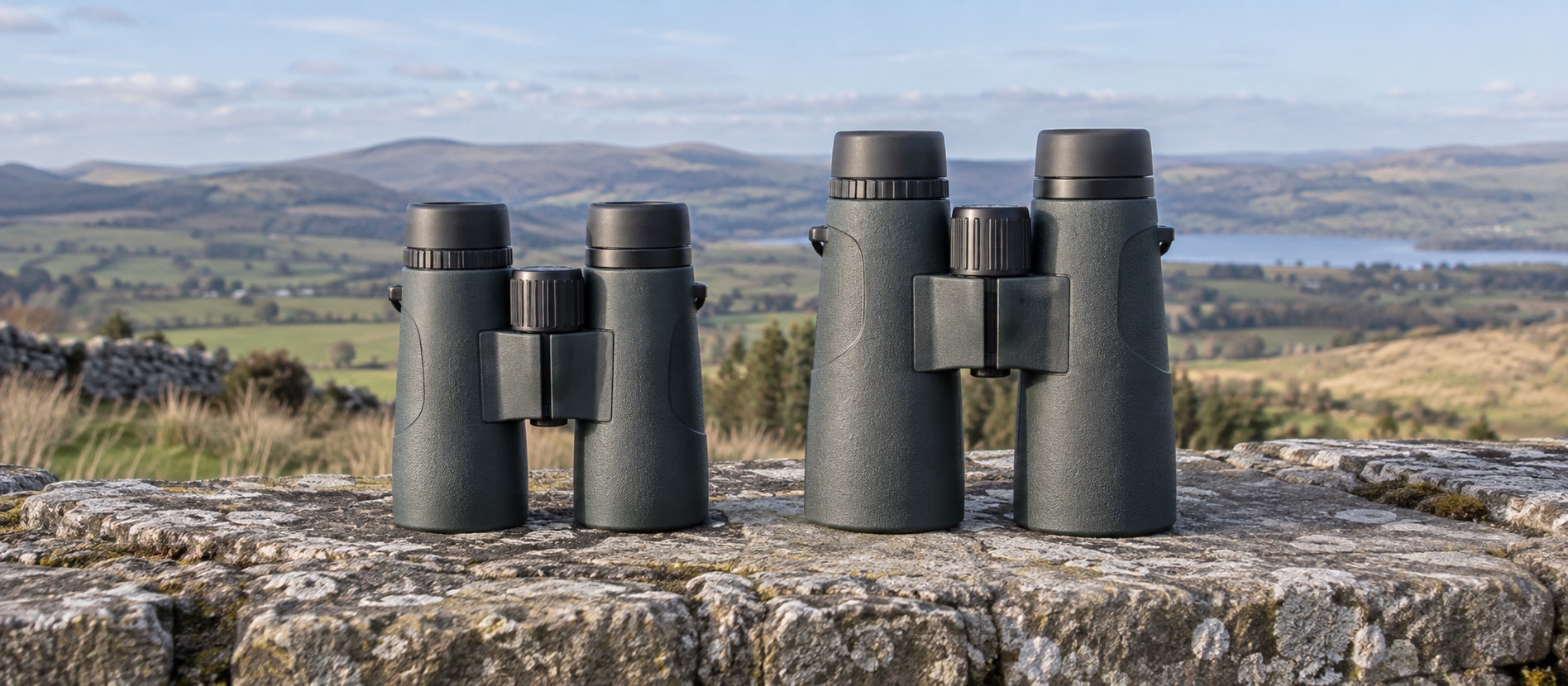
Magnification is identical; objective diameter creates the practical difference.
An 8×32 can be just as wide—or wider—than an 8×42, so check the stated field.
Fit, balance and eyecups can outweigh a small difference in grams.
An 8×32 and an 8×42 make a distant subject appear the same size. Both magnify eight times. The argument is about how much glass and body you want to carry in exchange for a larger exit pupil and a more forgiving view.
For long walks and travel, 8×32 is often the smarter format. For woodland, poor weather and birdwatching that continues towards dusk, 8×42 remains the safer all-round choice.
The differences at a glance
Swipe to compare both formats →
| Decision | 8×32 | 8×42 |
|---|---|---|
| Magnification | 8× | 8× |
| Exit pupil | 4mm | 5.25mm |
| Carry | Shorter and usually lighter | Larger and usually heavier |
| Eye placement | Good | More forgiving |
| Dull light | Capable | Stronger default |
| Best fit | Walking and travel | Mixed habitats and long sessions |
What 10mm of objective diameter changes
The area of a circular objective increases faster than its diameter. A 42mm lens has about 72% more area than a 32mm lens, although transmission losses and optical design mean that figure does not translate directly into a 72% brighter-looking view.
The immediately useful number is exit pupil. Divide objective diameter by magnification: 32 ÷ 8 gives 4mm, while 42 ÷ 8 gives 5.25mm. The larger disk of light from an 8×42 gives the eye more latitude and can supply more light when your pupil opens beyond 4mm.
Daylight performance is closer than many expect
In bright daylight, an adult pupil may contract to roughly 2–3mm. Both binocular formats then provide an exit pupil larger than the eye can accept. A good 8×32 can therefore look impressively close to an 8×42 in the middle of the day.
Differences become more obvious under tree cover, against a bright sky, in winter weather and towards the edges of the day. The 8×42 is also less punishing if the binocular is raised slightly off-centre.
Weight and dimensions
Matched models make the carry cost more concrete. The figures below are the makers' published specifications for the Vortex Diamondback HD 8×32 and 8×42, and the Celestron Nature DX 8×32 and 8×42. These are like-for-like comparisons within each range, not a claim that every 8×32 saves the same weight.
Swipe to compare the model pairs →
| Model pair | 8×32 | 8×42 |
|---|---|---|
| Vortex Diamondback HD · weight | 451g | 618g |
| Vortex · angular field | 8.1° | 7.5° |
| Vortex · eye relief | 16mm | 17mm |
| Celestron Nature DX · weight | 510g | 629g |
| Celestron · field at 1km | 129m | 129m |
| Celestron · eye relief | 17.5mm | 17.5mm |
The 8×42 adds 167g in the Vortex pair (618 − 451) and 119g in the Celestron pair (629 − 510). The difference is real, but a shorter body or a better strap may matter more to a particular walker than the gram figure alone.
Length and bag volume can matter even more. An 8×32 fits into smaller daypack pockets, interferes less with rucksack straps and swings less when scrambling. A 42mm model may require a harness to remain comfortable.
Field of view is not decided by objective size
Do not assume the 42mm model is wider. Field width depends on the eyepiece design as well as magnification. Here the Vortex 8×32 is 0.6° wider than its 8×42 sibling (8.1° versus 7.5°), while both Nature DX versions publish the same 129m at 1,000m. That is a useful counterexample to choosing objective size as a proxy for tracking birds. It does not tell us whether the edges of either view are equally sharp or whether either eyecup fits you.
Use the stated metres at 1,000m or angular degrees for the exact model. A wide field matters when finding a warbler in foliage, tracking a flying bird or scanning close woodland. Read binocular field of view explained if the figures are unfamiliar.
Stability and balance
Both formats magnify hand movement eight times, so neither has an inherent magnification advantage. The lighter 8×32 reduces fatigue, but the larger 8×42 can fill the hands more naturally and carry enough mass to damp fine tremor.
This is why balance cannot be inferred from a specification table. Hold each binocular at a small detailed target for several minutes, with and without a jacket, before deciding which is steadier for you.
Which should you choose for birdwatching?
Woodland and gardens: lean towards 8×42
The larger exit pupil helps under a canopy and on dark winter afternoons. It also makes rapid lifts to the eyes more forgiving when birds appear suddenly. A wide field and close focus remain just as important as objective size. See our woodland binocular picks for the habitat-specific choice.
Reserves and mixed countryside: either format
Choose 8×32 when you walk several miles between sightings. Choose 8×42 when you spend more time watching from hides, field edges or a garden. A light 8×42 can be the best single pair if the extra 100–150g does not discourage you.
Wetlands and coast: field and stability first
An 8×32 works well for flight and broad scanning in daylight. An 8×42 is more comfortable in flat grey light and wind, but distant identification may ultimately require a spotting scope rather than larger objectives alone.
Glasses and facial fit
An 8×42 body has room for larger eyecups, but that does not guarantee longer usable eye relief. Compare the number and then test whether your glasses can approach the eyecup without smearing or touching it. The Opticron Adventurer II WP PC 8×32, for example, publishes 20mm, while some full-size premium models publish nearer 17mm.
The final decision
Choose 8×32 when the binocular will spend hours on your body, most use is in daylight and you want conventional controls in a shorter package. Choose 8×42 when one pair must cover woodland, dull weather, dawn and dusk, or when easy eye placement matters more than minimising weight.
If an 8×32 still feels large, move to the best compact binoculars. If 42mm is settled but magnification is not, compare 8×42 vs 10×42.
Helpful products
Two sizes and one in-between option
These products show how much specifications can overlap: a light 8×32, a wide premium 8×30 and a full-size 8×42 with long eye relief.

Vortex Diamondback HD 8x32
Best for: Walks, travel and close viewing
A compact weather-sealed 8×32 that combines a 451g carry weight with a very wide 142m field and 1.5m close focus.
What stands out
- Approximately 451g
- Approximately 142m field of view at 1,000m
- Waterproof, fogproof and 1.5m close focus
Keep in mind
- 16mm eye relief may be marginal with some glasses
- Smaller 32mm objectives give up some low-light ease to 42mm models
- 8×32
- 451g
- 142m / 1,000m
- 16mm eye relief

Nikon MONARCH M7 8x30
Best for: Frequent travel and nature walks
A premium 465g compact with ED glass, a broad 145m field and 2m close focus in a sealed 8×30 body.
What stands out
- 145m field of view at 1,000m
- ED glass in a 465g body
- 2m close focus and locking dioptre
Keep in mind
- Premium price for a 30mm binocular
- 15.1mm eye relief is not the safest choice for all glasses wearers
- 8×30
- 465g
- 145m / 1,000m
- 2m close focus

Nikon PROSTAFF P7 8x42
Best for: Wide viewing with glasses
A 590g all-round 8x42 with a wide 126m field, long stated eye relief and a locking dioptre ring that helps preserve a personal focus setting.
What stands out
- 126m field of view at 1,000m
- 20.2mm stated eye relief
- 590g waterproof body with locking dioptre
Keep in mind
- 3m close focus is useful rather than class-leading
- No ED glass in the published specification
- 8×42
- 590g
- 126m / 1,000m
- 20.2mm eye relief
Frequently asked questions
8×32 and 8×42 questions
Is 8×32 powerful enough for birdwatching?
Yes. It has the same 8× magnification as an 8×42. The 42mm model does not make birds larger; it mainly provides a larger exit pupil and usually a larger body.
Is 8×42 much brighter than 8×32?
The 8×42 has greater light-gathering area and a 5.25mm exit pupil versus 4mm, which is most useful in dull conditions. In bright daylight, your pupil may be smaller than either exit pupil, so the difference can look modest.
Which is better for walking, 8×32 or 8×42?
An 8×32 is usually better for long walks because it is shorter and lighter. Choose 8×42 when the walk is mainly a route to a hide or wildlife site and low-light viewing is more important than carry comfort.
Which size is better with glasses?
Neither size guarantees a better fit. Compare usable eye relief and eyecup shape on the exact models. Some 8×32 binoculars offer 17–20mm eye relief, while some premium 8×42 models offer less.