
UK buying guide · Compact binoculars
Best compact binoculars
Compare five compact binoculars for walking, travel and nature, from pocketable 8×25 models to brighter 8×32 alternatives.
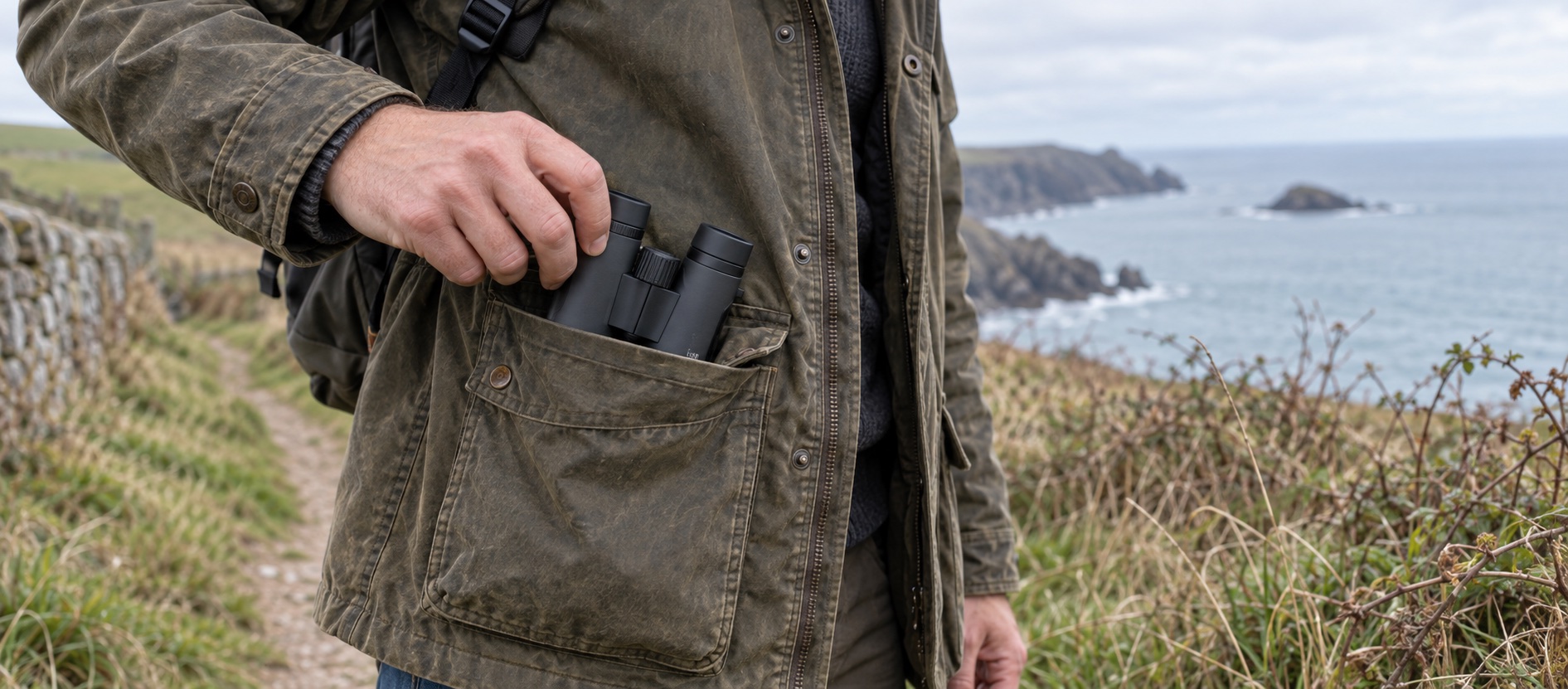
8×25 is genuinely pocketable; 8×30 and 8×32 are compact daypack binoculars.
Smaller objectives save weight but make eye placement and dusk viewing less forgiving.
Check folded dimensions as well as grams if the binocular must fit a coat pocket.
Quick picks
Choose by the detail that matters most
Links open the matching Amazon UK listing. Prices and sellers can change, so confirm the model name and ASIN before buying.
Swipe to compare all details →
| Model | Best for | Weight | Field of view | Eye relief | Close focus |
|---|---|---|---|---|---|
| Nikon PROSTAFF P7 8×30 | Best all-round compact | 485g | 152m at 1,000m | 15.4mm | 2.5m |
| Nikon SPORTSTAR EX II 8×25 | Smallest carry | 310g | 8.3° | Not stated on overview | Not stated on overview |
| Vortex Diamondback HD 8×32 | Light close-nature choice | 451g | Approx. 142m at 1,000m | 16mm | 1.5m |
| Nikon MONARCH M7 8×30 | Premium compact view | 465g | 145m at 1,000m | 15.1mm | 2m |
| Celestron Nature DX 8×32 | Practical mid-range pick | 510g | 129m at 1,000m | 17.5mm | 2m |
The detailed shortlist
Compact binoculars worth carrying
Every model below links to its exact Amazon UK listing. Confirm the model name and ASIN because compact ranges often share one retailer page across several sizes.

Nikon PROSTAFF P7 8x30
Best for: Walking and fast-moving wildlife
A compact 485g 8×30 with an unusually broad 152m field, a locking dioptre and a waterproof, fog-free body.
What stands out
- 152m field of view at 1,000m
- 485g compact body
- Waterproof with a locking dioptre
Keep in mind
- 15.4mm eye relief may be marginal with some glasses
- 30mm objectives are less forgiving than 42mm at dusk
- 8×30
- 485g
- 152m / 1,000m
- 2.5m close focus

Nikon SPORTSTAR EX II 8x25
Best for: Travel and all-day carry
A genuinely pocketable 310g binocular with a wide 8.3-degree field and a waterproof, nitrogen-filled body.
What stands out
- Only 310g
- Wide 8.3-degree field
- Waterproof and nitrogen-filled
Keep in mind
- 25mm objectives are less forgiving at dusk
- Compact controls can be fiddlier with gloves
- 8×25
- 310g
- 8.3° field
- Waterproof

Vortex Diamondback HD 8x32
Best for: Walks, travel and close viewing
A compact weather-sealed 8×32 that combines a 451g carry weight with a very wide 142m field and 1.5m close focus.
What stands out
- Approximately 451g
- Approximately 142m field of view at 1,000m
- Waterproof, fogproof and 1.5m close focus
Keep in mind
- 16mm eye relief may be marginal with some glasses
- Smaller 32mm objectives give up some low-light ease to 42mm models
- 8×32
- 451g
- 142m / 1,000m
- 16mm eye relief

Nikon MONARCH M7 8x30
Best for: Frequent travel and nature walks
A premium 465g compact with ED glass, a broad 145m field and 2m close focus in a sealed 8×30 body.
What stands out
- 145m field of view at 1,000m
- ED glass in a 465g body
- 2m close focus and locking dioptre
Keep in mind
- Premium price for a 30mm binocular
- 15.1mm eye relief is not the safest choice for all glasses wearers
- 8×30
- 465g
- 145m / 1,000m
- 2m close focus

Celestron Nature DX 8x32
Best for: Nature walks and insects
A compact 8×32 with phase-coated BaK-4 prisms, 2m close focus and weather protection in a 510g body.
What stands out
- 2m stated close focus
- Waterproof and nitrogen-filled
- Phase-coated BaK-4 prisms
Keep in mind
- 129m field is good rather than class-leading for an 8×32
- 510g is compact rather than pocket-light
- 8×32
- 510g
- 129m / 1,000m
- 17.5mm eye relief
A compact binocular succeeds when it removes the excuse to leave optics at home. The useful question is not which model is smallest on paper, but which one is small enough for your bag while still giving a view you enjoy using.
For most walkers and wildlife watchers, the sweet spot is 8×30 or 8×32. These formats retain a 3.75–4mm exit pupil and normal-sized controls without the bulk of an 8×42. A folding 8×25 wins when a coat pocket or cabin-bag limit is non-negotiable.
Why the Nikon PROSTAFF P7 8×30 is the best compact all-rounder
The P7 combines a 485g body with a published 152m field at 1,000m. That field is unusually generous and makes it easier to pick up a bird leaving cover, follow movement on a hillside or scan an unfamiliar skyline. The waterproof body and locking dioptre suit regular outdoor use rather than occasional sightseeing alone.
Its limitation is eye relief. A stated 15.4mm can work with close-fitting glasses, but it is not the low-risk specification offered by some larger models. Try it with your own frames if seeing the full field is essential.
Why the Nikon SPORTSTAR EX II 8×25 is the pocket pick
At 310g, the SPORTSTAR is the clear choice when every gram and centimetre matters. Its double-hinge shape folds tightly, while the broad 8.3-degree field avoids the tunnel-like feeling found in many tiny binoculars. Waterproofing and nitrogen filling also make it more credible for travel than a fair-weather theatre glass.
The trade-off is the 3.1mm exit pupil. In bright conditions it is entirely usable, but eye placement becomes less relaxed as light fades. Choose it for city breaks, daytime coast walks and events; do not expect it to replace an 8×42 for woodland dusk.
Why the Vortex Diamondback HD 8×32 suits close nature
The Vortex is compact rather than pocketable, but its 451g weight, approximately 142m field and 1.5m close focus create a useful walking package. Butterflies, dragonflies and nearby birds are easier to study than with models that stop focusing at 3–5m. Vortex lists a deluxe carry case and strap for the 8×32; unlike the 8×42 package, a GlassPak harness is not listed as included.
Published eye relief is 16mm, so glasses fit remains personal. The optical name does not by itself settle image quality; the practical reasons to choose this model are field width, close focus, weather protection and the included carry system.
Why the Nikon MONARCH M7 8×30 is the premium compact
The MONARCH M7 uses ED glass, a dielectric prism coating and a protective oil- and water-repellent external coating. More importantly in everyday use, it keeps the weight to 465g, provides a 145m field and focuses to 2m.
It is the premium choice for someone who will use one small binocular frequently and values a wide, refined view. It is not automatically the best travel purchase: its price raises the cost of loss or damage, and its 15.1mm eye relief again needs checking with glasses.
Why the Celestron Nature DX 8×32 is the practical alternative
The Nature DX is the heaviest compact here at 510g, yet it remains distinctly easier to pack than a full-size 8×42. A 2m close focus, 17.5mm eye relief and waterproof nitrogen-filled body make it a sensible middle route for gardens, reserves and holidays.
Its 129m field is respectable rather than exceptional. Choose it when the balance of close focus, eye relief and accessible specification suits you better than chasing the widest possible view.
8×25, 8×30 or 8×32?
Choose 8×25 for a real pocket
An 8×25 has a 3.125mm exit pupil. That is adequate in daylight, but less tolerant of imperfect eye position and less generous as pupils dilate in dim conditions. The small focus wheel can also be fiddly in gloves. Its great advantage is that it can go where larger binoculars are left behind.
Choose 8×30 for minimum bulk without tiny controls
An 8×30 produces a 3.75mm exit pupil and normally feels like a small conventional binocular. It works well for travel, hillwalking and general daytime nature. The body is unlikely to fit a trouser pocket, but it disappears into a daypack lid or small cross-body bag.
Choose 8×32 for the most relaxed compact format
An 8×32 reaches a 4mm exit pupil and usually offers a little more room for eyecups and focusing controls. It is the safest compact class for mixed nature use, though the physical saving over a light 8×42 can be modest. Our 8×32 vs 8×42 guide explains when that saving is worthwhile.
What to check before buying
- Folded size: a double hinge can matter more than a 50g weight difference.
- Field of view: wide compact binoculars are easier to point and feel less cramped.
- Eyecup fit: small bodies can leave less room around the nose and glasses.
- Focus wheel: make sure it remains usable with cold or gloved fingers.
- Waterproofing: worthwhile for a binocular that lives in changing bags and climates.
- Case design: a bulky case can erase the packing advantage.
If you are choosing between a small binocular and a brighter full-size model, read compact vs full-size binoculars. For the lightest options regardless of format, see our lightweight binocular guide.
The best compact binocular is the one that crosses your personal carry threshold without crossing your comfort threshold. For most people here that is the P7 8×30; for true pocket carry, it is the SPORTSTAR 8×25.
Frequently asked questions
Compact-binocular questions
What is the best compact binocular size?
An 8×30 or 8×32 is the most useful compromise for nature, walking and travel. It is meaningfully smaller than an 8×42 but easier to use in dull light than most 8×25 pocket binoculars.
Are compact binoculars good for birdwatching?
Yes, particularly in daylight and on walks where low weight means they are always carried. For woodland at dawn, winter afternoons or long hide sessions, an 8×42 is usually more forgiving.
Can compact binoculars fit in a pocket?
Double-hinge 8×25 models often fit a coat pocket. Most 8×30 and 8×32 binoculars are better described as small daypack or large-jacket-pocket models, so compare folded dimensions rather than relying on the word compact.
Is 10× too powerful for compact binoculars?
Not always, but 10× makes hand shake more visible and creates a smaller exit pupil from the same objective. An 8× compact is the safer all-round choice unless distant subjects are the main reason for buying.