
Astronomy · Night-sky beginner guide
Best binoculars for stargazing
Compare 8×42, 10×50 and 15×70 binoculars for learning the night sky, with realistic advice on support, light pollution, glasses and safe viewing.
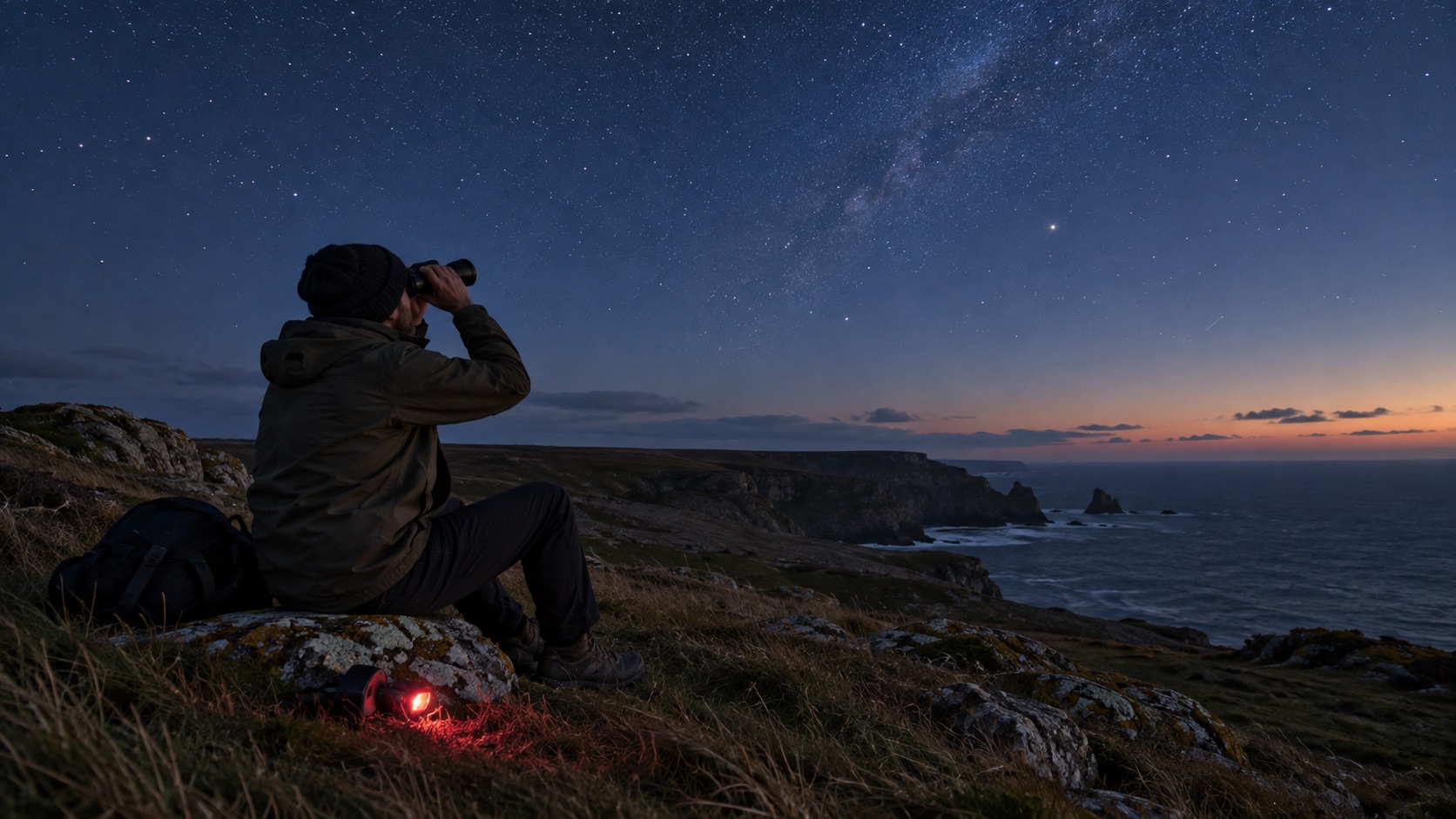
Dark skies and steady support often matter more than another jump in magnification.
A 10×50 gives a 5mm exit pupil; 15×70 gives about 4.7mm, with much more weight.
Never point ordinary binoculars near or at the Sun.
Quick picks
Choose by the detail that matters most
Links open the matching Amazon UK listing. Prices and sellers can change, so confirm the model name and ASIN before buying.
Swipe to compare all details →
| Model | Format | Weight | Exit pupil | Support | Main caution |
|---|---|---|---|---|---|
| Nikon PROSTAFF P7 | 8×42 | 590g | 5.25mm | Handheld | Less reach than 10× |
| Celestron UpClose G2 | 10×50 | 765g | 5mm | Brace for longer use | Short 12mm eye relief |
| Nature DX ED | 10×50 | 806g | 5mm | Brace or tripod | More weight and cost |
| SkyMaster | 15×70 | 1,361g | 4.7mm | Tripod essential | Large and water-resistant only |
The detailed shortlist
Four useful routes into binocular astronomy
These options solve different observing needs. Compare their stated weight, exit pupil, weather protection and support requirements before choosing.

Nikon PROSTAFF P7 8x42
Best for: Wide viewing with glasses
A 590g all-round 8x42 with a wide 126m field, long stated eye relief and a locking dioptre ring that helps preserve a personal focus setting.
What stands out
- 126m field of view at 1,000m
- 20.2mm stated eye relief
- 590g waterproof body with locking dioptre
Keep in mind
- 3m close focus is useful rather than class-leading
- No ED glass in the published specification
- 8×42
- 590g
- 126m / 1,000m
- 20.2mm eye relief

Celestron UpClose G2 10x50
Best for: Occasional clear-sky viewing
An inexpensive traditional 10×50 Porro with a broad 118m field and tripod socket for supported night-sky viewing.
What stands out
- 118m field at 1,000m
- 5mm exit pupil
- Tripod adaptable
Keep in mind
- Only water resistant, not waterproof
- 12mm eye relief is poor for glasses
- 10×50
- 765g
- 118m / 1,000m
- 12mm eye relief

Celestron Nature DX ED 10x50
Best for: Dusk and sky crossover
An ED-glass 10×50 with 103m field, 17.8mm eye relief and waterproof nitrogen-filled construction.
What stands out
- ED objectives and fully multi-coated optics
- 103m field at 1,000m
- Waterproof and tripod adaptable
Keep in mind
- 806g is tiring unsupported
- ED glass does not increase aperture or overcome sky glow
- 10×50
- 806g
- 103m / 1,000m
- 17.8mm eye relief

Celestron SkyMaster 15x70
Best for: Tripod-based deep-sky scanning
A large 15×70 astronomy Porro with 77m field and included tripod adaptor.
What stands out
- 70mm objectives
- Tripod adaptor included
- 18mm eye relief
Keep in mind
- 1,361g makes handheld use impractical
- Water resistant only; not nitrogen filled
- 15×70
- 1,361g
- 77m / 1,000m
- 18mm eye relief
Binocular astronomy is most rewarding when you can actually find your way around the sky. Two-eyed viewing, a wide field and simple setup make binoculars excellent for that job. The tempting mistake is to buy the biggest number first. A steady, comfortable view beats a shaking one, especially when trying to locate a faint object.
Start with the binocular you already own
A good 8×42 such as the Nikon PROSTAFF P7 gives a 5.25mm exit pupil, waterproof body and manageable 590g weight. Its wide terrestrial field helps when moving between bright guide stars and learning the shape of a constellation. It is also a useful birdwatching and walking binocular, so the purchase does not depend on clear skies.
It cannot show the same apparent scale as a 10×50, but it can be used unsupported for longer. If this is your first optic, an 8×42 is a defensible choice. Learn what binocular numbers mean before paying for an astronomy-specific format.
UpClose G2 10×50: the fair-weather budget route
The UpClose G2 provides the classic 10×50 pairing and a comparatively broad 118m field at 1,000m. That width makes star-hopping easier than with a narrow 10× model. A chair back or railing can reduce shake while preserving easy pointing.
There are two important compromises: Celestron specifies water resistance rather than waterproofing, and just 12mm eye relief. Glasses wearers may not see the full field. Keep it dry and choose a different model if you expect dew-heavy sessions or need glasses to correct astigmatism.
Nature DX ED 10×50: a sealed all-round option
The Nature DX ED adds waterproof nitrogen-filled construction, 17.8mm eye relief and ED objectives. Its 103m field is narrower than the UpClose G2's but still usable for broad targets. The ED designation chiefly addresses colour fringing; it does not increase the 50mm aperture or cancel light pollution.
At 806g, this is best for shorter handheld looks, braced viewing or a tripod. It is also a genuine wildlife crossover, unlike a larger 15×70. The standard Nature DX 10×50 and Outland X provide other sealed routes if ED glass is not a priority.
SkyMaster 15×70: mount it before judging it
The SkyMaster 15×70 has a much larger objective and higher magnification, so it can reveal fainter and smaller targets under suitable skies. It also weighs 1,361g. Celestron includes a tripod adaptor for good reason. On an ordinary photo tripod, pointing near the zenith can still be awkward; check head capacity and consider a parallelogram mount or reclining setup for extended sessions.
It is water-resistant rather than waterproof and is not nitrogen-filled. Store it dry. This is a specialist second instrument, not a replacement for a quick handheld 8×42. If you want a manageable 10×50 first, use the dedicated 10×50 astronomy comparison.
What can you see?
The Moon is an immediate target: binoculars show the broad pattern of dark maria and bright highlands. Large open clusters, the Andromeda Galaxy under good conditions and rich Milky Way fields suit wide binocular views. Precise results depend heavily on sky darkness, transparency, steadiness and eyesight. Expect a different experience from long-exposure photographs.
Plan an observing sequence with a printed sky map or app in dim red mode. Begin with an easy naked-eye landmark, then move one binocular field at a time. Let your eyes adapt to darkness, avoid bright phone screens and sit down when possible. Do not observe through a window; reflections and temperature differences degrade the view.
The safety rule
Never look directly at the Sun through ordinary binoculars, even at sunrise or sunset. Permanent eye injury can occur in moments. This guide is for night-sky use only; our solar-viewing safety guide explains why familiar shortcuts are unsafe.
Frequently asked questions
Stargazing-binocular questions
Are 8×42 binoculars enough for astronomy?
Yes for learning the sky, the Moon, bright clusters and broad star fields. A 10×50 adds reach and aperture, but a comfortable 8×42 used often is better than an unwieldy pair left at home.
Can I handhold 15×70 binoculars?
Not usefully for sustained observing. Their high magnification and roughly 1.36kg weight make a sturdy tripod or dedicated mount the practical requirement.
Will binoculars show planets like a telescope?
No. Bright planets appear as bright points or tiny discs; binoculars are strongest for wide star fields, the Moon and large clusters. A telescope is better for planetary detail.
Does light pollution make 10×50 pointless?
No, but it reduces faint-object contrast. A darker observing location and shielding from nearby lamps can make a larger difference than changing models.