
Model comparison · Nikon
Nikon PROSTAFF P7 vs MONARCH M5
Compare Nikon P7 and MONARCH M5 8×42 by field width, ED glass, eye relief, close focus and weight before paying for an upgrade.
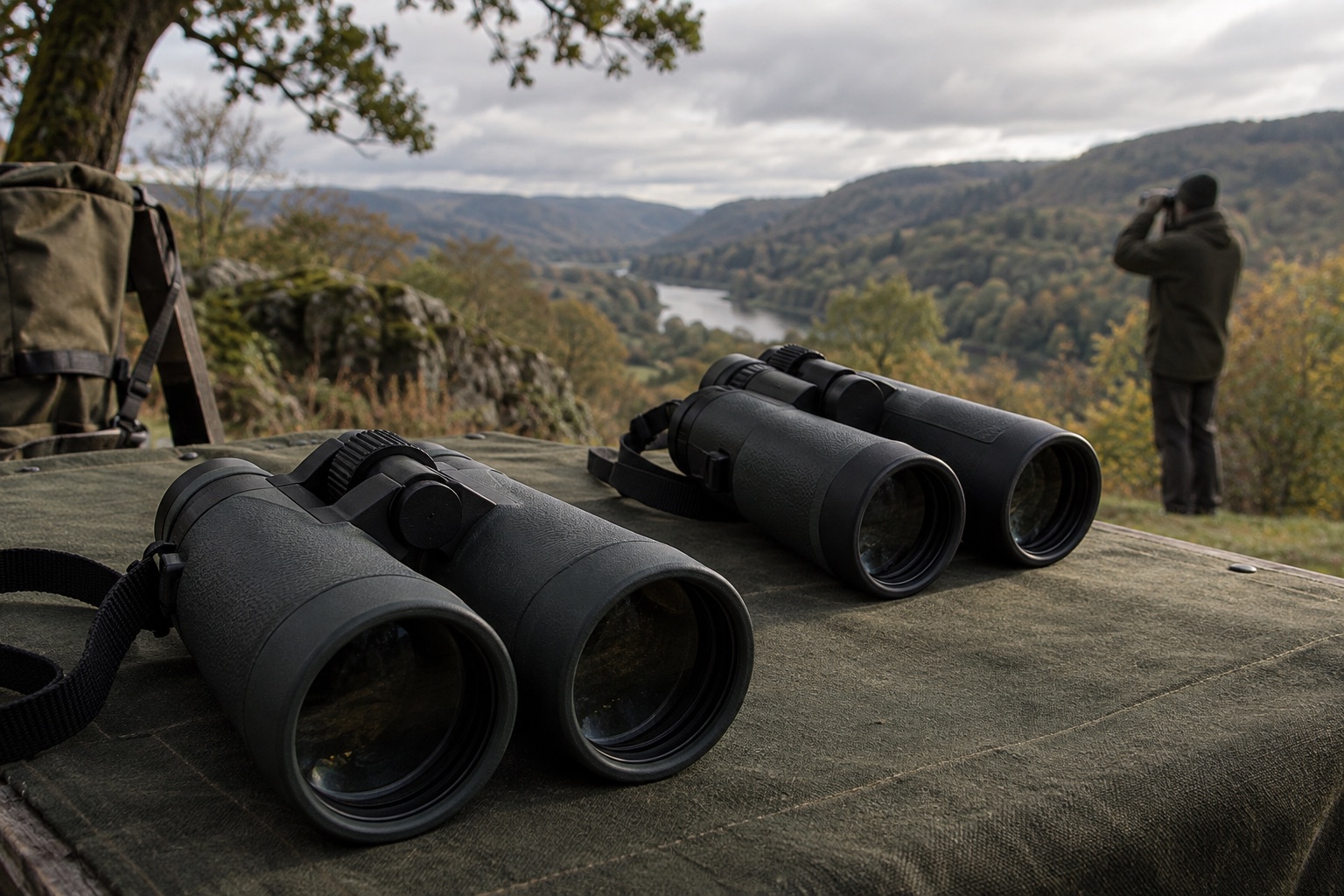
Both use roof prisms with phase-correction and dielectric reflective coatings.
P7 is wider and lighter; M5 adds ED glass and a closer minimum focus.
The best choice depends on backlit-detail priorities versus finding moving subjects quickly.
Quick picks
Choose by the detail that matters most
Links open the matching Amazon UK listing. Prices and sellers can change, so confirm the model name and ASIN before buying.
Swipe to compare all details →
| Feature | PROSTAFF P7 | MONARCH M5 |
|---|---|---|
| Field at 1km | 126m | 112m |
| Eye relief | 20.2mm | 19.5mm |
| Close focus | 3m | 2.5m |
| Weight | 590g | 630g |
| ED objectives | Not specified | Yes |
| Locking dioptre | Yes | Not listed |
| Prism coatings | Phase-corrected and dielectric | Phase-corrected and dielectric |
The detailed shortlist
The exact Nikon 8×42 pair
Compare the corresponding 8×42 versions by field, eye relief, glass and cost before deciding whether the step up is worthwhile.

Nikon PROSTAFF P7 8x42
Best for: Wide viewing with glasses
A 590g all-round 8x42 with a wide 126m field, long stated eye relief and a locking dioptre ring that helps preserve a personal focus setting.
What stands out
- 126m field of view at 1,000m
- 20.2mm stated eye relief
- 590g waterproof body with locking dioptre
Keep in mind
- 3m close focus is useful rather than class-leading
- No ED glass in the published specification
- 8×42
- 590g
- 126m / 1,000m
- 20.2mm eye relief

Nikon MONARCH M5 8x42
Best for: Glasses and high-contrast viewing
An ED-glass 8×42 with 19.5mm eye relief, 2.5m close focus and a compact 630g body; its 112m field is narrower than the P7's.
What stands out
- ED objectives and dielectric prism coating
- 19.5mm eye relief
- 2.5m close focus
Keep in mind
- 112m field is appreciably narrower than the P7
- No locking dioptre is listed
- 8×42
- 630g
- 112m / 1,000m
- 19.5mm eye relief
An upgrade should solve a problem you actually notice. Moving from PROSTAFF P7 8×42 to MONARCH M5 8×42 brings ED glass, but it also reduces the published field from 126m to 112m at 1,000m. That is a 14m loss in scanning width, or about 11% of the P7's field (14 ÷ 126). The M5 also adds 40g, about 7% of the P7's weight, while stated eye relief falls only 0.7mm and close focus improves by 0.5m. An “M” badge alone does not decide which combination works better for birds. These published differences identify the purchase trade; they do not quantify an ED-related sharpness gain.
The case for the PROSTAFF P7
The P7's broad field is valuable for tracking flight and searching reedbeds. At 590g it is 40g lighter than the M5. Nikon publishes 20.2mm eye relief, so it is a particularly strong glasses candidate, subject to a real fit check. The locking dioptre keeps your individual focus setting from being knocked, and the external lens surfaces have a water/oil-repellent coating.
It lacks ED objectives in Nikon's published description. Around dark branches against a bright sky, that may be the strongest reason to examine an upgrade. Yet P7 already has phase-corrected roof prisms and dielectric reflective coating, so the comparison is not “ordinary glass versus all optical treatment”.
The case for the MONARCH M5
M5 uses extra-low-dispersion glass to reduce colour fringing. It closes focus to 2.5m rather than P7's 3m, a small but useful difference for garden subjects or butterflies. Its 19.5mm eye relief remains generous on paper. At 630g it is still a manageable full-size body, though not the lighter option.
The narrower 112m field matters if your main subject is a fast bird in mixed habitat. It may matter less if you concentrate on perched or settled subjects and value a cleaner high-contrast edge. This is a model-specific trade-off, not a claim that ED never helps. See is ED glass worth it? for the optical context.
Do not confuse the 8× and 10× comparisons
In 10×42, Nikon publishes 122m for P7 and only 98m for M5. The gap is more dramatic than with these 8×42 models. The M5 10×42 does, however, offer 18.4mm eye relief versus P7's 15.7mm, so glasses may reverse the priority. If that is the format you are choosing, see best 10×42 binoculars rather than assuming the same answer.
How to decide in a shop or field
Use both on a high-contrast branch or sign, then move to a flying or walking subject. With your usual glasses, can you see the complete field on each? Is the M5's ED-related cleanliness noticeable to you, and does it outweigh the narrower field? Check the focus wheel and eyecup stops. If the P7 already gives an easy, broad, relaxed image, the M5 upgrade is optional. If colour fringing distracts you and the M5 fits, its extra cost may be justified.
Decide by what you miss in the field
If you lose fast birds at the edge of the view, P7's wider published field is a benefit every time you acquire one. If you usually study a stationary bird against a bright sky and coloured outlines distract you, M5's ED objectives give a concrete reason to try it. Close-focus distance favours M5 modestly, but a subject at 2.7m is relevant only if you genuinely watch birds, insects or flowers at that range. The MONARCH name alone cannot settle these different tasks.
Neither model's stated eye relief guarantees a complete view through every pair of spectacles. Try both with your normal frames; then move your eye slightly around the exit pupil and see whether the image cuts off. A small numerical advantage for P7 should not override an M5 that fits you better in practice. Likewise, published weight is only part of comfort: note where your fingers rest, how the barrels balance and whether the focus wheel can be operated without changing grip.
At checkout, confirm that both offers are the exact 8×42 variants used in this comparison. Mixing a 10×42 field figure with an 8×42 price creates a false bargain. If the price gap is large, decide which specific gain you would buy; if neither matters on your usual subjects, keeping the broader P7 view is a rational outcome, not a refusal to upgrade.
Frequently asked questions
P7 and M5 questions
Is MONARCH M5 always better than PROSTAFF P7?
No. M5 has ED glass and closer focus, but P7 is lighter and has a 14m wider field at 1,000m. The best feature depends on your subjects.
Which is better for moving birds?
The P7's wider 126m published field gives more room to find and follow movement than the M5's 112m.
Which is better with glasses?
Both publish generous figures: 20.2mm for P7 and 19.5mm for M5. A personal full-field test is more reliable than the small numerical difference.
Does the M5 have a locking dioptre?
Nikon lists a locking dioptre for the P7, but does not list one for the M5. Check the exact item if that feature matters.