
Format guide · 10×42
Best 10×42 binoculars
Compare four exact 10×42 binoculars by field, eye relief, close focus and weight, then decide when a steadier 8×42 is the wiser choice.
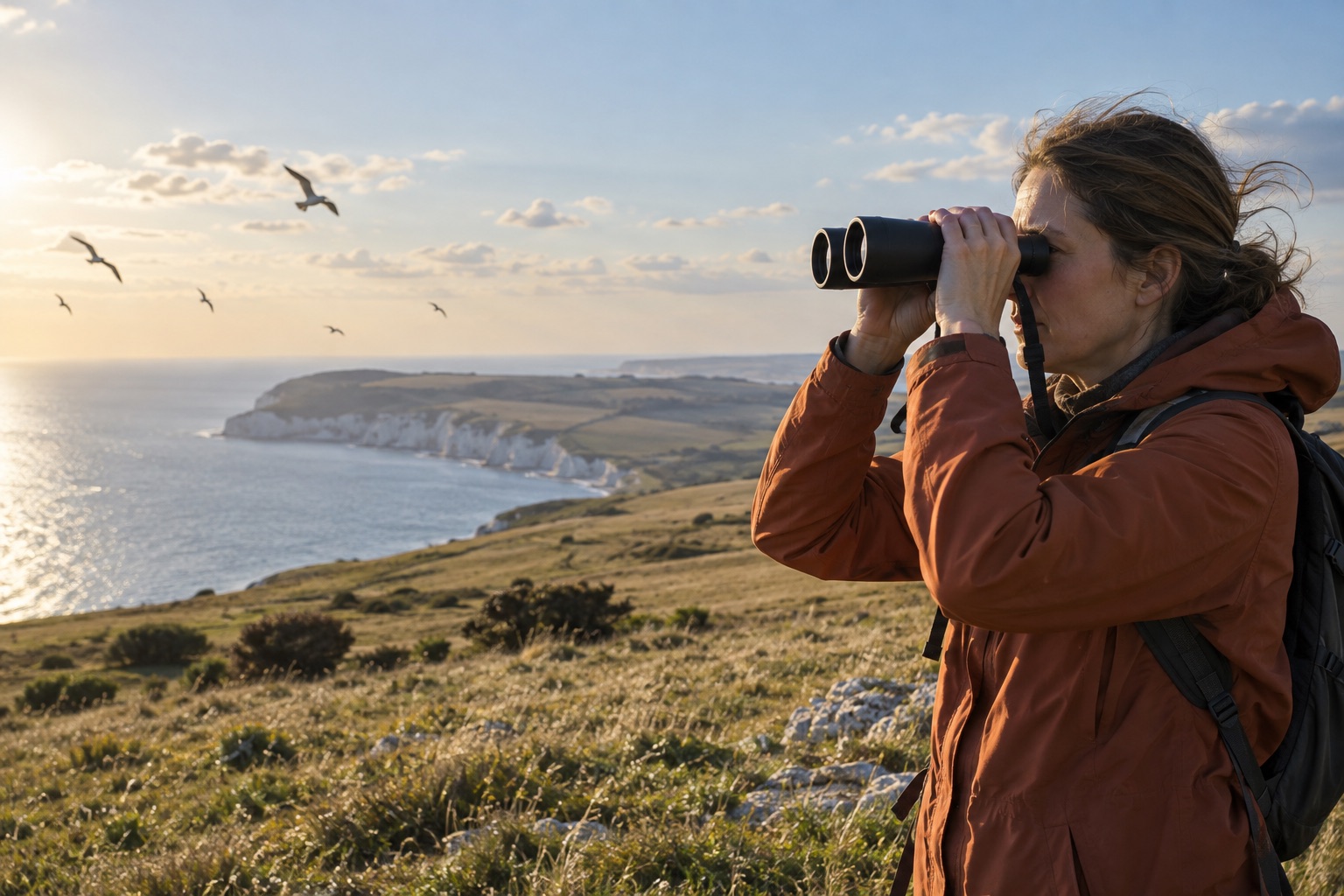
At 10×42, the exit pupil is 4.2mm; an 8×42 gives 5.25mm.
Published fields here range from 98m to 122m at 1,000m—a difference you will feel when finding moving birds.
Test the complete field with glasses before choosing by a millimetre number.
Quick picks
Choose by the detail that matters most
Links open the matching Amazon UK listing. Prices and sellers can change, so confirm the model name and ASIN before buying.
Swipe to compare all details →
| Model | Weight | Field at 1km | Eye relief | Close focus | Main trade-off |
|---|---|---|---|---|---|
| PROSTAFF P7 | 600g | 122m | 15.7mm | 3m | Broad field without ED |
| MONARCH M7 | 680g | 121m | 16.5mm | 2.5m | ED and broad field; heavier |
| MONARCH M5 | 640g | 98m | 18.4mm | 2.5m | ED and eye room; narrow field |
| Nature DX | 629g | 101m | 14mm | 2.2m | Close focus; glasses constraint |
The detailed shortlist
Four 10×42 models worth separating
These are exact-format Amazon UK product listings. Confirm the 10×42 variant before checkout; prices and sellers may change.

Nikon PROSTAFF P7 10x42
Best for: Estuaries and open-country distance
A 600g 10×42 with a notably wide 122m field, 15.7mm eye relief and a locking dioptre for repeatable long-distance viewing.
What stands out
- 122m field is wide for a 10×42
- 600g waterproof body
- Locking dioptre and protective lens coating
Keep in mind
- 15.7mm eye relief offers limited margin for some glasses
- 10× shake is more visible than with 8×
- 10×42
- 600g
- 122m / 1,000m
- 15.7mm eye relief

Nikon MONARCH M7 10x42
Best for: Detailed open-habitat viewing
A premium 10×42 with ED glass, a wide 121m field, 2.5m close focus and a 680g waterproof body.
What stands out
- 121m field is broad for a 10×42
- ED glass and dielectric prism coating
- 2.5m close focus and locking dioptre
Keep in mind
- Costs substantially more than the PROSTAFF P7
- 680g and 10× magnification demand steadier technique
- 10×42
- 680g
- 121m / 1,000m
- 16.5mm eye relief

Nikon MONARCH M5 10x42
Best for: Steady, settled 10× observation
An ED-glass 10×42 with 18.4mm eye relief and 2.5m close focus, but a comparatively narrow 98m field.
What stands out
- ED objectives
- 18.4mm stated eye relief
- 2.5m close focus
Keep in mind
- 98m field makes moving subjects harder to find
- 640g and 10× need a steady hold
- 10×42
- 640g
- 98m / 1,000m
- 18.4mm eye relief
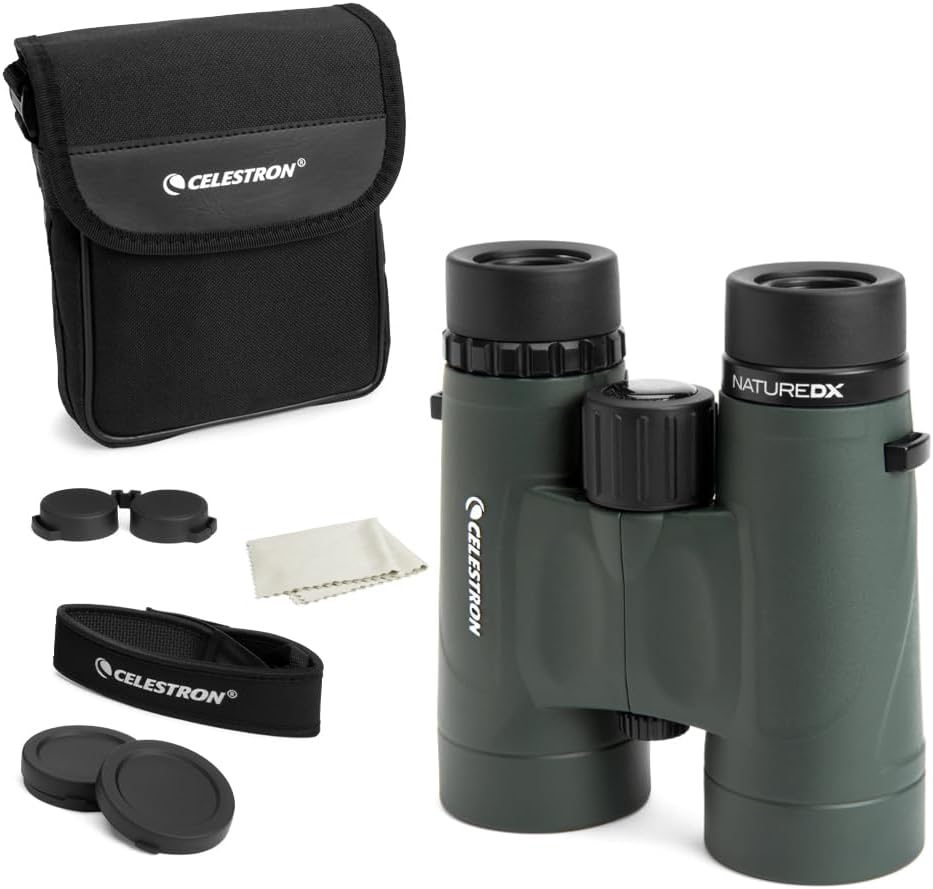
Celestron Nature DX 10x42
Best for: Distant daytime wildlife
A waterproof nitrogen-filled 10×42 with a 101m field and 2.2m close focus, but only 14mm stated eye relief.
What stands out
- 2.2m close focus
- Waterproof nitrogen-filled body
- Phase-coated BaK-4 prisms
Keep in mind
- 14mm eye relief limits some glasses users
- 101m field is narrower than Nikon P7
- 10×42
- 629g
- 101m / 1,000m
- 14mm eye relief
The question is not whether 10× looks closer than 8×. It does. The question is whether a 10×42 lets you find, hold and resolve the subject often enough to justify the narrower, shakier view. Across a broad estuary, a still deer on a hillside or a perched raptor, it can. Under a woodland canopy or while tracking a small flying bird, 8×42 is often the more effective tool.
What separates the four choices
The Nikon PROSTAFF P7 10×42 is the sensible first comparison. Its 122m field at 1,000m is broad for this format, and 600g is manageable over a long route. A locking dioptre and repellent outer lens coating help in regular field use. Its 15.7mm eye relief, however, may not show the full view to every glasses wearer. It also does not claim ED objectives.
The MONARCH M7 10×42 nearly matches that width at 121m while adding ED glass, a dielectric prism coating and 2.5m close focus. This is a coherent upgrade for a frequent open-habitat observer who notices colour fringing around high-contrast edges. At 680g, it is also the heaviest model here. An expensive optical upgrade is less useful if the extra weight means it stays at home.
The MONARCH M5 10×42 has a different strength: 18.4mm eye relief, ED glass and a 640g body. Its 98m field is 24m narrower than the P7's at 1,000m. That is a meaningful compromise when searching for a moving bird across water. It can be a good fit for glasses and settled subjects; it is not a universal step-up from the P7. Our P7 versus M5 comparison examines the 8×42 pair in more detail.
The Celestron Nature DX 10×42 offers a 2.2m close focus, 101m field and waterproof nitrogen-filled body. It can bridge distant birds and nearby garden subjects. Its 14mm eye relief is the short figure in this group, so glasses wearers should treat it cautiously. It is a useful benchmark for what a straightforward 10×42 gives without paying for ED glass.
Which habitat makes 10× worthwhile?
Open estuary and coast are the obvious cases. Distance eats apparent detail; a supported 10× view can help separate a resting bird from the surrounding flock. At a wetland, use a hide rail, fence or your elbows to steady the image. For seawatching, binoculars locate and follow; a spotting scope is usually the next tool for prolonged very distant identification.
In woodland, higher power makes the view jump more and leaves less context around the bird. At dusk, the 4.2mm exit pupil is less forgiving than an 8×42's 5.25mm. Good coatings and steady technique still matter, but magnification does not create light. See 8×42 vs 10×42 before buying just for the larger number.
A five-minute fit check
Aim at a distant detailed subject from a safe location. Set the eyecups and interpupillary distance, then view with both eyes relaxed. Glasses wearers should check that the full circular field is visible without pressing lenses against the eyecups. Focus on a still target, then follow a moving one. Finally compare the same target at 8×: if 10× shake erases the apparent gain, choose the steadier format or plan to support the binocular.
Frequently asked questions
10×42 binocular questions
Are 10×42 binoculars better than 8×42?
Only when extra apparent reach matters and you can hold the view steady. An 8×42 is usually easier to aim, steadier and more forgiving in shade.
Which 10×42 here has the widest field?
The Nikon PROSTAFF P7 publishes 122m at 1,000m, narrowly ahead of the MONARCH M7 at 121m.
Is the MONARCH M5 automatically better than the PROSTAFF P7?
No. The M5 adds ED glass and more eye relief, but its 98m field is much narrower than the P7's 122m. Choose by what you watch.
Can I use a 10×42 with glasses?
Possibly. The M5's 18.4mm stated eye relief gives more margin than the others here, but eyecup shape and your glasses decide whether the entire field is visible.