
Habitat guide · Land-based seawatching
Best binoculars for seawatching
Five binoculars for land-based seawatching, compared for 10× reach, 8× scanning, field of view, stability, weather protection and glasses.
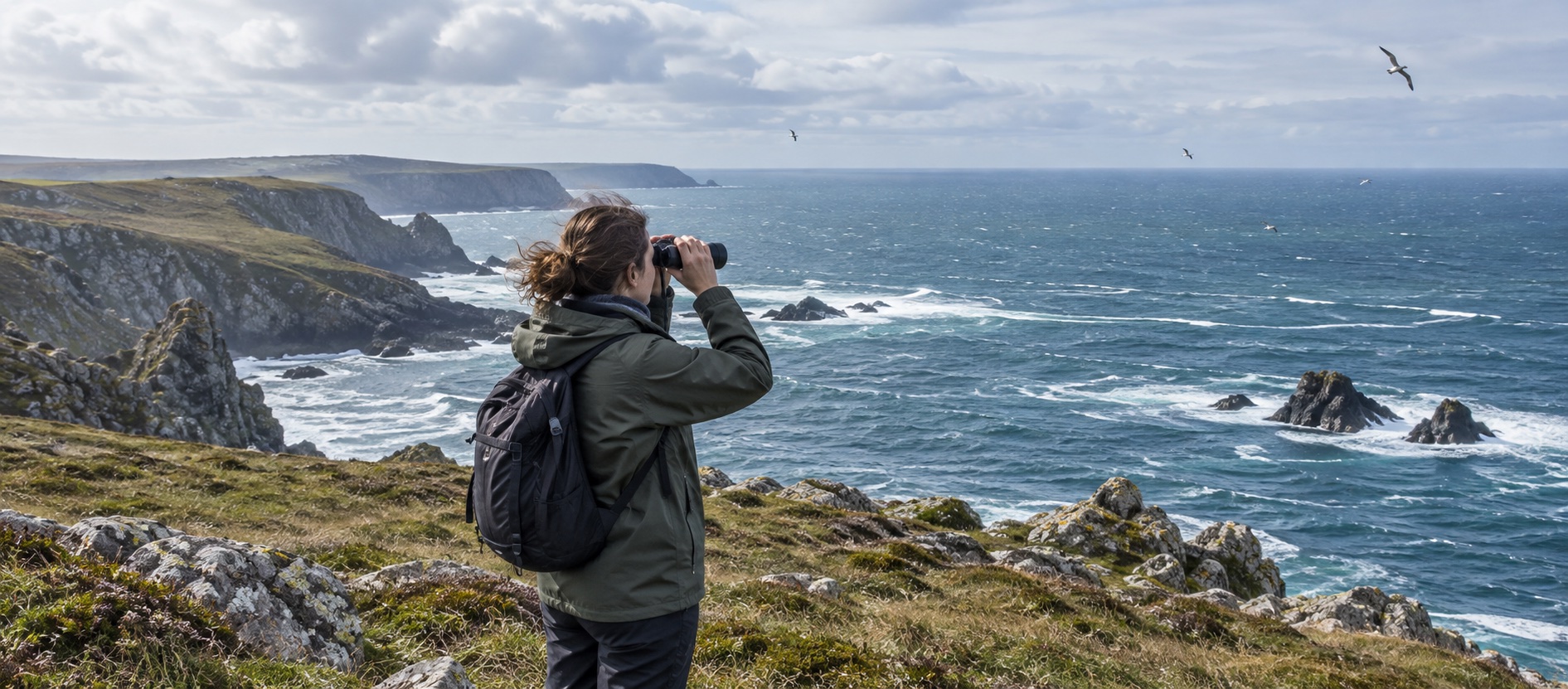
This guide is for shore and headland observation, not navigation from a boat.
Support matters: a steady 10× reveals more than a shaking one.
For prolonged distant identification, binoculars should find the bird and a spotting scope should study it.
Quick picks
Choose by the detail that matters most
Links open the matching Amazon UK listing. Prices and sellers can change, so confirm the model name and ASIN before buying.
Swipe to compare all details →
| Model | Best for | Weight | Field | Eye relief | Seawatching role |
|---|---|---|---|---|---|
| Nikon MONARCH M7 10×42 | Premium supported distance | 680g | 121m / 1,000m | 16.5mm | Distant birds and vessels |
| Nikon PROSTAFF P7 10×42 | Accessible 10× reach | 600g | 122m / 1,000m | 15.7mm | Value distance choice |
| Nikon MONARCH M7 8×42 | Premium wide scanning | 670g | 145m / 1,000m | 17.1mm | Flight and finding |
| Vortex Diamondback HD 8×42 | Mobile coastal walks | 618g | Approx. 131m / 1,000m | 17mm | Harness included |
| Nikon PROSTAFF P7 8×42 | Glasses and long sessions | 590g | 126m / 1,000m | 20.2mm | Relaxed 8× viewing |
The detailed shortlist
Binoculars for headlands, harbours and coastal passage
The 10× models prioritise distant scale; the 8× models prioritise steadiness and acquisition. Links open exact Amazon UK listings, so verify magnification and ASIN.

Nikon MONARCH M7 10x42
Best for: Detailed open-habitat viewing
A premium 10×42 with ED glass, a wide 121m field, 2.5m close focus and a 680g waterproof body.
What stands out
- 121m field is broad for a 10×42
- ED glass and dielectric prism coating
- 2.5m close focus and locking dioptre
Keep in mind
- Costs substantially more than the PROSTAFF P7
- 680g and 10× magnification demand steadier technique
- 10×42
- 680g
- 121m / 1,000m
- 16.5mm eye relief

Nikon PROSTAFF P7 10x42
Best for: Estuaries and open-country distance
A 600g 10×42 with a notably wide 122m field, 15.7mm eye relief and a locking dioptre for repeatable long-distance viewing.
What stands out
- 122m field is wide for a 10×42
- 600g waterproof body
- Locking dioptre and protective lens coating
Keep in mind
- 15.7mm eye relief offers limited margin for some glasses
- 10× shake is more visible than with 8×
- 10×42
- 600g
- 122m / 1,000m
- 15.7mm eye relief

Nikon MONARCH M7 8x42
Best for: Finding and following moving birds
A step-up ED-glass 8x42 whose key distinction is an expansive 145m field, alongside a locking dioptre and protective external lens coatings.
What stands out
- 145m field of view at 1,000m
- ED glass and dielectric prism coating
- Locking dioptre and oil-repellent external coating
Keep in mind
- Costs materially more than capable starting models
- 17.1mm eye relief gives less margin than the PROSTAFF P7
- 8×42
- 670g
- 145m / 1,000m
- 17.1mm eye relief

Vortex Diamondback HD 8x42
Best for: All-weather wildlife walks
A weather-sealed 8x42 with a broad published field, 17mm eye relief and an included harness, giving it a practical ready-to-carry package.
What stands out
- Wide 7.5-degree published field
- GlassPak harness included
- Waterproof, fogproof roof-prism body
Keep in mind
- 17mm eye relief may not suit every glasses wearer
- HD naming alone does not mean ED objective glass
- 8×42
- 618g
- 7.5° field
- 1.5m close focus

Nikon PROSTAFF P7 8x42
Best for: Wide viewing with glasses
A 590g all-round 8x42 with a wide 126m field, long stated eye relief and a locking dioptre ring that helps preserve a personal focus setting.
What stands out
- 126m field of view at 1,000m
- 20.2mm stated eye relief
- 590g waterproof body with locking dioptre
Keep in mind
- 3m close focus is useful rather than class-leading
- No ED glass in the published specification
- 8×42
- 590g
- 126m / 1,000m
- 20.2mm eye relief
Seawatching from land is a different task from using binoculars on a boat. The observer is usually stable enough to exploit 10× magnification, but wind, long sessions and fast-moving birds still reward a wide, steady view.
That produces a genuine split: 10×42 for supported distance, 8×42 for finding, flight and difficult wind. Neither replaces a spotting scope when the bird is a speck near the horizon.
Why the Nikon MONARCH M7 10×42 is the premium distance choice
The MONARCH M7 10×42 combines 10× magnification with a 121m field at 1,000m, which is broad enough to remain practical for moving subjects. ED glass is relevant around high-contrast silhouettes, and the locking dioptre helps preserve a personal setup.
At 680g, it benefits from support during a long watch. Its 16.5mm eye relief may suit some glasses wearers but is not as generous as the 8× PROSTAFF P7.
Why the Nikon PROSTAFF P7 10×42 is the accessible 10×
The P7 is lighter at 600g and slightly wider on paper at 122m. It lacks ED glass, but the field, waterproof body and locking dioptre make it a credible seawatching tool without the premium step.
The 15.7mm eye relief is the main caution. Glasses wearers should confirm that the whole field is visible, not merely that the central image looks sharp.
Why the MONARCH M7 8×42 is the premium scanner
The 8× M7 offers a 145m field and 5.25mm exit pupil. That extra width is valuable when a bird is first picked up by eye and the binocular needs to acquire it quickly against a featureless sky or sea. The steadier image also helps when gusts move the observer.
Choose it if broad scanning and flight dominate, or if 10× has proved tiring in practice. Apparent subject size is lower, but usable detail can be higher when the view remains settled.
Why the Vortex Diamondback HD 8×42 suits coastal walking
The Vortex's broad published field and included harness suit birders who move between coves, harbours and headlands rather than staying at one shelter. The harness keeps the binocular controlled in wind and leaves the neck free from a swinging load.
The 1.5m close focus is not central to distant sea observation, but it makes the pair more versatile for general nature on the walk in and out.
Why the PROSTAFF P7 8×42 suits long sessions with glasses
The P7 8×42 publishes 20.2mm eye relief and weighs 590g. Its 126m field is narrower than the premium and Vortex 8× models, but the glasses margin and lower weight may matter more over several hours.
Choose it when comfort and repeatable setup are stronger priorities than maximum width. A stable, complete field beats a nominally wider view that glasses cut off.
How to scan open sea
Divide the view into repeatable horizontal bands: near water, mid-distance, horizon and sky. Move in overlapping sections using fixed landmarks, buoys or headlands where available. Random sweeping causes fatigue and leaves gaps.
Begin at 8× or with unaided eyes when passage is active. Once a line of movement is understood, 10× can inspect it more closely. Keep both eyes relaxed and take frequent breaks from the eyepieces.
Wind changes the useful magnification
Ten-times magnifies body movement by the same factor as the bird. Sit, kneel or brace the elbows against a solid support when safe. A short, tensioned strap can add stability. Do not lean a bare objective or bridge against abrasive concrete.
If the view shakes continuously, move down to 8× or onto a mounted scope. More nominal power does not create more information when the image never stops moving.
Haze, rain and sea spray
Atmospheric haze and sea mist limit contrast at distance. No binocular coating can recover detail that the air has removed. Lower magnification can sometimes look cleaner because it enlarges the disturbance less.
Waterproof sealing is essential around coastal weather. After salt spray, follow the manufacturer's cleaning instructions, remove loose grit first and wipe the external body carefully with fresh water where permitted. Dry the binocular outside its closed case. Our rain and sea-spray care guide explains why a rinse cannot be assumed safe for every pair.
Binoculars and a spotting scope
Binoculars provide speed, orientation and two-eyed comfort. A scope provides stable high magnification for identification. On a serious watch, use binoculars continuously and move to the scope only after the subject's direction and speed are clear.
For estuaries and closer wetland work, see best binoculars for wetlands and estuaries. If the binocular will be used aboard a vessel or for bearings, choose from the separate best marine binoculars guide.
Frequently asked questions
Seawatching-binocular questions
Is 10× better than 8× for seawatching?
Ten-times makes distant subjects appear larger and can be useful from a supported position. Eight-times is steadier, wider and easier for locating birds in flight, especially in strong wind.
Do I need 7×50 marine binoculars for seawatching from land?
No. Marine 7×50 models are designed for stability, low light and rugged boat use, often with individual focus or a compass. A wide 8×42 or supported 10×42 is usually more versatile for identifying birds from shore.
Are binoculars enough for serious seawatching?
They are excellent for scanning and flight, but a spotting scope is the better tool for sustained study of very distant birds. Many observers use binoculars to find a subject and a scope to examine it.
How do I steady binoculars in coastal wind?
Face slightly away from the wind, sit or kneel, support the elbows and use a wall or hide when safe. A tripod adaptor can help during long 10× sessions. Never adopt an unstable position near an edge.