
Habitat guide · Wetlands and estuaries
Best binoculars for wetlands and estuaries
Five binoculars for wetlands, mudflats and estuaries, compared for 8× scanning, 10× reach, field width, eye relief and weather protection.
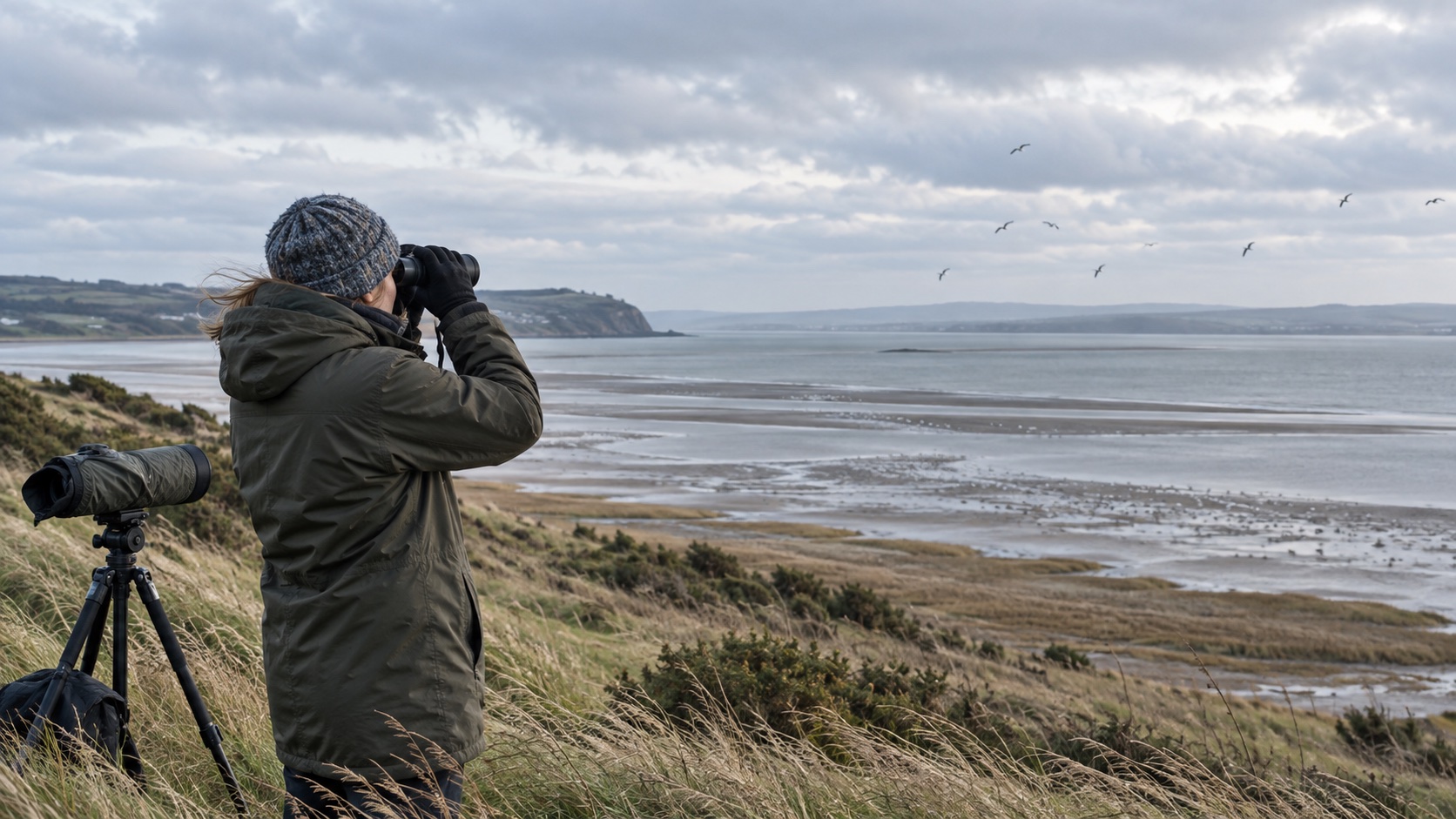
Eight-times is faster for flocks, flight and scanning reedbeds.
Ten-times helps with distant static subjects but magnifies wind and hand movement.
A scope is the better next tool when identification depends on prolonged high magnification.
Quick picks
Choose by the detail that matters most
Links open the matching Amazon UK listing. Prices and sellers can change, so confirm the model name and ASIN before buying.
Swipe to compare all details →
| Model | Best for | Weight | Field | Eye relief | Format strength |
|---|---|---|---|---|---|
| Nikon MONARCH M7 8×42 | Premium wide scanning | 670g | 145m / 1,000m | 17.1mm | Flight and mixed distance |
| Nikon PROSTAFF P7 8×42 | Glasses-friendly all-round use | 590g | 126m / 1,000m | 20.2mm | Long hide sessions |
| Vortex Diamondback HD 8×42 | Carry-ready reserve walks | 618g | Approx. 131m / 1,000m | 17mm | Harness included |
| Nikon PROSTAFF P7 10×42 | Accessible distant viewing | 600g | 122m / 1,000m | 15.7mm | Distant static subjects |
| Nikon MONARCH M7 10×42 | Premium distance | 680g | 121m / 1,000m | 16.5mm | ED glass and reach |
The detailed shortlist
Binoculars for reeds, mudflats and open water
This page separates scanning tools from distance tools. Exact Amazon UK product links are provided; confirm the ASIN and magnification before ordering.

Nikon MONARCH M7 8x42
Best for: Finding and following moving birds
A step-up ED-glass 8x42 whose key distinction is an expansive 145m field, alongside a locking dioptre and protective external lens coatings.
What stands out
- 145m field of view at 1,000m
- ED glass and dielectric prism coating
- Locking dioptre and oil-repellent external coating
Keep in mind
- Costs materially more than capable starting models
- 17.1mm eye relief gives less margin than the PROSTAFF P7
- 8×42
- 670g
- 145m / 1,000m
- 17.1mm eye relief

Nikon PROSTAFF P7 8x42
Best for: Wide viewing with glasses
A 590g all-round 8x42 with a wide 126m field, long stated eye relief and a locking dioptre ring that helps preserve a personal focus setting.
What stands out
- 126m field of view at 1,000m
- 20.2mm stated eye relief
- 590g waterproof body with locking dioptre
Keep in mind
- 3m close focus is useful rather than class-leading
- No ED glass in the published specification
- 8×42
- 590g
- 126m / 1,000m
- 20.2mm eye relief

Vortex Diamondback HD 8x42
Best for: All-weather wildlife walks
A weather-sealed 8x42 with a broad published field, 17mm eye relief and an included harness, giving it a practical ready-to-carry package.
What stands out
- Wide 7.5-degree published field
- GlassPak harness included
- Waterproof, fogproof roof-prism body
Keep in mind
- 17mm eye relief may not suit every glasses wearer
- HD naming alone does not mean ED objective glass
- 8×42
- 618g
- 7.5° field
- 1.5m close focus

Nikon PROSTAFF P7 10x42
Best for: Estuaries and open-country distance
A 600g 10×42 with a notably wide 122m field, 15.7mm eye relief and a locking dioptre for repeatable long-distance viewing.
What stands out
- 122m field is wide for a 10×42
- 600g waterproof body
- Locking dioptre and protective lens coating
Keep in mind
- 15.7mm eye relief offers limited margin for some glasses
- 10× shake is more visible than with 8×
- 10×42
- 600g
- 122m / 1,000m
- 15.7mm eye relief

Nikon MONARCH M7 10x42
Best for: Detailed open-habitat viewing
A premium 10×42 with ED glass, a wide 121m field, 2.5m close focus and a 680g waterproof body.
What stands out
- 121m field is broad for a 10×42
- ED glass and dielectric prism coating
- 2.5m close focus and locking dioptre
Keep in mind
- Costs substantially more than the PROSTAFF P7
- 680g and 10× magnification demand steadier technique
- 10×42
- 680g
- 121m / 1,000m
- 16.5mm eye relief
Wetlands force a choice between breadth and reach. One moment you are following a flock across the sky; the next you are studying a distant bird on the far edge of a scrape. A wide 8×42 handles the first task more easily, while 10×42 gives the second subject more apparent scale.
For one binocular, 8×42 remains the stronger default. Add or choose 10× when distance is routine and you already know you can keep the view steady.
Why the Nikon MONARCH M7 8×42 is the premium all-rounder
The MONARCH M7's 145m field at 1,000m is its key wetland advantage. It makes it easier to take in a flock, follow a bird leaving reeds and search a broad band of water without constant repositioning. The 5.25mm exit pupil also helps in flat grey weather.
ED glass and dielectric coatings strengthen fine contrast, while the waterproof 670g body remains manageable with a good strap. Its 17.1mm eye relief should still be checked by glasses wearers.
Why the Nikon PROSTAFF P7 8×42 suits glasses and hides
The P7 weighs 590g and publishes 20.2mm eye relief. That combination is useful during long hide sessions, where comfort matters more than shaving every gram. Its 126m field is adequate for general scanning, though clearly narrower than the M7.
The locking dioptre helps a sole user preserve the setup between visits. A shared reserve binocular may benefit less because the setting will change frequently.
Why the Vortex Diamondback HD 8×42 suits reserve walks
The Vortex publishes a broad field and includes a GlassPak harness. This is useful on reserves where several kilometres of path link pools, reedbeds and viewpoints. The 1.5m close focus also covers insects and nearby birds along the route.
At 17mm eye relief, glasses fit is personal. Its main appeal here is a wide, carry-ready package rather than any single optical label.
Why the Nikon PROSTAFF P7 10×42 is the accessible distance choice
The P7 10×42 combines 10× magnification with a 122m field—broad by 10× standards. At 600g it is also lighter than several premium 8×42 models. That makes it a credible option for distant waders, raptors and waterbirds when a scope is not being carried.
Its 15.7mm eye relief is the weakest fit figure in this shortlist, and hand shake becomes more visible in wind. Brace on a hide shelf when possible without placing bare binocular barrels on a gritty surface.
Why the MONARCH M7 10×42 is the premium reach option
The M7 10×42 keeps a 121m field, adds ED glass and focuses to 2.5m. It suits regular observers who favour distance but still want a binocular usable for general wildlife.
At 680g, extended unsupported scanning can tire the arms. A tripod adapter, monopod or solid hide support helps recover the detail that 10× promises.
Scan first, identify second
Use unaided eyes to divide the habitat into bands: near reeds, open water, far bank and sky. Scan each band methodically with binoculars rather than sweeping randomly. A wide 8× makes this process faster and reduces the chance of passing over a moving subject.
Once a distant bird is located, 10× or a spotting scope can be brought onto it. This division of labour is why many experienced observers still carry 8× binoculars alongside a high-magnification scope.
Wind, shimmer and support
Wetlands are exposed. Wind moves the observer, while warm air over mud and water can distort the subject. Greater magnification enlarges both problems. On a shimmering day, 10× may make the disturbance larger without revealing more plumage detail.
Use a wall, hide frame or seated posture to steady the view. Keep elbows supported and the strap tensioned lightly. If a scope is available, use lower power until conditions improve.
Light and glare over water
Flat grey light rewards a larger exit pupil and good contrast. Bright low sun creates a different problem: glare and veiling light. A small change of position or shading the objectives can improve the view more than increasing magnification.
Never use binoculars to look at the sun, even when it is low or partially obscured.
Waterproofing and aftercare
Rain and spray are normal around water. A sealed, nitrogen- or argon-filled binocular protects its internal air space, but salt and fine mud still need care. Blow loose particles away, wipe the armouring with a lightly damp cloth and dry the instrument outside its case.
Coastal spray requires especially prompt fresh-water cleaning of the exterior without flooding moving controls. Follow the manufacturer's care instructions for the exact model.
For dedicated land-based sea observation, continue to best binoculars for seawatching. For boats and navigation, use the separate marine binocular guide; a good birding binocular and a true marine 7×50 are not the same tool.
Frequently asked questions
Wetland and estuary questions
Is 8× or 10× better for wetlands?
Eight-times is better for broad scanning, birds in flight and mixed distances. Ten-times is useful when most important subjects are static and far across open water or mud.
Do I need a spotting scope for an estuary?
Not for every visit, but a scope is much more effective for prolonged identification of distant waders and waterbirds. Binoculars remain the faster tool for finding subjects and following flight.
What field of view is useful on wetlands?
For an 8× model, roughly 130m or more at 1,000m is a useful target, especially for flocks and flight. A 10× around 115–122m is relatively wide for its magnification.
Should wetland binoculars be waterproof?
Yes. Rain, spray, damp hides and temperature changes make sealed, gas-filled construction worthwhile. Wipe the body and let the binocular dry before returning it to a closed case.