
Format choice · Reach and mobility
Binoculars or a spotting scope?
Decide when handheld binoculars are enough and when distant birds, prolonged viewing and higher magnification justify a scope and tripod.
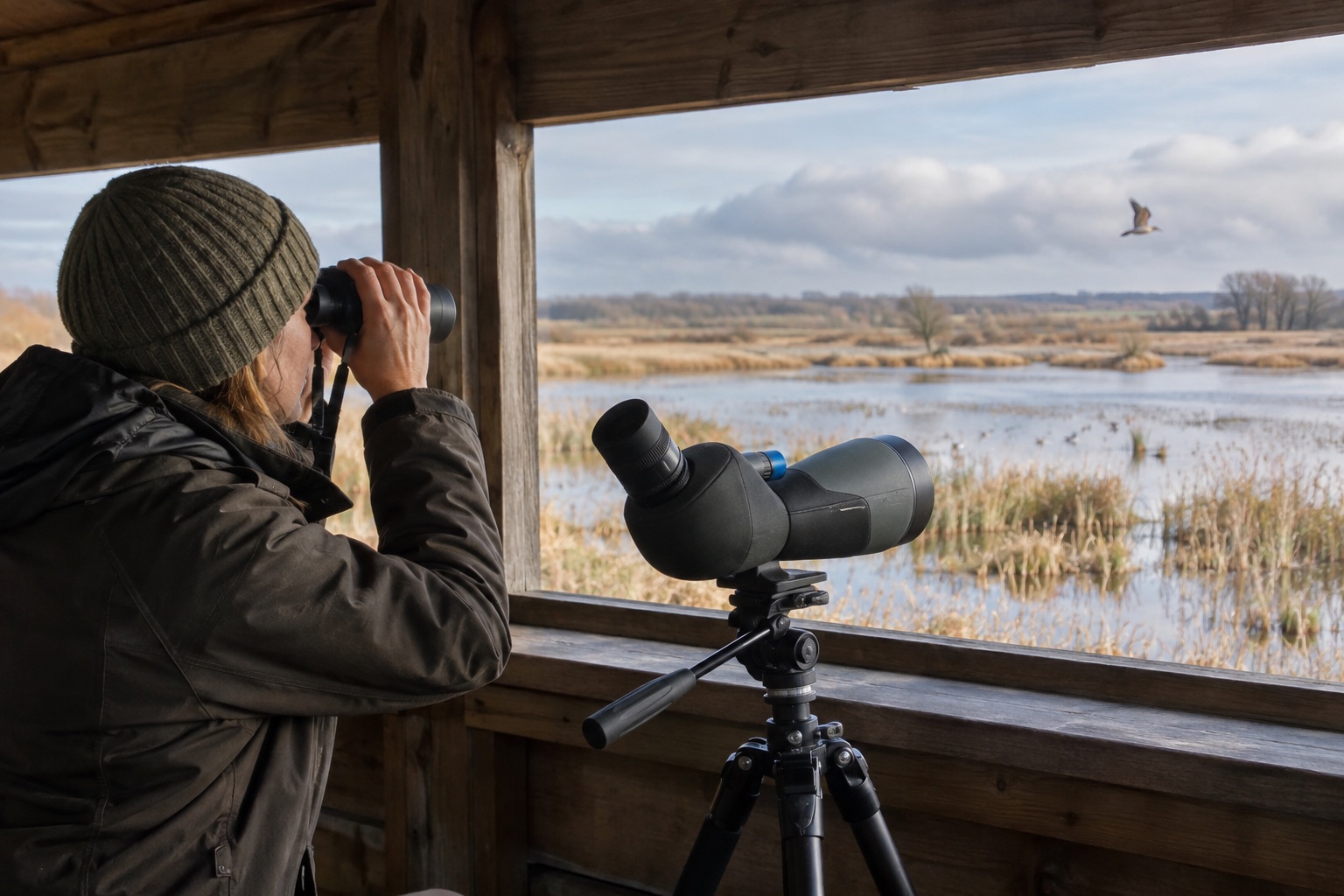
Binoculars give a broad, fast handheld view, commonly around 8–10×.
A scope offers substantially higher power but needs stable support.
Budget and carry weight must include tripod and head.
If you own neither, buy a comfortable binocular first. It lets you find a bird quickly, follow movement and keep observing while you walk. A spotting scope is the next tool when your ordinary subjects are far enough away that a steady 8× or 10× view does not resolve the detail you need.
Swipe to compare both formats →
| Question | Binoculars | Spotting scope |
|---|---|---|
| Typical use | Scan and follow | Study a located subject |
| Usual support | Handheld | Tripod and head |
| View | Broad, two-eye | Narrower, one-eye |
| Moving birds | Quick to acquire | Harder to track |
| Best job | Mobile everyday observation | Distant settled detail |
Why more magnification is not the whole answer
A Nikon P7 8×42 has a published 126m field at 1,000m and weighs 590g. It is plausible to carry ready for the whole walk. The Celestron TrailSeeker 65 offers a 16–48× zoom and weighs 1,361g before support. A compatible TrailSeeker tripod with its included pan head adds 1,790g: 3,151g together, before cases or any accessories, versus the binocular body's 590g. The scope's low-end field is also 45m at 1,000m rather than 126m, although those figures are at different powers. This is why the scope is a second-stage tool after locating a distant subject, not a replacement for scanning on the move. Its extra scale can reveal settled detail, but heat haze and support stability can erase the theoretical gain. An 80mm scope increases the carried mass again; our 65mm versus 80mm guide treats that separate choice.
The scope does not simply provide a better version of the binocular view. It is usually one-eye viewing, at a fixed position and with setup time. On a woodland path, a bird can move before the scope is aimed. At an estuary hide, the sequence works well: scan with binoculars, locate the group, then aim the scope at the particular bird.
Count the tripod as part of the purchase
A scope's foot must mate securely with a suitable plate and head. The tripod must reach your seated or standing eye position without wobbling at the magnification you intend to use. A kit that is technically below the tripod's load limit can still take too long to settle after each touch. See our complete tripod comparison. Carrying the combined scope, head and legs may be unrealistic on a long hill route even when the scope body sounds compact.
Choose by your normal day
Garden birds, woodland, walking and sport favour binoculars. Regular wetland, sea or reservoir identification from a hide favours adding a scope. If you are unsure, spend several outings noting how often the 8× view actually prevents an identification while the bird remains in sight long enough to set up. That is stronger evidence than buying high power on speculation. The birdwatching scope guide helps if that need is recurring.
Never aim either instrument at the Sun. Ordinary binoculars and scopes can cause immediate eye injury without properly designed solar protection.
Helpful products
A realistic two-part field kit
The Nikon P7 8×42 illustrates a handheld scanning pair. Celestron's TrailSeeker 65 illustrates a 16–48× scope body; it still needs a compatible stable tripod.

Nikon PROSTAFF P7 8x42
Best for: Wide viewing with glasses
A 590g all-round 8x42 with a wide 126m field, long stated eye relief and a locking dioptre ring that helps preserve a personal focus setting.
What stands out
- 126m field of view at 1,000m
- 20.2mm stated eye relief
- 590g waterproof body with locking dioptre
Keep in mind
- 3m close focus is useful rather than class-leading
- No ED glass in the published specification
- 8×42
- 590g
- 126m / 1,000m
- 20.2mm eye relief

Celestron TrailSeeker 16–48×65 angled spotting scope
Best for: Wetland hides and shared viewing
A 65mm angled field scope with dual-speed focus and a rotating tripod collar for deliberate wetland observation.
What stands out
- Dual coarse/fine focusing
- Rotating collar and 45° eyepiece
- Waterproof nitrogen-filled body
Keep in mind
- About 1.36kg before tripod
- High zoom still needs solid support and good light
- 16–48×65
- 1,361g
- 45–23m / 1,000m
- 18–15mm eye relief
Frequently asked questions
Binocular or scope questions
Can a spotting scope replace binoculars?
Usually not for moving subjects or walking observation. The scope's narrow, high-power view takes longer to aim and normally needs a tripod.
Do I need a scope for birdwatching?
No. Binoculars cover much woodland, garden and mixed-reserve birdwatching. A scope earns its place for regular distant wetlands, coastlines and prolonged identification work.
Can I handhold a spotting scope?
A small scope may offer a brief low-power view, but a stable support is normally needed to benefit from its higher magnification.
Should I buy a more powerful binocular instead?
A 12× or 15× binocular can bridge part of the gap, but shake and narrow field rise; large models may need a tripod too. Compare the whole setup.