
Birdwatching · Spotting scopes
Best spotting scopes for birdwatching
Choose a birdwatching spotting scope for wetlands, seawatching or long walks. Compare field width, 65mm and 80mm bodies, support and eye comfort.
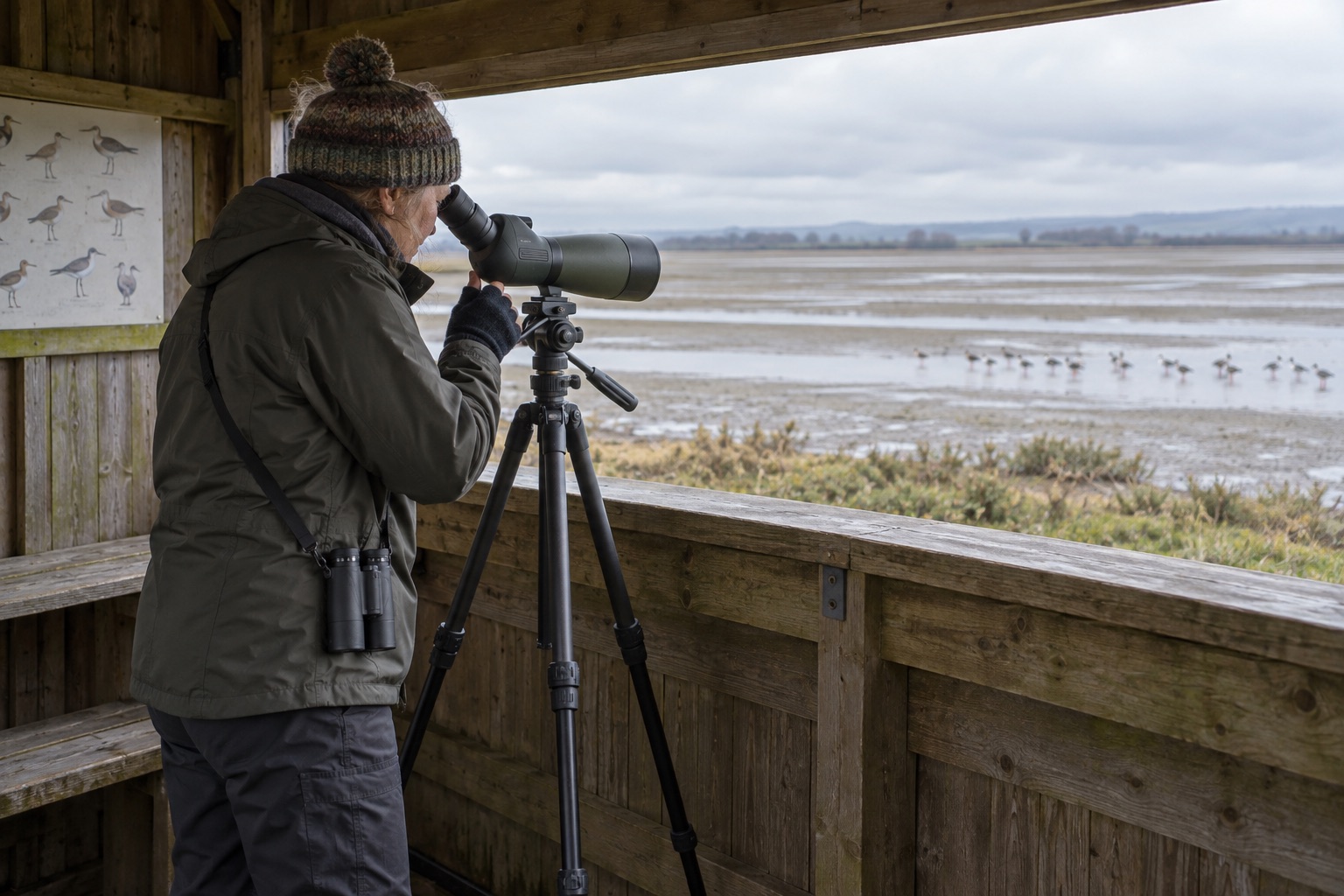
For moving birds, the low-zoom field is more useful than the maximum zoom number.
Glasses wearers should check the entire field at both ends of the eyepiece's zoom.
Add the tripod, head and case to the carrying weight before choosing.
Quick picks
Choose by the detail that matters most
Links open the matching Amazon UK listing. Prices and sellers can change, so confirm the model name and ASIN before buying.
Swipe to compare all details →
| Scope | Zoom | Objective | Published weight | Low-end field at 1km | Main use |
|---|---|---|---|---|---|
| TrailSeeker 65 | 16–48× | 65mm | 1,361g | 45m | Regular wetland hide |
| Regal M2 65ED | 16–48× | 65mm | 1,649g with zoom | 43m | ED-glass upgrade |
| TrailSeeker 80 | 20–60× | 80mm | 1,548g | 35m | Longer stationary sessions |
| Nature-Trek Compact | 9–27× | 56mm | About 575g | About 79m | Long walks |
The detailed shortlist
Birdwatching scopes with different jobs
These are exact UK Amazon listings and corresponding product images. Check the model, eyepiece and seller before ordering, and budget for a support separately.

Celestron TrailSeeker 16–48×65 angled spotting scope
Best for: Wetland hides and shared viewing
A 65mm angled field scope with dual-speed focus and a rotating tripod collar for deliberate wetland observation.
What stands out
- Dual coarse/fine focusing
- Rotating collar and 45° eyepiece
- Waterproof nitrogen-filled body
Keep in mind
- About 1.36kg before tripod
- High zoom still needs solid support and good light
- 16–48×65
- 1,361g
- 45–23m / 1,000m
- 18–15mm eye relief

Celestron Regal M2 16–48×65 ED angled spotting scope
Best for: High-contrast birds and glasses checks
A 65mm ED scope with a 20mm stated eye relief at 16× and interchangeable 1.25-inch eyepiece mount.
What stands out
- ED objective glass
- 20mm eye relief at 16×
- Dual-speed focus and 1.25-inch eyepiece compatibility
Keep in mind
- 1,649g with included zoom, before tripod
- Eye relief at other zoom settings needs an in-person check
- 16–48×65
- 1,649g with zoom
- 43–23m / 1,000m
- 20mm eye relief at 16×

Celestron TrailSeeker 20–60×80 angled spotting scope
Best for: Long sessions from a hide or viewpoint
An 80mm angled scope with a 20–60× eyepiece, dual-speed focus and rotating tripod collar for longer stationary views.
What stands out
- 80mm objective and dual-speed focusing
- 20× starting power with 35m field at 1,000m
- Waterproof nitrogen-filled body
Keep in mind
- 1,548g before tripod and head
- At 60×, atmosphere and support can limit usable detail
- 20–60×80
- 1,548g
- 35–17m / 1,000m
- 18–15mm eye relief

Hawke Nature-Trek Compact 9–27×56 spotting scope
Best for: Long walks and travel
A roughly 575g, short 56mm angled scope for daypacks and lower-zoom viewing from a compact support.
What stands out
- About 575g scope weight
- 9× low end helps locate birds
- 20mm published eye relief
Keep in mind
- Smaller 56mm objective limits higher-zoom dusk use
- A monopod or tripod remains useful at 27×
- 9–27×56
- About 575g
- 20mm eye relief
- Compact angled body
Birdwatching gives a spotting scope a clear purpose: resolving a distant bird that binoculars have already found. At a mudflat or reservoir, the extra reach can reveal shape, plumage and behaviour without asking you to get closer. The useful purchase is not simply the scope with the largest front lens. It is the scope, eyepiece and support that you will actually carry to the places where you watch birds.
A 65mm scope is the sensible centre of the range
The Celestron TrailSeeker 16–48×65 has a 45m field at 1,000m at its lowest setting. That relatively forgiving starting view helps you transfer from binoculars to a wader on open mud. Dual-speed focusing is valuable when you first locate a bird and then want to refine a small detail. It weighs 1,361g before a tripod. This is for a short walk to a hide, not a pocket option.
The Regal M2 16–48×65 ED is a different 65mm choice rather than an automatic winner. Its ED objectives may reduce distracting colour fringing around a dark bird against bright water, and its standard 1.25-inch eyepiece mount opens up compatible alternatives. Celestron lists 1,337g without the eyepiece but 1,649g with the included zoom; use the latter when planning a birdwatching kit. The published 20mm eye relief refers to the 16× setting; if you wear glasses, do not assume the same comfort at 48×. Read spotting-scope eye relief explained before paying for an eyepiece you have not tried.
When 80mm earns its place
The TrailSeeker 20–60×80 adds 15mm of objective diameter but also a larger body, at 1,548g. That is not a dramatic weight difference on paper, yet the assembled system can require a sturdier tripod and more pack space. Its 35m low-end field is narrower than the 65mm TrailSeeker's 45m, partly because it starts at 20× rather than 16×. For a patient seawatch or dull winter estuary session, the additional aperture may be welcome; for finding fast-moving birds, the narrower starting view is a cost. Our 65mm versus 80mm guide works through the full trade-off.
The Hawke Nature-Trek Compact 9–27×56 solves a different problem. At about 575g, it is a plausible addition to a walking bag, and its 9× low end is easy to aim. Do not mistake its size for the same high-power, low-light role as an 80mm scope. At 27× it still needs a stable support. Choose it when a long walk, train journey or steep viewpoint matters more than prolonged high-zoom viewing.
Set the system up for birds, not a specification sheet
Start with a bird found through binoculars, remember a fixed landmark, then aim the scope at its lowest power. Centre the subject before zooming. If the bird becomes larger but loses definition, turn back down; heat haze and vibration cannot be cured by more power. A smooth tripod head helps follow a bird crossing a mudflat without a jolt. Check the tripod's comfortable column-down height and make sure the mounting plate is secure.
For a first scope, our beginner guide starts with the whole-kit budget. If most birds are nearby and moving through trees, a good birdwatching binocular may be the more rewarding upgrade. Never point a spotting scope at or near the Sun, and keep enough distance that your observation does not disturb feeding or nesting birds.
Frequently asked questions
Birdwatching scope questions
What scope size is best for birdwatching?
For many UK reserve visits, a 65mm body is a useful compromise. A 56mm scope travels more easily; 80mm is more useful when you stop for long periods in dull light and can carry a steadier support.
Do I still need binoculars with a spotting scope?
Usually. Binoculars find and follow birds quickly with both eyes. A scope is better for sustained inspection of a distant bird once you know where it is.
Is 60× always better than 48× for birds?
No. Higher zoom narrows the view and reduces exit pupil. Shimmering air, poor light or vibration may hide detail that is clearer at a lower setting.
Which body style works in a shared bird hide?
An angled eyepiece and rotating collar often make sharing easier across different heights, but a straight scope may be quicker for some people to aim. Try your usual viewing position.