
Field conditions · Troubleshooting
Heat haze through a spotting scope
Learn why distant birds shimmer through a spotting scope, how to distinguish heat haze from focus or tripod shake, and what field changes help.
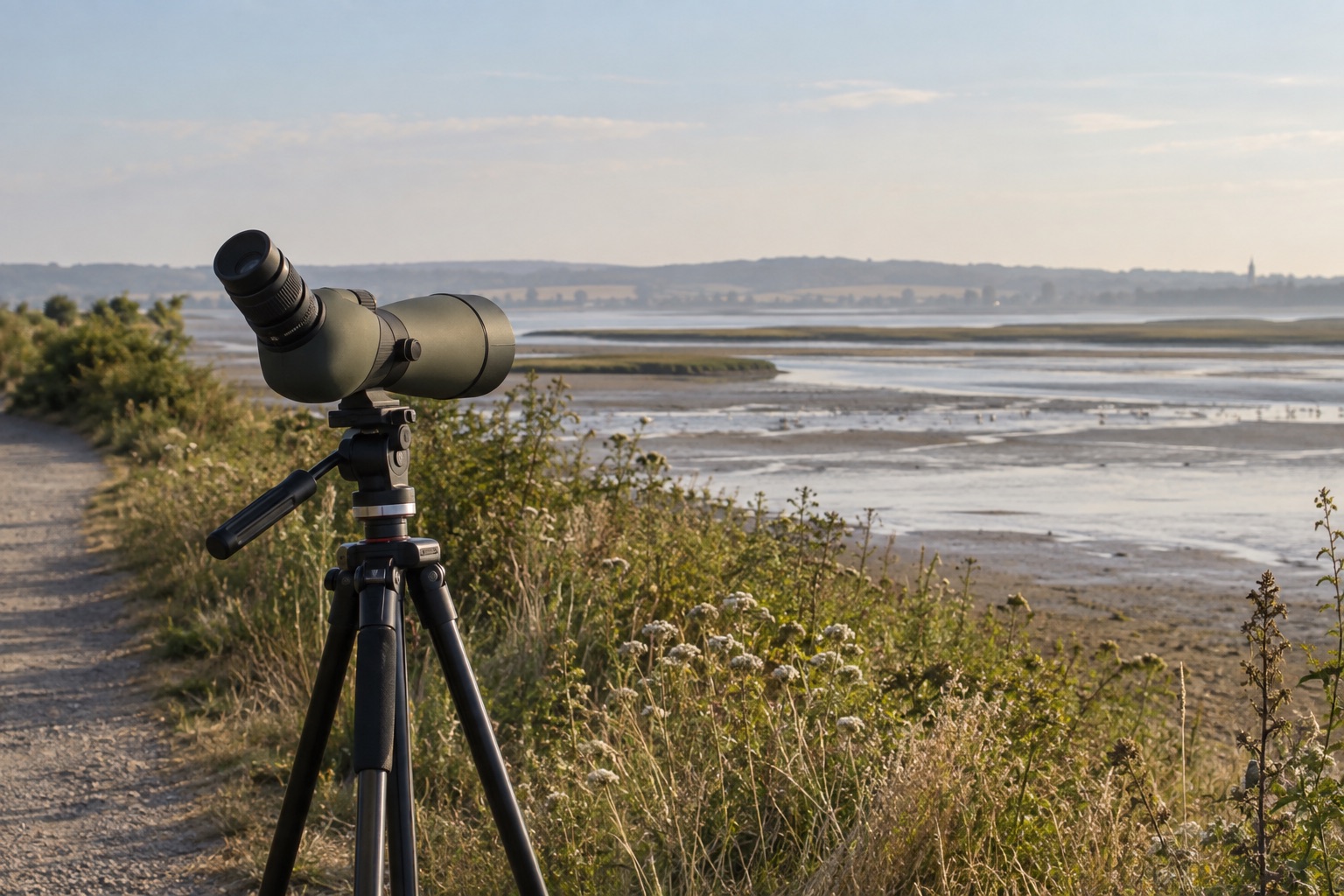
Watch for moving ripples affecting distant objects but not nearby ones.
Compare a lower magnification before assuming the focus wheel is faulty.
Keep the scope away from warm roofs, tarmac or vehicle exhaust.
You may focus carefully on a distant wader, only to see its outline ripple as though it were underwater. If nearby reeds look steady while the far shore continuously shifts, the problem may be the air between you and the bird rather than the scope. Spotting scopes make atmospheric shimmer conspicuous because they magnify it along with the subject.
What you are seeing
Air at different temperatures has different optical density. When those layers mix along a long sightline, light bends by changing amounts and fine detail appears to dance or smear. Sun-warmed mud, sand, tarmac or a roof can create a particularly turbulent route. A low line of sight across a shoreline can pass through a large amount of unsettled air. The effect is sometimes called heat shimmer or poor seeing. It is not limited to a hot summer afternoon: any sufficient temperature gradient may matter.
Separate haze from an equipment problem
First look at a fixed, nearer object through the same setup. If it remains crisp while distant objects waver, atmosphere is a strong suspect. If the whole view jumps in time with wind gusts, footsteps or your touch on the focus wheel, check the tripod and head. If everything remains uniformly soft and still, refocus, check the eyepiece is seated and clean accessible external glass only by the maker's safe method. Do not open a sealed scope. A heat-haze pattern changes from moment to moment; a focus error normally does not.
Work with the conditions
Lower magnification first. A bird at 30× may show more identifiable structure than a bigger but boiling image at 60×. Move a little if a warm wall, parked vehicle or sunlit path sits directly below your sightline. Try a higher, shaded or shorter view across the habitat where permitted. Early or later viewing may bring steadier air, but watch the scene rather than assuming a particular hour will always be best. Never move closer if it would disturb wildlife or leave a permitted path.
An 80mm scope and ED glass can improve aspects of the optical system, but neither can reconstruct detail distorted before light reaches the objective. This is why our 65mm versus 80mm guide treats aperture as one factor, and why scope magnification is about useful detail rather than the highest printed power. For a phone photo, settle the scope and wait for a brief clearer moment; digital zoom will only enlarge the shimmer.
Frequently asked questions
Heat-haze questions
Why does a bird look wavy through my scope?
If the whole distant scene seems to ripple or boil, light may be passing through moving layers of different-temperature air. Focus and tripod shake can also blur a view, so compare a nearby fixed object and lower magnification.
Does heat haze only happen on hot days?
No. Strong temperature differences near the ground or water can create distortion in cooler weather too, especially across long sightlines.
Will an 80mm ED scope eliminate heat haze?
No. Better optics may improve the instrument's own image quality, but cannot reverse atmospheric distortion between you and the subject.
Should I turn up magnification to see through it?
Usually not. Higher power enlarges the moving distortion. Try lower zoom, a different position, a shorter sightline or steadier air.