
Format comparison · Objective size
65mm vs 80mm spotting scopes
Compare the real light, zoom, field, weight and tripod trade-offs between 65mm and 80mm spotting scopes for UK birdwatching.
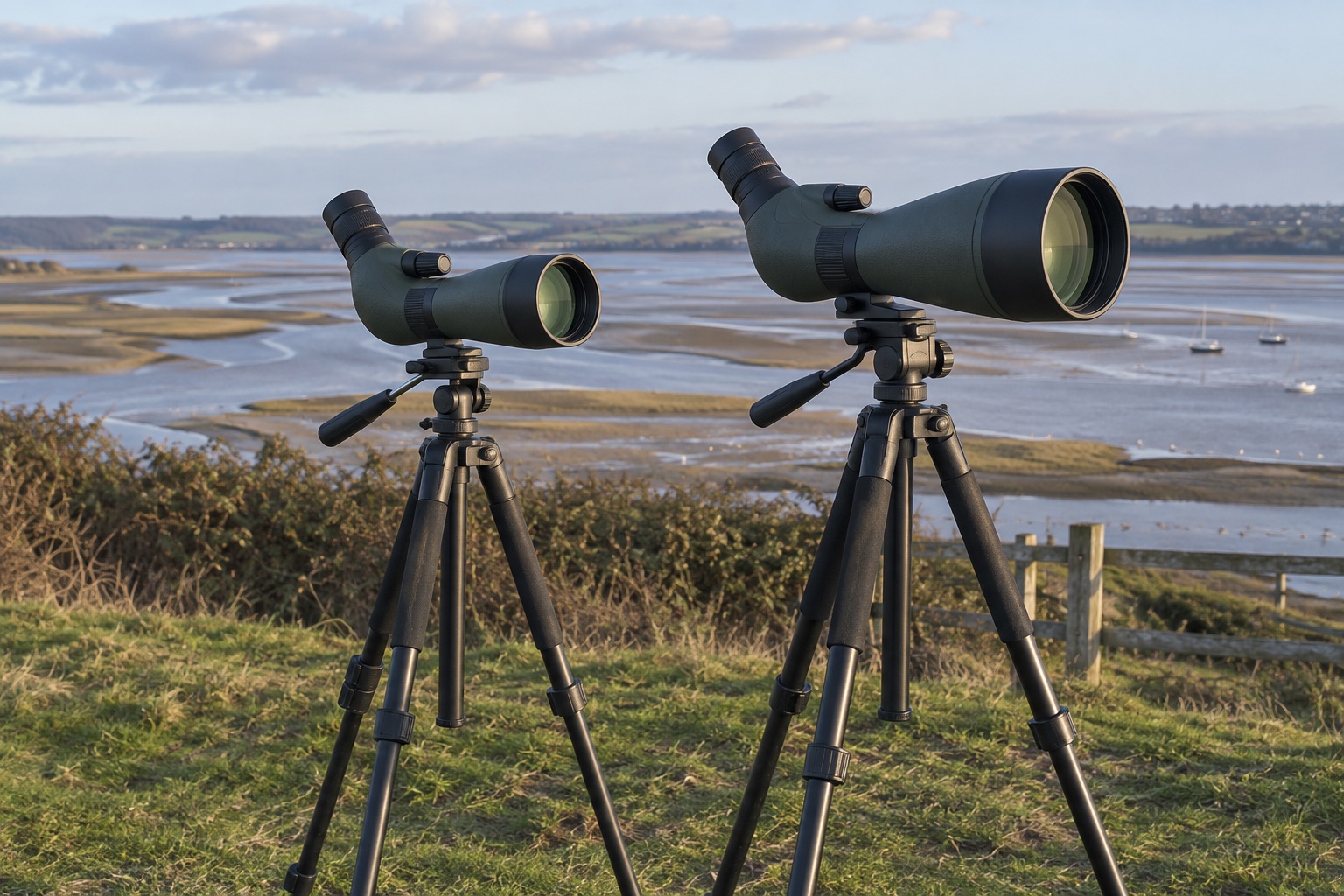
Compare complete kits, not only bare scope weights.
At equal power, 80mm gives a larger exit pupil; at unequal power, compare again.
A wider low-end field may matter more than aperture for finding moving birds.
The number in a 65mm or 80mm spotting scope is the diameter of its front objective lens. Larger glass can gather more light and support finer detail in good conditions. It also increases the size of the instrument you must carry and stabilise. For birdwatching, that is the real decision: how much benefit will you see in the light and locations you actually use?
A matched scope pair shows the complete trade-off
The Celestron TrailSeeker 16–48×65 and 20–60×80 are angled bodies in one range. Celestron publishes these figures for the supplied zoom configurations:
Swipe to compare the two scopes →
| Specification | 65mm | 80mm |
|---|---|---|
| Included zoom | 16–48× | 20–60× |
| Field at lowest power, 1km | 45m at 16× | 35m at 20× |
| Body weight | 1,361g | 1,548g |
| Body length | 417mm | 505mm |
| Close focus | 5.5m | 7.5m |
The 80mm body is 187g heavier and 88mm longer. Its lowest-power field is 10m narrower at 1,000m, but its zoom also starts at 20× rather than 16×. The field difference cannot fairly be credited to aperture alone. Equally, the 80mm model reaches 60× rather than 48×; that is an option for suitable conditions, not evidence that 60× will reveal more detail through heat haze.
The light difference is real, but not a brightness guarantee
Light-collecting area rises with the square of objective diameter. On that calculation, an 80mm lens has roughly 51% more area than a 65mm lens. At the same magnification, the larger scope also produces a larger exit pupil: at 40×, about 2.0mm for 80mm against about 1.6mm for 65mm. The difference can make sustained viewing more forgiving in dull conditions.
Yet complete scopes do not differ only in diameter. The TrailSeeker 65 starts at 16× and the TrailSeeker 80 at 20×. At those low settings both have an approximately 4mm exit pupil, while the 65mm model's published field is 45m at 1,000m versus 35m for the 80mm. The smaller one may therefore be easier for finding a moving bird. Higher power then narrows the view and reduces exit pupil on both.
Think about the whole carried system
The two TrailSeeker bodies illustrate the scale: 1,361g for 65mm and 1,548g for 80mm in the manufacturer figures. The difference is 187g before cases, but the larger body takes more bag room and may make an inadequate tripod more obvious. A full-height tripod and smooth head are not optional at 48× or 60×. Try the assembled kit at the height you use, with the centre column mostly down. A low tripod can be suitable from a hide shelf but frustrating on open ground.
For a short walk from car to wetland hide, 80mm can be a good choice if you often watch into a dim winter afternoon. For several miles of mixed walking and occasional stops, a 65mm body is more likely to come along. If even that feels too much, see the compact-scope guide rather than buying an 80mm body that remains indoors.
Do not let atmosphere decide your budget for you
Over a sun-warmed beach or reservoir, distant detail can appear to ripple. At that point, extra aperture and 60× cannot recover information blurred by the air itself. Lowering the zoom and changing your viewing time or position often helps more. Our heat-haze guide explains the signs.
Choose 65mm for mobility, finding birds and a more manageable support. Choose 80mm if you have a specific long-distance, stationary use and are comfortable carrying the larger complete setup. If you are still deciding whether a scope belongs in your kit, begin with the birdwatching scope shortlist rather than treating objective diameter as the whole purchase.
Helpful products
Two sizes in the same scope family
The TrailSeeker 65 and 80 show the aperture choice in a broadly comparable range; their included zooms also start at different powers, so the views are not identical except for size.

Celestron TrailSeeker 16–48×65 angled spotting scope
Best for: Wetland hides and shared viewing
A 65mm angled field scope with dual-speed focus and a rotating tripod collar for deliberate wetland observation.
What stands out
- Dual coarse/fine focusing
- Rotating collar and 45° eyepiece
- Waterproof nitrogen-filled body
Keep in mind
- About 1.36kg before tripod
- High zoom still needs solid support and good light
- 16–48×65
- 1,361g
- 45–23m / 1,000m
- 18–15mm eye relief

Celestron TrailSeeker 20–60×80 angled spotting scope
Best for: Long sessions from a hide or viewpoint
An 80mm angled scope with a 20–60× eyepiece, dual-speed focus and rotating tripod collar for longer stationary views.
What stands out
- 80mm objective and dual-speed focusing
- 20× starting power with 35m field at 1,000m
- Waterproof nitrogen-filled body
Keep in mind
- 1,548g before tripod and head
- At 60×, atmosphere and support can limit usable detail
- 20–60×80
- 1,548g
- 35–17m / 1,000m
- 18–15mm eye relief
Frequently asked questions
Scope-size questions
How much more light does an 80mm scope gather than a 65mm?
By objective area, about 51% more: (80 ÷ 65) squared is roughly 1.51. Perceived brightness still depends on magnification, transmission, the observer and conditions.
Is 65mm enough for seawatching?
Yes in many daylight conditions with a steady tripod and useful field. An 80mm body can be more comfortable in dull light if you have a sheltered position and will remain there for a while.
Does an 80mm scope always resolve more detail?
It has more aperture potential, but heat haze, wind shake, focus quality and optical design may set the real limit before objective size does.
Which size is better for a long walk?
A 65mm scope is normally easier to carry. Add the tripod, head and case to both choices and consider whether you would actually take the larger kit on your usual route.