
Walking kit · Compact scopes
Best compact spotting scopes
Learn when a small spotting scope is worth carrying, compare a genuine 56mm compact with 65mm alternatives, and avoid tripod and low-light surprises.
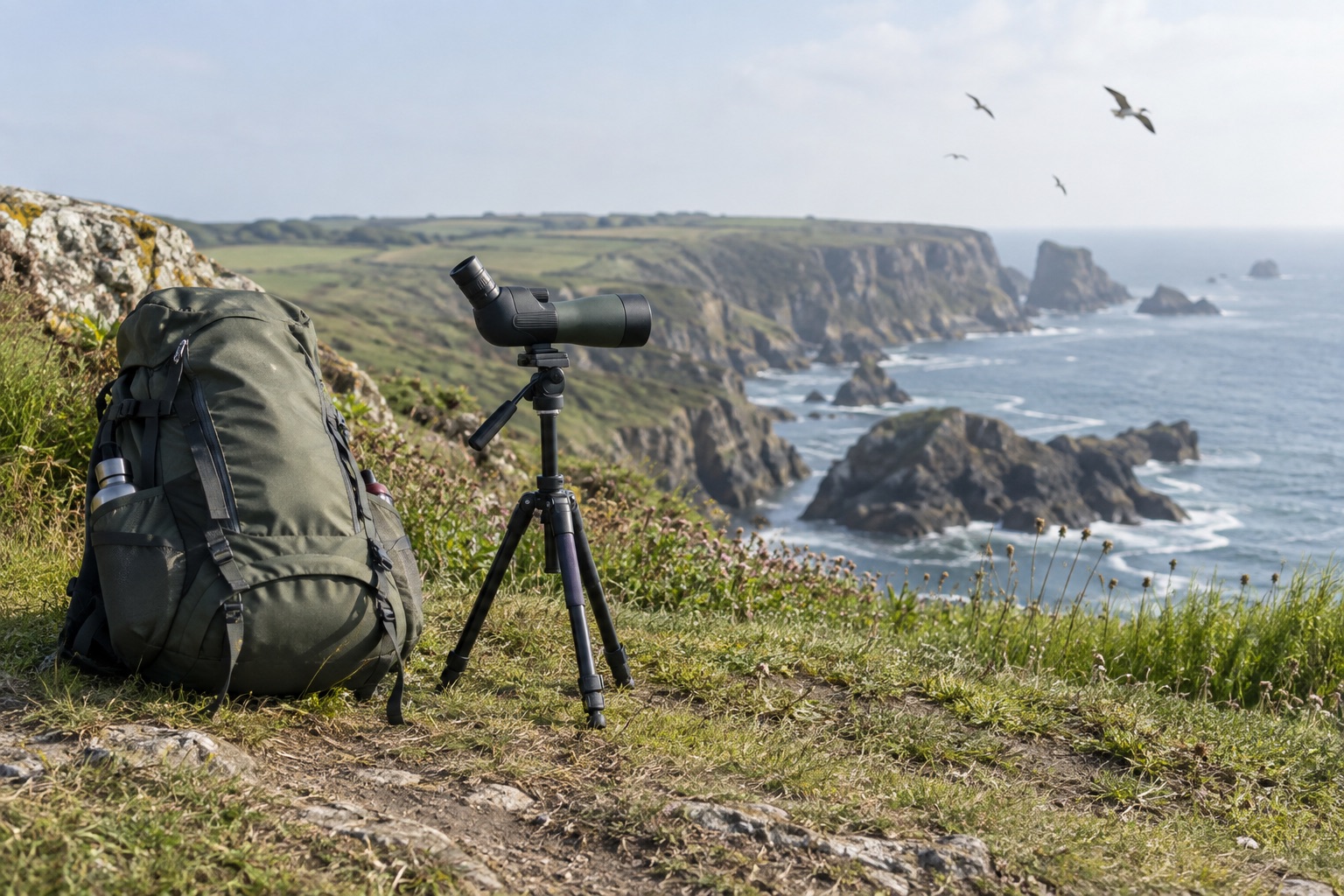
A 56mm body can make a daypack; a full-size tripod may still not.
Low zoom is useful for finding birds and keeps the image brighter.
Do not mistake a short body for a handholdable 27× view.
Quick picks
Choose by the detail that matters most
Links open the matching Amazon UK listing. Prices and sellers can change, so confirm the model name and ASIN before buying.
Swipe to compare all details →
| Scope | Objective | Zoom | Scope weight | Intended role |
|---|---|---|---|---|
| Nature-Trek Compact | 56mm | 9–27× | About 575g | Walk-first scope |
| Ultima 65 | 65mm | 18–55× | 1,049g | Accessible hide scope |
| TrailSeeker 65 | 65mm | 16–48× | 1,361g | Regular stationary use |
The detailed shortlist
Packable versus full-size alternatives
These Amazon UK cards show exact product variants; the larger scopes are included as reference points, not relabelled as compact products.

Hawke Nature-Trek Compact 9–27×56 spotting scope
Best for: Long walks and travel
A roughly 575g, short 56mm angled scope for daypacks and lower-zoom viewing from a compact support.
What stands out
- About 575g scope weight
- 9× low end helps locate birds
- 20mm published eye relief
Keep in mind
- Smaller 56mm objective limits higher-zoom dusk use
- A monopod or tripod remains useful at 27×
- 9–27×56
- About 575g
- 20mm eye relief
- Compact angled body

Celestron Ultima 18–55×65 angled spotting scope
Best for: A first fixed-position scope
A conventional 65mm angled scope and a simpler starting point for fixed-position birdwatching.
What stands out
- 65mm objective for overcast-day viewing
- Waterproof nitrogen-filled construction
- Viewing case included
Keep in mind
- Narrower 27–11.6m published field than the TrailSeeker
- 55× does not guarantee useful detail in poor seeing
- 18–55×65
- 1,049g
- 27–11.6m / 1,000m
- 18mm eye relief

Celestron TrailSeeker 16–48×65 angled spotting scope
Best for: Wetland hides and shared viewing
A 65mm angled field scope with dual-speed focus and a rotating tripod collar for deliberate wetland observation.
What stands out
- Dual coarse/fine focusing
- Rotating collar and 45° eyepiece
- Waterproof nitrogen-filled body
Keep in mind
- About 1.36kg before tripod
- High zoom still needs solid support and good light
- 16–48×65
- 1,361g
- 45–23m / 1,000m
- 18–15mm eye relief
Compact scopes make sense when the main obstacle to observation is carrying the scope at all. They are useful for a long coastal path, a rail trip to a reserve or a short climb to a viewpoint. But “compact” is easily stretched into a marketing label. A 65mm scope above a kilogram can be compact next to an 80mm instrument and still feel bulky beside a 575g model.
Hawke Nature-Trek Compact 9–27×56: the walking-first choice
The 9× low end makes it easier to locate a subject than starting at 18×. The roughly 575g body and short length are plausible daypack equipment. Published 20mm eye relief is encouraging for glasses wearers, but eye fit still needs checking at 27×. The 56mm objective gathers less light than a 65mm scope: at 27× the theoretical exit pupil is about 2.1mm, and overcast late-afternoon viewing can become tiring.
The biggest trap is imagining the lower body weight removes the support requirement. The scope may be light enough to lift, but at 27× hand movement still dominates the view. A small stable tripod can work if it reaches a comfortable height; a flimsy tabletop stand in open ground cannot. On a hide shelf, a beanbag or short support may be enough if the surface is solid and the eyepiece sits naturally. Do not balance an expensive scope on a rail over water.
When the full-size alternative is better
The Celestron Ultima 65 is about 1,049g and the TrailSeeker 65 about 1,361g, both before support. That is a substantial pack penalty. In a hide reached by a short walk, however, the larger objective and higher zoom range may be worth it. The TrailSeeker's 45m low-end field at 1,000m is also much more accommodating than the Ultima's 27m, despite the latter being lighter. Compare the full spotting-scope shortlist rather than choosing only by grams.
A carry test before checkout
Lay out the scope, tripod, head, binoculars, layers and water you normally bring. Can the scope and support be retrieved without unpacking everything? Can you set it up where your birds actually appear? If the answer is no, a lightweight binocular may be the more useful item for that outing.
For seawatching in wind, a compact optic on a very light tripod may show less than a larger, steadier setup from a sheltered site. For quick flight tracking, binoculars still win. For a distant stationary wader in daylight, a small scope on proper support can extend your reach without dominating the whole day. Choose angled or straight according to setup position, not an assumption that one is always more compact. Never look toward the Sun through any spotting scope.
Carry the complete kit once before buying
Put the body, support, head, case, eyepiece and any phone mount on a scale together if you can. Then plan where the tripod rides on your pack and whether you can open it without blocking a path. A 575g body can still be a poor walking purchase if its required support is awkward. Conversely, a heavier 65mm scope may be the right choice when you set up once at a hide and stay for an hour. Your real travel and stopping pattern determines which meaning of “compact” is useful.
At checkout, confirm whether the exact listing includes the eyepiece and protective cover you expect. Ask how the foot connects to your tripod plate, and test whether the case allows you to reach focus and zoom controls. If glasses matter, check the field at both ends of the zoom range. If the main use is a bird already located through binoculars, higher power may be worth the extra mass; if the subject appears suddenly and moves, the low-power field and fast setup deserve more weight than the maximum zoom number.
Frequently asked questions
Compact-scope questions
Can I handhold a compact spotting scope?
Briefly at 9×, perhaps, but expect shake at 20–27×. A stable tripod, monopod or solid hide shelf normally reveals more detail.
Is 56mm enough for birdwatching?
Yes for many daytime walks, especially at the lower half of the zoom. It is less forgiving at dusk or under dense cloud than a larger objective.
Will a compact scope replace binoculars?
Usually not. Binoculars are quicker to raise, easier to track with and more restful for scanning. A compact scope is for pausing over a distant subject.
How much does the whole kit weigh?
More than the listed scope weight: add the tripod or monopod, head, case and any phone adapter. Weigh the assembled kit before deciding it is a walking setup.