
Field guide · Spotting scopes
Best spotting scopes UK
Compare four UK-available spotting scopes by usable zoom, field of view, carry weight, eye relief and tripod needs—not magnification alone.
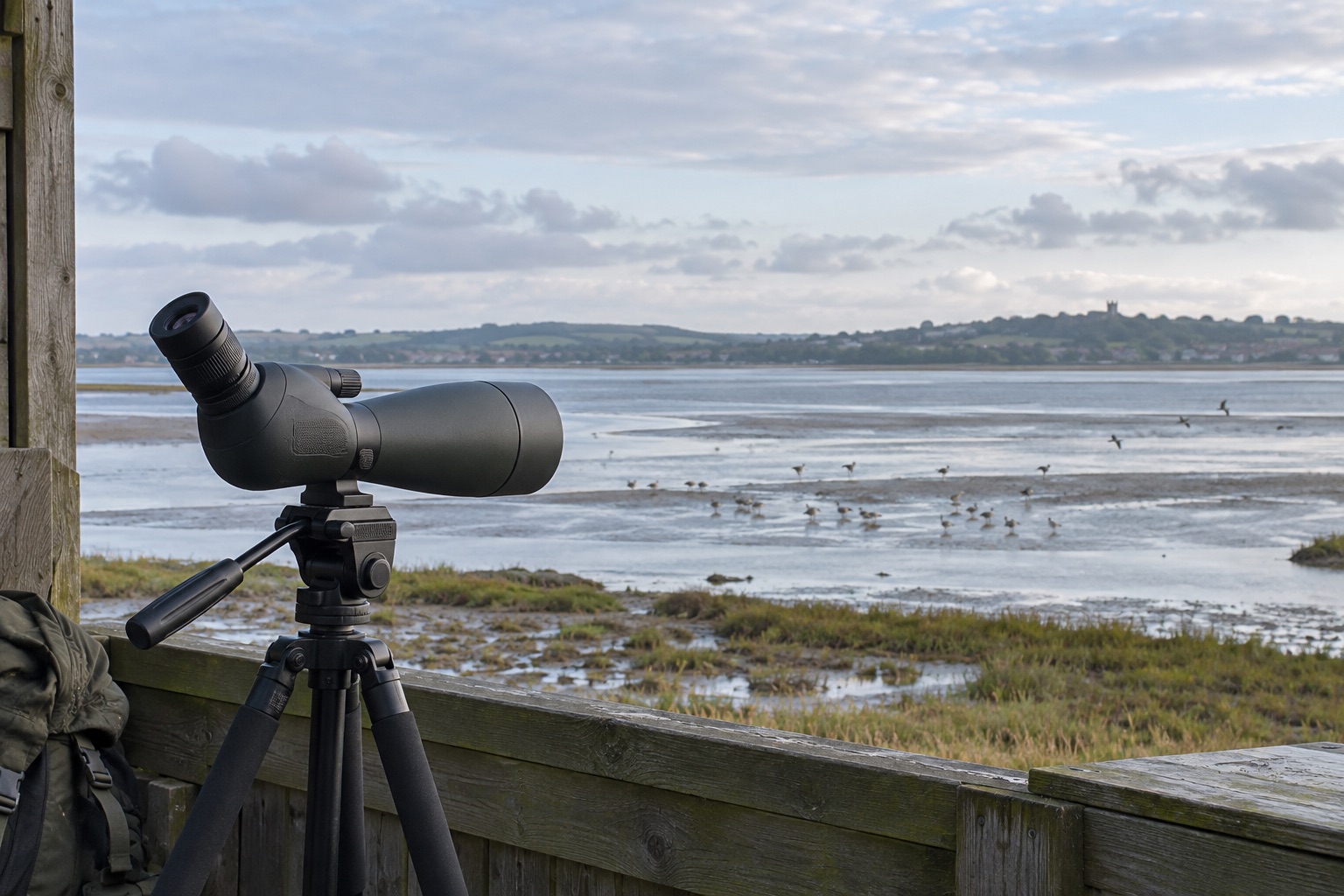
Compare the scope and tripod as one carrying system.
Start at the low end of the zoom to find a bird, then increase only while detail improves.
A published field, eye relief and weight tell you more than the maximum zoom number.
Quick picks
Choose by the detail that matters most
Links open the matching Amazon UK listing. Prices and sellers can change, so confirm the model name and ASIN before buying.
Swipe to compare all details →
| Scope | Zoom | Objective | Published weight | Low-end field at 1km | Best use |
|---|---|---|---|---|---|
| TrailSeeker 65 | 16–48× | 65mm | 1,361g | 45m | Regular hide use |
| Regal M2 65ED | 16–48× | 65mm | 1,649g with zoom | 43m | ED-glass upgrade |
| Ultima 65 | 18–55× | 65mm | 1,049g | 27m | First stationary scope |
| Nature-Trek Compact | 9–27× | 56mm | About 575g | About 79m | Long walks |
The detailed shortlist
Four scopes with different strengths
Compare field, glass, weight and setup cost; check the model code, included eyepiece and seller before ordering. Budget for a suitable tripod separately.

Celestron TrailSeeker 16–48×65 angled spotting scope
Best for: Wetland hides and shared viewing
A 65mm angled field scope with dual-speed focus and a rotating tripod collar for deliberate wetland observation.
What stands out
- Dual coarse/fine focusing
- Rotating collar and 45° eyepiece
- Waterproof nitrogen-filled body
Keep in mind
- About 1.36kg before tripod
- High zoom still needs solid support and good light
- 16–48×65
- 1,361g
- 45–23m / 1,000m
- 18–15mm eye relief

Celestron Regal M2 16–48×65 ED angled spotting scope
Best for: High-contrast birds and glasses checks
A 65mm ED scope with a 20mm stated eye relief at 16× and interchangeable 1.25-inch eyepiece mount.
What stands out
- ED objective glass
- 20mm eye relief at 16×
- Dual-speed focus and 1.25-inch eyepiece compatibility
Keep in mind
- 1,649g with included zoom, before tripod
- Eye relief at other zoom settings needs an in-person check
- 16–48×65
- 1,649g with zoom
- 43–23m / 1,000m
- 20mm eye relief at 16×

Celestron Ultima 18–55×65 angled spotting scope
Best for: A first fixed-position scope
A conventional 65mm angled scope and a simpler starting point for fixed-position birdwatching.
What stands out
- 65mm objective for overcast-day viewing
- Waterproof nitrogen-filled construction
- Viewing case included
Keep in mind
- Narrower 27–11.6m published field than the TrailSeeker
- 55× does not guarantee useful detail in poor seeing
- 18–55×65
- 1,049g
- 27–11.6m / 1,000m
- 18mm eye relief

Hawke Nature-Trek Compact 9–27×56 spotting scope
Best for: Long walks and travel
A roughly 575g, short 56mm angled scope for daypacks and lower-zoom viewing from a compact support.
What stands out
- About 575g scope weight
- 9× low end helps locate birds
- 20mm published eye relief
Keep in mind
- Smaller 56mm objective limits higher-zoom dusk use
- A monopod or tripod remains useful at 27×
- 9–27×56
- About 575g
- 20mm eye relief
- Compact angled body
A spotting scope earns its space when binoculars show you where a distant bird is but cannot reveal enough detail to identify it. On a UK estuary, a reservoir or a distant seabird watch, the scope's extra magnification is genuinely useful. On a short woodland walk, it may be an awkward extra kilo plus tripod. The choices below weigh published specifications against those different uses.
The four choices, and the trade-off each makes
Celestron TrailSeeker 16–48×65: regular hide use
Its 45m published field at 1,000m on 16× is a friendlier starting view than the Ultima's 27m on 18×. That matters when a bird is moving across mudflats. Coarse and fine focus controls help move quickly from one distance to another, then refine feather detail without overshooting. The angled eyepiece and rotating collar make shared use easier when viewers differ in height. At 1,361g, it is a destination scope rather than a casual addition to a light walk.
Celestron Regal M2 65ED: a considered step up
The Regal M2 adds ED objectives, a 43m low-end field and a standard 1.25-inch eyepiece mount. ED glass can help control colour fringing around a dark wader against bright water; it does not guarantee that every view will look better to every observer. The published 20mm eye relief is specifically at 16×, so glasses wearers should check comfort at the zoom they actually expect to use. This is the flexible choice for someone already sure a full-size scope will be used often.
Check the weight basis before treating this as a light ED alternative. Celestron gives the Regal M2 65ED as 1,337g without its eyepiece and 1,649g with the included zoom. The 312g difference is equipment you need for the stated 16–48× view. A scope-body-only figure would understate what you carry to a hide. Its 43m low-end field is only 2m less than the TrailSeeker 65's 45m at the same 16×, so the ED feature and eyepiece flexibility—not a dramatically wider starting view—are the reasons to consider it.
Celestron Ultima 18–55×65: a simpler first scope
The Ultima is lighter than the two 65mm models above at 1,049g and includes a viewing case. It reaches a generous headline 55×, but its narrower 27m low-end field makes locating a small bird less forgiving. Begin at 18× and use binoculars to locate the subject first. The 18mm stated eye relief warrants a real glasses check. This is a sensible entry point for a fixed hide; it is not automatically the best choice for following flight.
Hawke Nature-Trek Compact 9–27×56: the carried scope
At about 575g, the Hawke is the choice that might actually make it into a walking bag. Its 9× low end helps locate a bird before moving up to 27×. The smaller 56mm objective gives less light-gathering area than 65mm, especially when zoomed in. It does not abolish the need for support: a small tripod or monopod remains useful at 27×. Read the compact scope guide before treating packability as the only criterion.
Budget for the tripod and the conditions
A flimsy tripod can make an excellent scope frustrating. Test a comfortable eyepiece height without extending the centre column too far, and check that the head starts and stops without jerking. For wind-exposed seawatching, stability may matter more than saving a few hundred grams. If you usually share a scope between adults and children, an angled body can reduce repeated tripod-height changes.
Do not choose by maximum zoom alone. At 48× on a 65mm objective the exit pupil is only about 1.35mm; at 16× it is about 4.1mm. The high setting can be dim and sensitive to poor atmospheric conditions. If the bird becomes larger but less clear, zoom back. Never point any scope at or near the Sun.
For a first purchase, continue with best spotting scopes for beginners. If the scope would mainly duplicate binoculars on local walks, how to choose binoculars may solve the problem with less kit.
For reserve use, see the birdwatching-specific scope choice. If you already have a body, our complete tripod guide and eye-relief check help finish the setup.
Frequently asked questions
Spotting-scope buying questions
Do I need a tripod for a spotting scope?
Usually, yes. At 16–48× even small movement obscures detail. A steady full-height tripod and a head that pans smoothly are part of the useful system, not optional decoration.
Is a 65mm scope enough for birdwatching?
A 65mm scope is a sensible carry-and-light compromise for daytime and overcast birdwatching. An 80mm objective can help in dull light, but it also increases the support and pack burden.
Does a 55× scope show more detail than a 48× scope?
Not automatically. Heat haze, light, optical quality and tripod shake often limit useful detail well before the zoom reaches its maximum.
Are these scopes suitable for glasses wearers?
Check usable eye relief across the zoom range, not just at the low setting. Try the eyecup with your own glasses and confirm you can see the complete field.