
Scope basics · Body shape
Angled vs straight spotting scopes
Compare angled and straight spotting scopes for aiming, tripod height, shared viewing, hides, shorelines and glasses before choosing a body style.
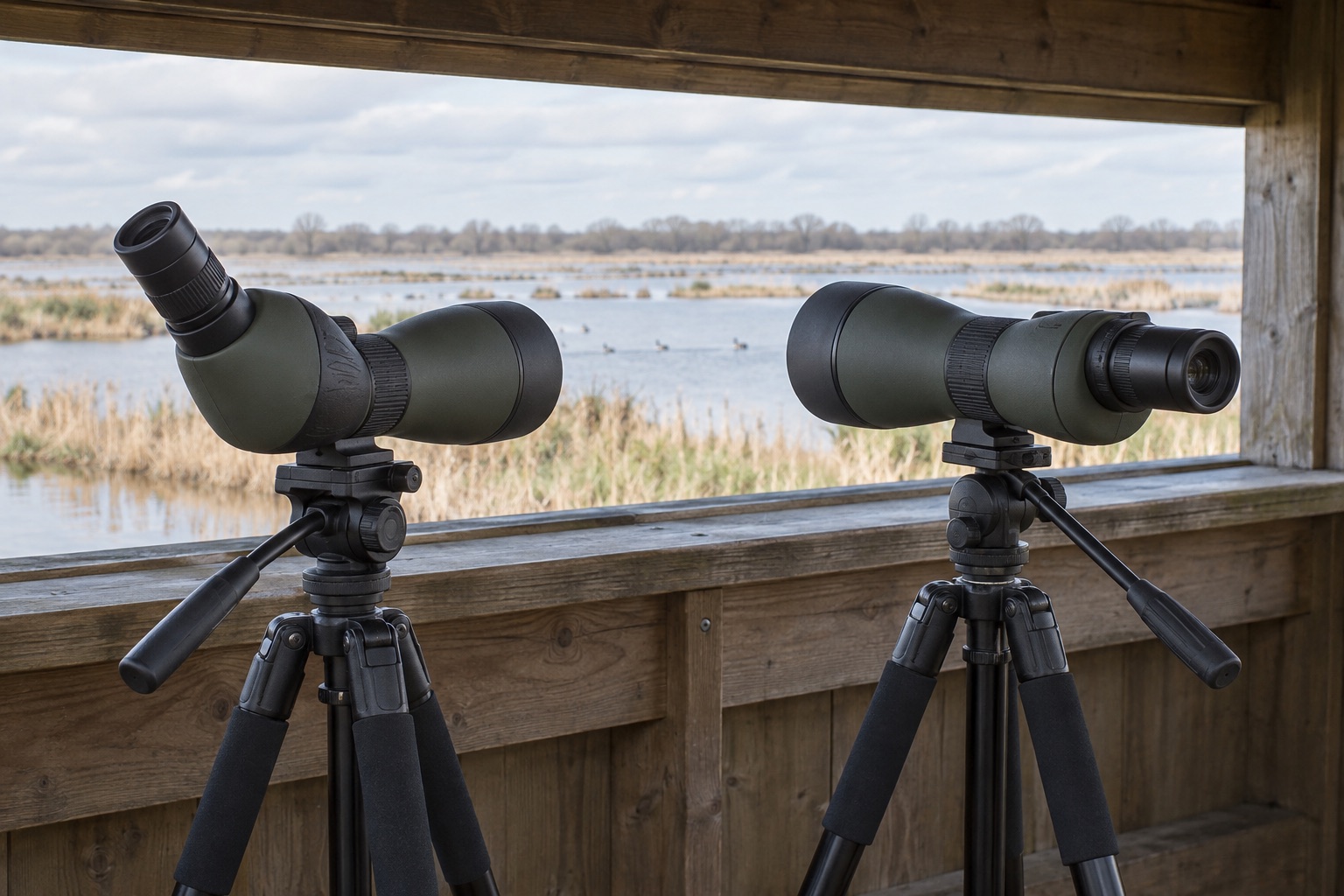
A lower angled setup can be more stable, but only if the eyepiece remains comfortable.
Straight is intuitive to sight along; angled may take practice to aim.
Body shape alone says nothing about optical quality.
The choice between angled and straight spotting scopes is chiefly about posture and aiming. With an angled scope, the eyepiece normally points upwards at roughly 45°. With a straight body, your eye looks along the main tube. Both can have the same objective, zoom and optical design; the body style does not create a brighter view by itself.
Where angled wins
At a wetland hide, a 45° eyepiece lets a tall person look down into a scope set below eye level. A shorter companion can often use the same tripod height by standing closer, rather than extending and collapsing legs repeatedly. This is particularly useful when a family or birding group is taking turns. A rotating collar, as on the Celestron TrailSeeker 65, can turn the eyepiece sideways for an awkward window or seated position without shifting the tripod.
The lower tripod position can also reduce vibration in wind. That is a potential system advantage, not a guarantee: a poorly matched head, soft ground or extended centre column can still spoil the view. Angled eyepieces are often pleasant for birds above the horizon, such as raptors over a ridge, because you need not crane your neck as much. Avoid a setup that forces a repeated hunched posture; adjust tripod height to your body.
Where straight wins
Some people find straight scopes more intuitive to aim. Point the tube toward a landmark, look along it, then refine through the eyepiece at low zoom. A straight design can feel natural for a single user at a fixed height, particularly when scanning horizontally over water. It may also fit better through a narrow hide slot or vehicle opening where the eye has room behind the tube but not above it.
The trade-off is tripod height. If a standing observer needs the straight eyepiece near eye level, the legs may have to extend farther. On a light tripod, that can amplify vibration. From a seated hide, though, the geometry can be ideal. Neither style universally dominates for seawatching or travel; the structure you look through matters.
Run a position test
Set up each shape where you will actually observe: seated hide, open shore, garden or vehicle. Without altering tripod height, ask two people of different height to view through it. Then acquire a distant sign at minimum zoom. Which requires fewer moves of the legs? Which puts less strain on your neck? Can you pan without your face bumping the camera adapter or eyecup? Check glasses clearance separately—spotting-scope eye relief is an eyepiece specification, not an angled-versus-straight benefit.
For most shared UK reserve use, we lean angled. For one observer who prioritises fast direct pointing through a restricted opening, straight is entirely defensible. Whichever you choose, buy a suitable support with the scope and never aim it toward the Sun.
Helpful products
What an angled field model looks like
The TrailSeeker is an actual 45° angled example with a rotating collar; its card is context for the format, not proof that angled is always preferable.

Celestron TrailSeeker 16–48×65 angled spotting scope
Best for: Wetland hides and shared viewing
A 65mm angled field scope with dual-speed focus and a rotating tripod collar for deliberate wetland observation.
What stands out
- Dual coarse/fine focusing
- Rotating collar and 45° eyepiece
- Waterproof nitrogen-filled body
Keep in mind
- About 1.36kg before tripod
- High zoom still needs solid support and good light
- 16–48×65
- 1,361g
- 45–23m / 1,000m
- 18–15mm eye relief
Frequently asked questions
Angled or straight questions
Is an angled spotting scope better for beginners?
It can be easier to share and set at a lower height, but straight scopes are often faster to aim at first. Practise with both on a tripod if possible.
Which style is easier for a family to share?
Usually angled, especially with a rotating collar: adults and children can approach the eyepiece without repeatedly raising the whole tripod.
Does an angled scope show an upside-down image?
No. Modern terrestrial scopes present an upright image in either body style. The difference is where your eye meets the eyepiece.
Which style is better from a car or narrow hide window?
It depends on opening height and viewing direction. Straight can align naturally through a slot; angled may help when the scope must sit low. Test the actual space.