
First scope · Birdwatching
Best spotting scopes for beginners
Choose a first spotting scope for birdwatching by matching viewing position, tripod, field width and eye fit, with three concrete models and avoidable mistakes.
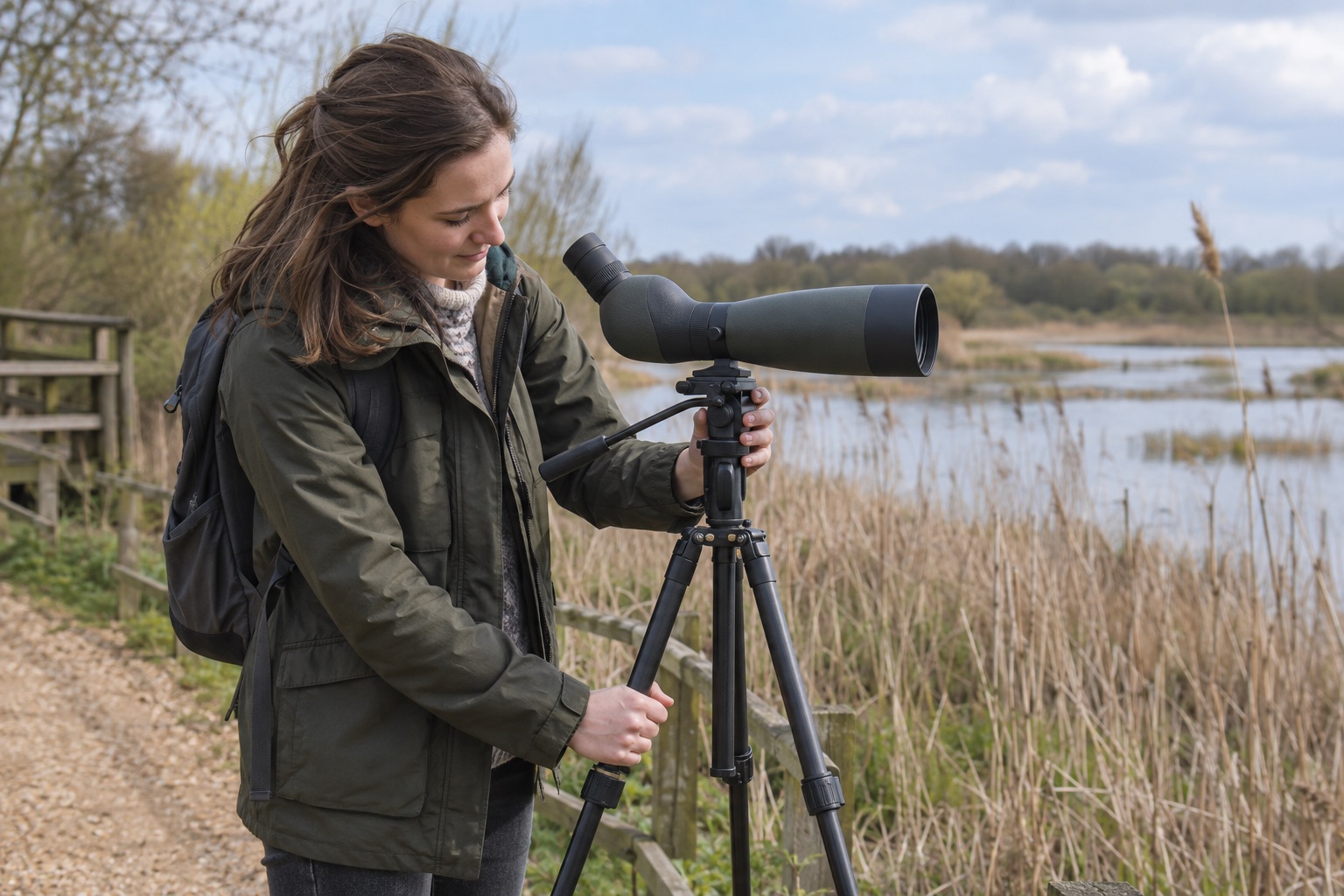
Try the lowest zoom first: a wider field makes birds easier to find.
Include a tripod and head in the whole-kit decision.
Check eye relief with your own glasses before buying.
Quick picks
Choose by the detail that matters most
Links open the matching Amazon UK listing. Prices and sellers can change, so confirm the model name and ASIN before buying.
Swipe to compare all details →
| Model | Starting zoom | Field at 1km at low end | Scope weight | Main compromise |
|---|---|---|---|---|
| Ultima 65 | 18× | 27m | 1,049g | Narrower initial search view |
| TrailSeeker 65 | 16× | 45m | 1,361g | Heavier carry |
| Nature-Trek Compact | 9× | About 79m | About 575g | Less light at high zoom |
The detailed shortlist
Three beginner routes
Model-specific Amazon UK cards follow; the pictures belong to those exact listings. No price or stock claim is built into the recommendation.

Celestron Ultima 18–55×65 angled spotting scope
Best for: A first fixed-position scope
A conventional 65mm angled scope and a simpler starting point for fixed-position birdwatching.
What stands out
- 65mm objective for overcast-day viewing
- Waterproof nitrogen-filled construction
- Viewing case included
Keep in mind
- Narrower 27–11.6m published field than the TrailSeeker
- 55× does not guarantee useful detail in poor seeing
- 18–55×65
- 1,049g
- 27–11.6m / 1,000m
- 18mm eye relief

Celestron TrailSeeker 16–48×65 angled spotting scope
Best for: Wetland hides and shared viewing
A 65mm angled field scope with dual-speed focus and a rotating tripod collar for deliberate wetland observation.
What stands out
- Dual coarse/fine focusing
- Rotating collar and 45° eyepiece
- Waterproof nitrogen-filled body
Keep in mind
- About 1.36kg before tripod
- High zoom still needs solid support and good light
- 16–48×65
- 1,361g
- 45–23m / 1,000m
- 18–15mm eye relief

Hawke Nature-Trek Compact 9–27×56 spotting scope
Best for: Long walks and travel
A roughly 575g, short 56mm angled scope for daypacks and lower-zoom viewing from a compact support.
What stands out
- About 575g scope weight
- 9× low end helps locate birds
- 20mm published eye relief
Keep in mind
- Smaller 56mm objective limits higher-zoom dusk use
- A monopod or tripod remains useful at 27×
- 9–27×56
- About 575g
- 20mm eye relief
- Compact angled body
The first mistake with a spotting scope is to buy the highest magnification advertised. The second is to spend the whole budget on glass and leave nothing for support. A scope is a one-eye, high-power observation tool: it shines when you have already found a distant subject and can stop to study it. For learning birds in moving woodland, 8×42 binoculars remain a better first tool.
Start with your usual outing
If you visit a wetland hide by car, a 65mm scope and steady full-height tripod can be entirely reasonable. At a coastal viewpoint, consider wind and the ability to pan smoothly. If your typical day is a six-mile walk with the scope used twice, a lighter 56mm model may win despite a less generous view at high power. Scope weight figures above exclude the tripod, head and case.
The Ultima 65 is the straightforward full-size start. It has an 18–55× zoom and a 1,049g published body weight. Its low-end field is only 27m at 1,000m, however, so sight along the tube and start at 18×. The TrailSeeker 65 is heavier but its 16× starting field is 45m and its dual-speed focus is helpful when moving between a near shoreline and a distant island. Those are genuine usability differences, not simply a more expensive tier.
The Nature-Trek Compact starts at 9×, which is easy to aim, and is about 575g. It is not a miniature version of a bright 80mm scope: when you raise magnification towards 27× on an overcast afternoon, the smaller objective and exit pupil become limiting. The compact-scope guide covers that trade more fully.
Try this three-minute test in a shop or at a reserve
Find a sign or distant branch with your unaided eye, then point the scope at its low zoom setting. Can you acquire it without searching for a minute? Pan to another subject and focus it. Check whether the image settles after you touch the controls. If it keeps vibrating, the tripod is the problem. Finally, look with your actual glasses on, eyecup adjusted, and ask whether you can see the whole field without pressing against the eyepiece.
An angled eyepiece is comfortable for sharing at different heights and can work with a shorter tripod. A straight body often aligns naturally with where you point it, which some beginners prefer. Neither changes the optical quality of a given model. See angled vs straight spotting scopes for the specific use cases.
A sensible buying order
Set a whole-system budget; choose your typical observation location; shortlist the body; then choose a tripod that reaches your viewing height steadily. Only after that should you compare 48× with 55×. On damp UK days, also check the manufacturer's exact weather claim. A water-resistant instrument is not necessarily one to leave in a downpour. Keep the Sun well outside the field of view at all times.
If you already own binoculars, bring them. Find the bird with the binocular, note a landmark, then transfer to the scope at its lowest zoom. That simple sequence produces more successful views than buying extra magnification alone. Our overall scope comparison gives the next step once you know your preferred format.
Then check 65mm versus 80mm if you are choosing a full-size body, and tripods for spotting scopes before treating a bare scope price as your complete budget.
Frequently asked questions
First-scope questions
Should a beginner buy binoculars or a scope first?
Usually binoculars first: they are quick to aim and useful while walking. Add a scope when distant stationary birds remain too small to identify.
What magnification is easiest for a first scope?
Use the low end, often around 9–18×, to locate the subject. Zoom only after it is centred and the tripod has settled.
Do I need an angled or straight scope?
Angled suits a shared hide and a lower tripod; straight can make initial aiming more intuitive. The eyepiece should fit the way you actually observe.
Can I use a cheap tabletop tripod outdoors?
Only where a solid table, hide shelf or wall is at a comfortable height. For standing field use, a stable full-height tripod and smooth head are usually more effective.