
Viewing comfort · Spotting scopes
Spotting scope eye relief explained
Learn what spotting scope eye relief means, why it may change with zoom and how to check whether an eyepiece gives glasses wearers the full field.
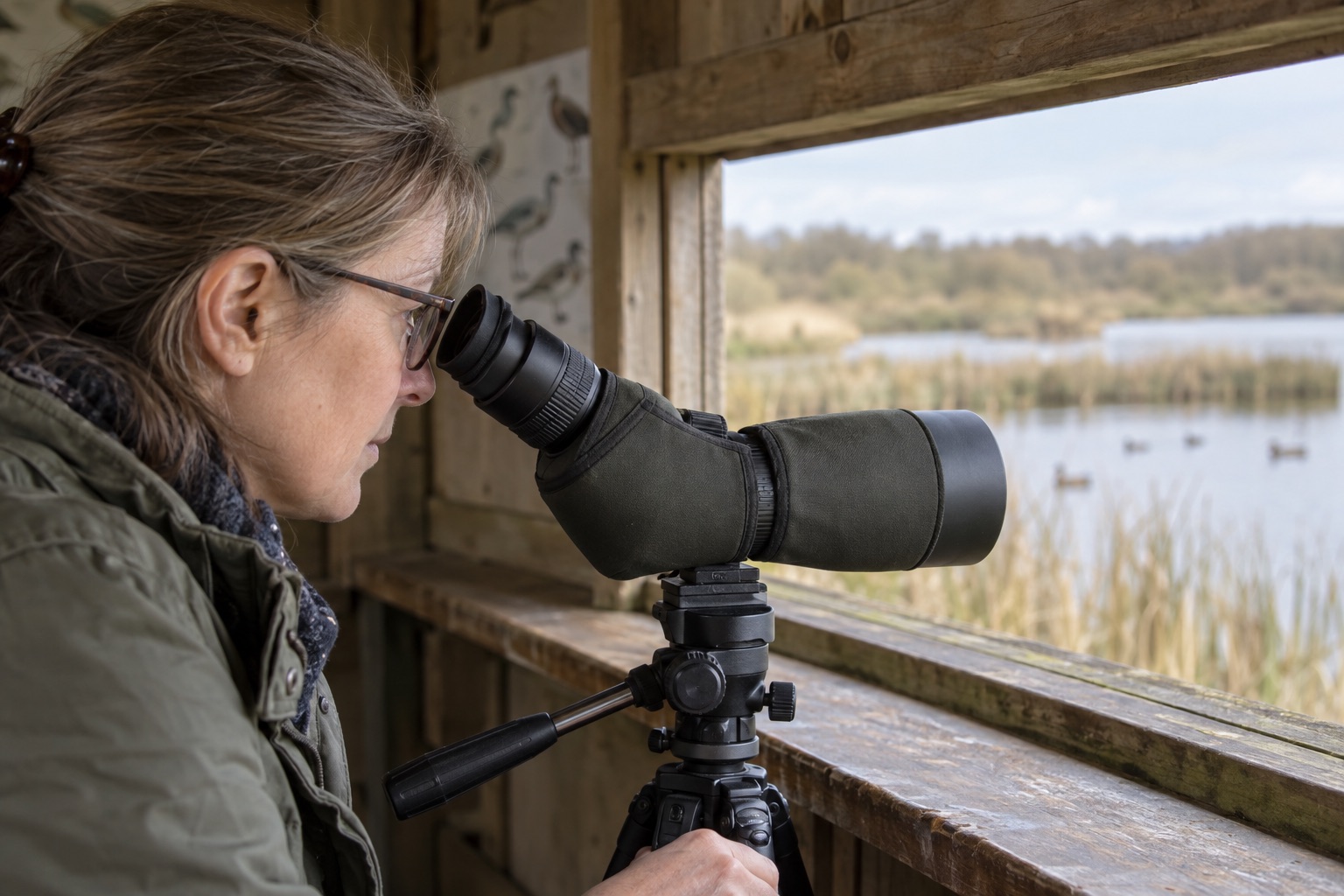
Look for an eye-relief range or a stated magnification alongside the number.
With glasses on and the eyecup down, check whether the field edge is visible.
Do not confuse eye relief with exit pupil or the scope's objective diameter.
If you see a black ring or cropped edges through a scope while wearing glasses, eye relief may be part of the problem. It describes where your eye must sit behind the eyepiece to see the complete field. It is not the distance from your face to the front lens, and it does not tell you how bright the view is.
A millimetre figure needs context
The Celestron TrailSeeker 20–60×80 lists eye relief as 18–15mm. That means the published distance changes across its zoom, becoming shorter at one end. The Regal M2 65ED's published 20mm is stated at 16×; treating that as a guaranteed 20mm throughout the zoom would be misleading. Look for the exact eyepiece's range and any note about which magnification was measured.
Your glasses sit in front of your eye, and thicker frames or lenses can keep the eye farther from the eyepiece. An eyecup rolled or twisted down creates room, but a recessed eye lens can reduce usable clearance. Two scopes with the same published millimetres may feel different. Numbers narrow a shortlist; trying the assembled setup settles the question.
A five-minute glasses-fit check
Set the eyecup to its glasses position. Look through the scope at low power without pressing your lenses against the eyepiece. Can you see a clean circular field edge without moving your head around? Refocus, then repeat at a middle setting and at the highest power you realistically expect to use. Notice whether the view blacks out when you shift slightly and whether the eyecup contacts your frames. If you share the scope, check the other viewer's comfortable eye position too.
Do not choose by eye relief alone. A broad low-end field of view helps find a bird, while steady mounting keeps the target there long enough to inspect it. A well-fitting eyepiece on a wobbly tripod still makes a poor field setup.
Distinguish three similar-sounding measurements
Eye relief is a distance behind the eyepiece, given in millimetres. Exit pupil is the diameter of the light beam leaving it; it gets smaller as magnification rises. Objective diameter is the front lens size, such as 65mm or 80mm. A larger objective can improve light-gathering potential, but does not automatically change the eyepiece's eye relief. If you are choosing body size too, see 65mm versus 80mm scopes.
For glasses wearers, the right question is not simply “does the listing say long eye relief?” It is “can I see the full, comfortable field with my glasses at the zoom I will use?” Check return terms if you cannot try the scope in person.
Helpful products
A real example of changing eye relief
Celestron specifies 18–15mm across the TrailSeeker 20–60×80's zoom. This is a useful reminder to test comfort at high as well as low power; it is not a universal glasses-fit guarantee.

Celestron TrailSeeker 20–60×80 angled spotting scope
Best for: Long sessions from a hide or viewpoint
An 80mm angled scope with a 20–60× eyepiece, dual-speed focus and rotating tripod collar for longer stationary views.
What stands out
- 80mm objective and dual-speed focusing
- 20× starting power with 35m field at 1,000m
- Waterproof nitrogen-filled body
Keep in mind
- 1,548g before tripod and head
- At 60×, atmosphere and support can limit usable detail
- 20–60×80
- 1,548g
- 35–17m / 1,000m
- 18–15mm eye relief
Frequently asked questions
Eye-relief questions
How much eye relief do I need with glasses?
There is no single guaranteed threshold. Around 17–20mm is often a useful starting specification, but the eyecup, lens recess and your frames determine whether you actually see the full field. Try the eyepiece where possible.
Does eye relief stay the same when I zoom?
Not necessarily. Some zoom eyepieces publish a range; others quote a figure at one power. Check the exact eyepiece and test both ends.
Should I leave my glasses on at a scope?
If they correct astigmatism, keeping them on is often important. For simple near- or long-sightedness, refocusing may compensate, but comfort and shared use can still favour glasses. Ask your optician if unsure about your prescription.
Does an 80mm scope have more eye relief than a 65mm scope?
Not by virtue of objective size. Eye relief is chiefly an eyepiece property, so compare the actual eyepiece specifications.