
Support · Buying guide
Best tripod heads for spotting scopes
Choose a spotting-scope tripod head for smooth bird tracking, secure balance and plate compatibility. Compare two exact Manfrotto fluid heads.
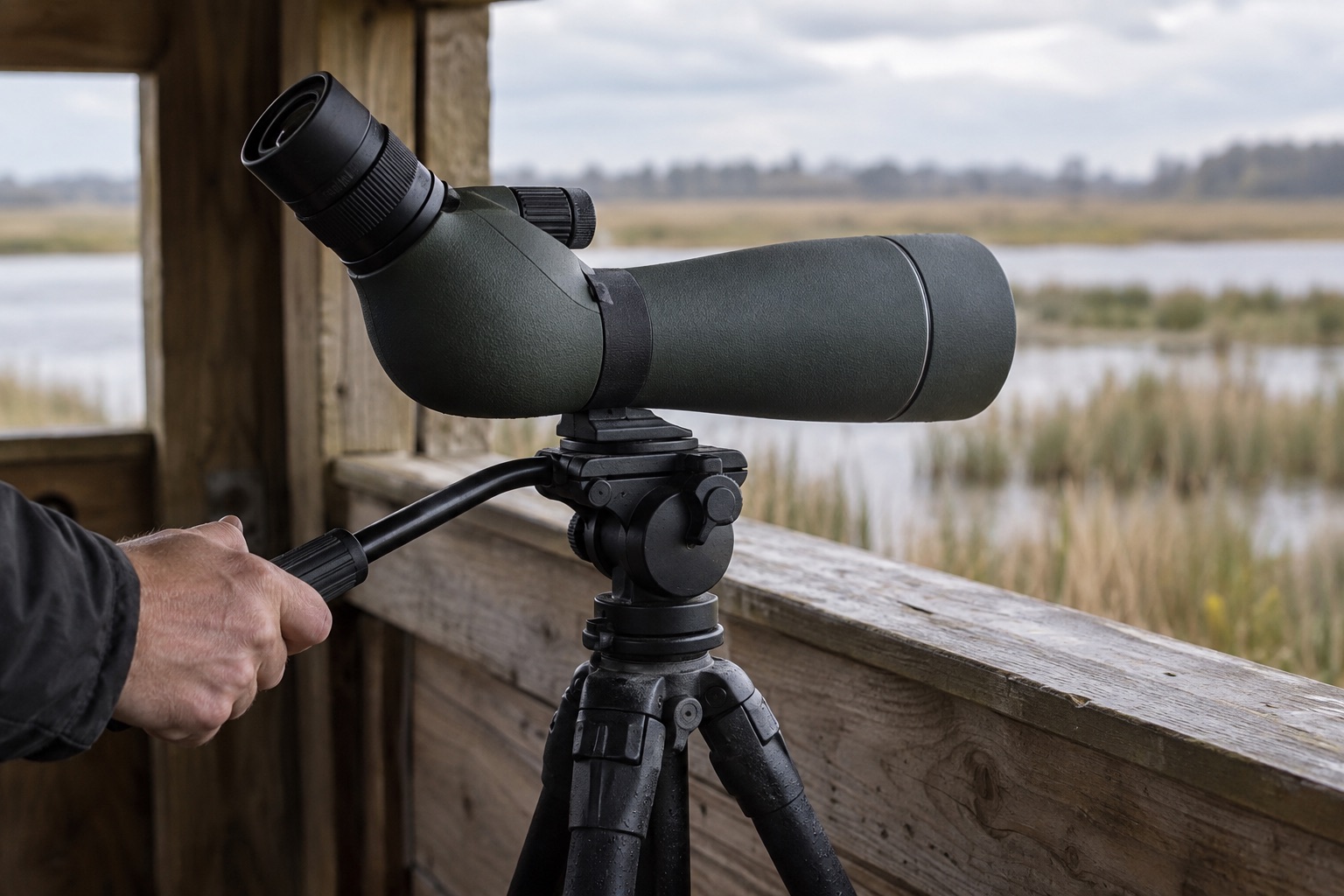
Confirm the leg-top mounting thread and head's plate system.
Check whether a long scope tips or springs back after you release the handle.
Keep enough friction for safety while following moving birds.
Quick picks
Choose by the detail that matters most
Links open the matching Amazon UK listing. Prices and sellers can change, so confirm the model name and ASIN before buying.
Swipe to compare all details →
| Head | Movement | Plate | Published head weight | Main reason to choose |
|---|---|---|---|---|
| Manfrotto 128RC | Fluid pan and tilt | Quick-release 1/4-inch screw | 1kg | Simple controlled tracking |
| Manfrotto XPRO 2W | Adjustable tilt fluidity | 200PL-14 | 0.76kg | More tilt control |
The detailed shortlist
Two fluid heads to compare
These are head-only choices. Check plate compatibility, current box contents and whether your existing tripod legs are suitable.

Manfrotto 128RC micro fluid head
Best for: Upgrading existing tripod legs
A standalone two-way fluid head with pan bar and quick-release plate for deliberate scope panning on compatible tripod legs.
What stands out
- Fluid pan and tilt movements
- Quick-release plate with 1/4-inch screw
- Flat-base mounting
Keep in mind
- Tripod legs are not included
- Confirm leg-top thread and plate compatibility
- Two-way fluid head
- 1kg published weight
- Quick-release plate with 1/4-inch screw
- Tripod legs sold separately

Manfrotto XPRO MHXPRO-2W fluid head
Best for: Controlled panning and digiscoping
A standalone two-way fluid head with selectable tilt drag, separate pan and tilt locks and a 200PL-14 quick-release plate.
What stands out
- Two tilt-drag settings
- Separate pan and tilt locks
- 0.76kg published head weight
Keep in mind
- More head than a casual small scope needs
- Tripod legs and plate-system check are separate
- 0.76kg
- 5kg safety payload
- 200PL-14 plate
- Two tilt-drag settings
A good scope head lets you move along a mudflat, stop precisely on a bird and remove your hand without the image drifting away. The head's feel becomes more obvious as magnification rises. A strong set of legs with a jerky head can be as frustrating as a smooth head on flexing legs.
The 128RC and XPRO 2W have different jobs
Manfrotto's 128RC is a compact micro-fluid video head with pan and tilt movement and quick release. It is a sensible straightforward choice if you have compatible tripod legs and want controlled tracking rather than a photographic ball head. The XPRO 2W offers a fluidity selector on tilt, independent pan and tilt locks and a 200PL-14 plate; Manfrotto publishes a 0.76kg head weight and 5kg safety payload. That extra adjustability can help tune movement to a longer scope, but it does not make the legs beneath it any sturdier.
Neither product here includes tripod legs. If you do not already own a support, compare complete spotting-scope tripods first. Otherwise, identify your legs' top mounting stud and whether an adapter is needed. Check the head's quick-release plate against your scope foot's thread, and leave enough clearance for a stay-on case or rotating collar.
Balance is as important as load capacity
An angled 80mm scope can be front- or rear-heavy depending on its eyepiece and accessories. Before locking it down, move the plate where the mounting system allows and check whether the scope wants to dive when the tilt control is eased. Never let go of an unlocked, unbalanced rig. Use the handle to follow a subject and adjust friction so the view moves deliberately without fighting you.
A quoted maximum load is a safety specification, not a promise that the image will settle instantly at 60×. Long legs, a raised centre column or wind can still make it vibrate. Test by focusing at a distant fixed object, releasing the handle and watching whether the view stops promptly. Then pan slowly as you would after a moving bird. If it overshoots, more fluid control may help; if the entire tripod oscillates, the legs or setup are the likely limit.
For birds, aim the scope at a known landmark at low power, centre the target and move smoothly. If higher zoom makes tracking awkward, step back down. Our magnification explainer covers why a larger image does not always deliver more information.
Check the mounting path before choosing a head
Identify the tripod legs' top fitting, the head's base connection and the scope foot's thread or plate interface. The complete chain must be compatible; a head sold with a plate is not necessarily a match for a different quick-release receiver you already own. A stay-on case can stop a plate from sitting flat, and a rotating scope collar may need space to turn without hitting the handle. Assemble the actual eyepiece and any phone adapter before assessing clearance and balance.
For a short 65mm scope used mainly from one hide, the 128RC's simple pan-and-tilt workflow may be enough. An 80mm body or repeat digiscoping setup can make the XPRO 2W's adjustable tilt feel more valuable, provided the legs do not flex beneath it. Do not assume a more elaborate head will steady an undersized tripod. If you have to buy legs too, compare the total weight and cost with a complete tripod kit.
A practical balance trial
With the scope securely held, point it at a fixed target and ease the tilt control only enough to feel whether it noses forward or falls back. Adjust the mounting position within the plate's permitted travel, then lock it and check that the plate cannot slide free. Pan across a distant branch, stop, release the handle and observe how long the image takes to settle. Repeat at the magnification you actually use. If movement comes from the platform or ground rather than the head, changing head models will not fix it. Keep a hand on the scope throughout setup.
Frequently asked questions
Tripod-head questions
Is a ball head suitable for a spotting scope?
It can hold a compact scope, but releasing a ball head can allow both axes to move together. A controlled pan-tilt or fluid head is often easier for following birds while keeping the horizon level.
Will any head fit any tripod?
No. Check the tripod's mounting stud, head base thread or adapter, plate design and scope mounting foot. A 1/4-inch scope socket does not tell you what attaches the head to the legs.
Do these products include tripod legs?
No. The two Manfrotto products here are standalone heads. If you need a complete support, see our tripod guide instead.
Does a high payload rating prevent shake?
No. It addresses safe supported weight, while vibration also depends on leg stiffness, column height, wind, scope length and how smoothly the head moves.