
Buying guide · Safari and travel
Best binoculars for safari and travel
Five travel and safari binoculars compared for packing, vehicle use, field width, low light, weather protection and glasses.
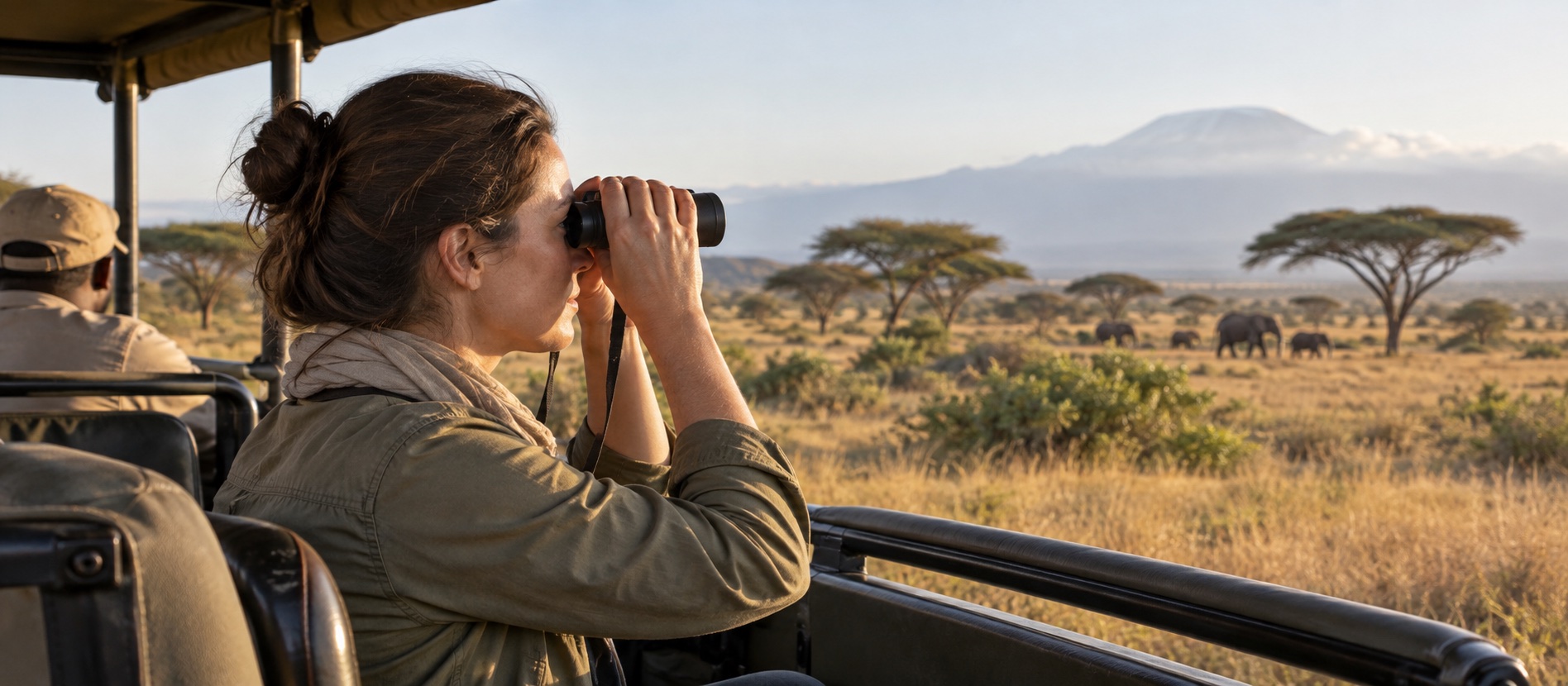
A wide 8× view helps find animals quickly from a moving or crowded vehicle.
Keep binoculars in hand luggage and pack them so eyecups and focus cannot be crushed.
Waterproofing protects against rain and humidity; it does not make a binocular safe to store wet.
Quick picks
Choose by the detail that matters most
Links open the matching Amazon UK listing. Prices and sellers can change, so confirm the model name and ASIN before buying.
Swipe to compare all details →
| Model | Best for | Weight | Field of view | Low-light format | Travel note |
|---|---|---|---|---|---|
| Nikon PROSTAFF P7 8×30 | Best overall travel balance | 485g | 152m / 1,000m | 3.75mm exit pupil | Compact and waterproof |
| Nikon MONARCH M7 8×30 | Premium compact travel | 465g | 145m / 1,000m | 3.75mm exit pupil | ED glass and 2m close focus |
| Vortex Diamondback HD 8×32 | Mixed close wildlife | 451g | Approx. 142m / 1,000m | 4mm exit pupil | 1.5m close focus |
| Nikon PROSTAFF P7 8×42 | Dawn and dusk | 590g | 126m / 1,000m | 5.25mm exit pupil | 20.2mm eye relief |
| Nikon MONARCH M7 10×42 | Distant open habitat | 680g | 121m / 1,000m | 4.2mm exit pupil | Needs steady technique |
The detailed shortlist
Travel binoculars with a clear reason to pack them
The shortlist covers compact 8×, full-size low-light and a carefully limited 10× option. Links open the exact Amazon UK models; check the ASIN before purchase.

Nikon PROSTAFF P7 8x30
Best for: Walking and fast-moving wildlife
A compact 485g 8×30 with an unusually broad 152m field, a locking dioptre and a waterproof, fog-free body.
What stands out
- 152m field of view at 1,000m
- 485g compact body
- Waterproof with a locking dioptre
Keep in mind
- 15.4mm eye relief may be marginal with some glasses
- 30mm objectives are less forgiving than 42mm at dusk
- 8×30
- 485g
- 152m / 1,000m
- 2.5m close focus

Nikon MONARCH M7 8x30
Best for: Frequent travel and nature walks
A premium 465g compact with ED glass, a broad 145m field and 2m close focus in a sealed 8×30 body.
What stands out
- 145m field of view at 1,000m
- ED glass in a 465g body
- 2m close focus and locking dioptre
Keep in mind
- Premium price for a 30mm binocular
- 15.1mm eye relief is not the safest choice for all glasses wearers
- 8×30
- 465g
- 145m / 1,000m
- 2m close focus

Vortex Diamondback HD 8x32
Best for: Walks, travel and close viewing
A compact weather-sealed 8×32 that combines a 451g carry weight with a very wide 142m field and 1.5m close focus.
What stands out
- Approximately 451g
- Approximately 142m field of view at 1,000m
- Waterproof, fogproof and 1.5m close focus
Keep in mind
- 16mm eye relief may be marginal with some glasses
- Smaller 32mm objectives give up some low-light ease to 42mm models
- 8×32
- 451g
- 142m / 1,000m
- 16mm eye relief

Nikon PROSTAFF P7 8x42
Best for: Wide viewing with glasses
A 590g all-round 8x42 with a wide 126m field, long stated eye relief and a locking dioptre ring that helps preserve a personal focus setting.
What stands out
- 126m field of view at 1,000m
- 20.2mm stated eye relief
- 590g waterproof body with locking dioptre
Keep in mind
- 3m close focus is useful rather than class-leading
- No ED glass in the published specification
- 8×42
- 590g
- 126m / 1,000m
- 20.2mm eye relief

Nikon MONARCH M7 10x42
Best for: Detailed open-habitat viewing
A premium 10×42 with ED glass, a wide 121m field, 2.5m close focus and a 680g waterproof body.
What stands out
- 121m field is broad for a 10×42
- ED glass and dielectric prism coating
- 2.5m close focus and locking dioptre
Keep in mind
- Costs substantially more than the PROSTAFF P7
- 680g and 10× magnification demand steadier technique
- 10×42
- 680g
- 121m / 1,000m
- 16.5mm eye relief
Travel binoculars must survive more than the destination. They move through hand luggage, vehicle footwells, air conditioning, humidity, dust and unfamiliar routines. The best pair is optically useful but also compact enough to keep under your control rather than burying it in checked baggage.
For a typical safari or nature holiday, 8×30 or 8×32 is the best starting format. It is wide and steady from a vehicle, packs neatly and remains large enough for normal focusing controls. Full-size 8×42 becomes worthwhile when early and late viewing is a major part of the itinerary.
Why the Nikon PROSTAFF P7 8×30 is the best travel balance
At 485g, the P7 is compact without feeling miniature. Its 152m field at 1,000m is a real advantage when an animal appears briefly between vegetation or several passengers are trying to point out the same subject. Waterproofing, a locking dioptre and protective external coating suit a pair that moves repeatedly between bags and climates.
The 15.4mm eye relief is the main reservation for glasses wearers. Test the exact model rather than assuming the broad published field will all remain visible behind glasses.
Why the MONARCH M7 8×30 is the premium compact
The M7 is even lighter at 465g and adds ED glass, dielectric coatings and a 2m close focus. Its 145m field is broad enough for rapid finding while the small body is easy to keep in cabin luggage.
Choose it when the trip is important enough to justify premium optics and the binocular will continue to be used at home. If loss, sand or hard vehicle use will make you overprotect it, the less costly P7 may be the more practical companion.
Why the Vortex Diamondback HD 8×32 suits mixed wildlife
The Vortex weighs 451g and focuses to 1.5m. That close focus is useful on trips that combine larger wildlife with butterflies, reptiles or garden-sized subjects. Vortex lists a carry case and strap with the 8×32, so budget separately for a harness if that is part of your preferred walking setup.
Its 16mm eye relief needs a personal check with glasses. The 32mm objective gives a 4mm exit pupil: a balanced daylight specification, not a substitute for 42mm at the darkest ends of a drive.
Why the Nikon PROSTAFF P7 8×42 earns extra bag space
The P7 8×42 weighs 590g and publishes 20.2mm eye relief. Its 5.25mm exit pupil gives easier eye placement and more latitude in dawn, dusk, forest and heavy cloud. That can be worth more than a compact body when the trip is built around wildlife observation.
It is still relatively light for a full-size binocular. Use a padded hand-luggage compartment and avoid leaving it loose beneath other bags in a vehicle.
When the MONARCH M7 10×42 makes sense
Ten-times magnification can help with distant antelope, raptors or mammals across open country. The MONARCH M7 limits the usual field penalty with a published 121m at 1,000m and adds ED glass, but it weighs 680g and magnifies vehicle vibration and hand movement.
Choose it only if you already know you are comfortable with 10×. An 8× user who occasionally wants more detail is often better served by a guide's scope or a supported view than by accepting shake throughout the trip.
Vehicle viewing changes the choice
A wide field matters when sightings are brief and directions arrive as hurried clock positions. Eight-times magnification also recovers more quickly after bumps and engine vibration. Keep the strap short enough that binoculars cannot swing into door frames or another passenger.
Never rest unprotected objectives on a dusty sill. Brace your forearms, not the glass, and keep a lens brush or blower accessible.
Packing and airport handling
- Carry binoculars in cabin luggage where possible.
- Retract eyecups and avoid pressure on the focus wheel.
- Use a soft case inside a structured compartment, not a case that adds excessive bulk.
- Keep the model and serial details separately in case of insurance claims.
- Check current airline, airport and destination rules rather than relying on past journeys.
- Never leave optics visible in an unattended vehicle.
For strict cabin limits, compare the best compact binoculars. A compact that remains with you is more valuable than a brighter pair that is inaccessible or vulnerable in checked baggage.
Dust, humidity and temperature changes
Loose dust must be blown or brushed away before wiping; rubbing grit across a coated lens can cause permanent marks. In humid climates, let a damp binocular dry in moving air before closing the case. Silica gel can help inside luggage, but it does not replace drying.
Moving from air conditioning into warm humid air can fog external surfaces. Give the binocular time to acclimatise. Internal fogging in a sealed model indicates a problem and should be assessed after the trip.
Choose by trip style
- Mixed holiday with occasional wildlife: PROSTAFF P7 8×30.
- Premium nature-focused trip: MONARCH M7 8×30.
- Wildlife plus insects and walking: Vortex Diamondback HD 8×32.
- Dawn drives or forest: PROSTAFF P7 8×42.
- Distant open-country specialist: MONARCH M7 10×42.
If safari is only one use among many, compare the broader wildlife binocular guide. The best travel binocular is the one you can keep safe, reach quickly and use steadily when the sighting lasts seconds.
Frequently asked questions
Safari and travel questions
Is 8× or 10× better for safari?
Eight-times is better for most travellers because it is steadier and wider, which helps from a vehicle and when animals appear quickly. Ten-times can help with distant subjects in open habitat if you can hold it steadily.
Can binoculars go in hand luggage?
Binoculars are normally carried in cabin luggage, but airline and airport rules can change. Keep them protected, allow room for inspection and check the current restrictions for every airport on the itinerary.
Are compact binoculars bright enough for safari?
An 8×30 or 8×32 is effective for most daylight drives. For repeated dawn, dusk or dense-forest viewing, an 8×42 provides a larger exit pupil and more forgiving eye placement.
Do safari binoculars need to be waterproof?
Waterproof sealing is a sensible minimum for dust, humidity, rain and temperature changes. It does not mean lenses can be wiped dry with dusty clothing; use a blower and clean cloth after loose grit is removed.