
Low light · Dusk and dawn
Best binoculars for low light
Compare 8×42, 10×50 and 7×50 binoculars for dawn, dusk and grey UK weather, with realistic guidance on exit pupil, coatings, steadiness and weight.
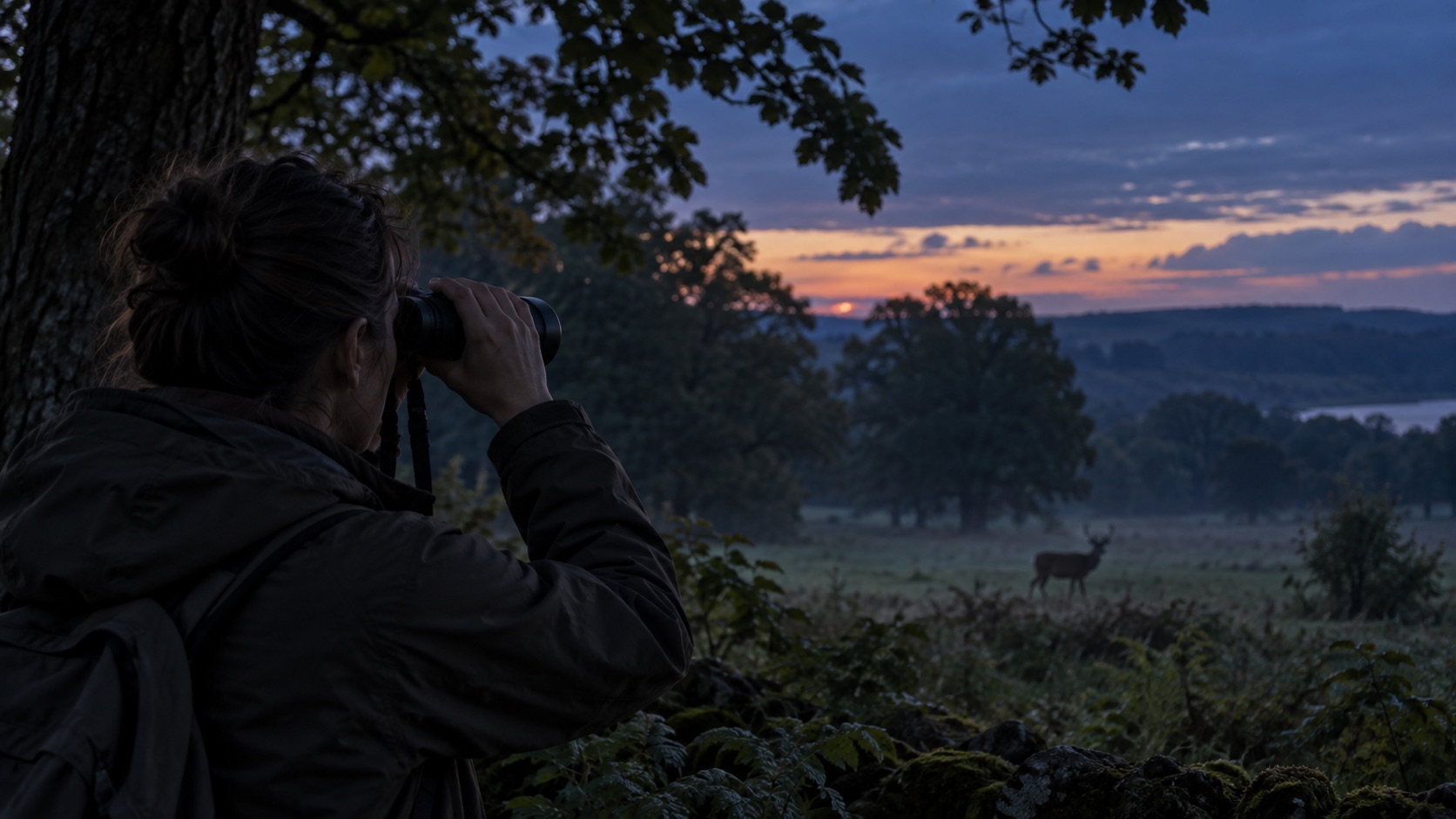
No ordinary binocular is night vision: details disappear when there is too little light.
The exit pupil is only one part of usable low-light performance.
Do not sacrifice a steady image for extra magnification you cannot hold.
Quick picks
Choose by the detail that matters most
Links open the matching Amazon UK listing. Prices and sellers can change, so confirm the model name and ASIN before buying.
Swipe to compare all details →
| Model | Format | Exit pupil | Weight | Field | Main compromise |
|---|---|---|---|---|---|
| Nikon MONARCH M7 | 8×42 | 5.25mm | 670g | 145m / 1,000m | Premium cost |
| Nikon PROSTAFF P7 | 8×42 | 5.25mm | 590g | 126m / 1,000m | Narrower field |
| Nature DX ED | 10×50 | 5mm | 806g | 103m / 1,000m | Shake and weight |
| Steiner Navigator | 7×50 | About 7.1mm | 754g | About 140m / 1,000m | Marine-style focus |
The detailed shortlist
Four low-light choices with different compromises
These are ordinary binoculars for twilight and dull weather, not electronic night-vision devices. Product links and images match exact Amazon UK listings.

Nikon MONARCH M7 8x42
Best for: Finding and following moving birds
A step-up ED-glass 8x42 whose key distinction is an expansive 145m field, alongside a locking dioptre and protective external lens coatings.
What stands out
- 145m field of view at 1,000m
- ED glass and dielectric prism coating
- Locking dioptre and oil-repellent external coating
Keep in mind
- Costs materially more than capable starting models
- 17.1mm eye relief gives less margin than the PROSTAFF P7
- 8×42
- 670g
- 145m / 1,000m
- 17.1mm eye relief

Nikon PROSTAFF P7 8x42
Best for: Wide viewing with glasses
A 590g all-round 8x42 with a wide 126m field, long stated eye relief and a locking dioptre ring that helps preserve a personal focus setting.
What stands out
- 126m field of view at 1,000m
- 20.2mm stated eye relief
- 590g waterproof body with locking dioptre
Keep in mind
- 3m close focus is useful rather than class-leading
- No ED glass in the published specification
- 8×42
- 590g
- 126m / 1,000m
- 20.2mm eye relief

Celestron Nature DX ED 10x50
Best for: Dusk and sky crossover
An ED-glass 10×50 with 103m field, 17.8mm eye relief and waterproof nitrogen-filled construction.
What stands out
- ED objectives and fully multi-coated optics
- 103m field at 1,000m
- Waterproof and tripod adaptable
Keep in mind
- 806g is tiring unsupported
- ED glass does not increase aperture or overcome sky glow
- 10×50
- 806g
- 103m / 1,000m
- 17.8mm eye relief

Steiner Navigator 7x50
Best for: Serious boating without a compass
A purpose-built 7×50 marine binocular with individual eyepiece focus, a 7.1mm exit pupil and waterproofing to a stated 5m.
What stands out
- Waterproof to a stated 5m
- Approximately 140m field at 1,000m
- 20.2mm eye relief and individual focus
Keep in mind
- 20m close focus is unsuitable for nearby nature
- Individual focus is slower when subject distance changes often
- 7×50
- 754g
- 140m / 1,000m
- Waterproof to 5m
“Low light” covers more than one scene: a woodland floor under heavy cloud, a deer at dusk, or a bird against a bright sunset. The eye, not just the binocular, changes between those conditions. A good choice keeps enough light in the view and stays steady, easy to align and quick to focus.
The 8×42 default: Nikon MONARCH M7
The MONARCH M7 8×42 publishes a particularly wide 145m field, ED objectives and a 5.25mm exit pupil. The field helps you locate an animal against a cluttered woodland edge before the light drops further. Eight-times magnification is easier to hold steady than 10× when you are tired or cold.
It weighs 670g and costs materially more than an entry-level pair. Its 17.1mm eye relief should be checked with glasses. The premium here is for a broad, refined all-round view, not a guarantee that you can see after dark.
A lighter, glasses-friendly 8×42: Nikon PROSTAFF P7
The P7 8×42 weighs 590g and gives 20.2mm stated eye relief. That pairing can make a long twilight watch more comfortable, particularly for glasses wearers. It shares the 8×42 format's 5.25mm exit pupil but has a narrower 126m field than the M7.
The simpler optical specification may be a reasonable trade if fit and carry comfort dominate. Try the complete field through your own glasses; a published eye-relief number is a screening tool, not a fit promise.
More reach and aperture: Nature DX ED 10×50
The Nature DX ED 10×50 brings 50mm objectives, 10× apparent scale and a 5mm exit pupil. Its ED glass and sealed body make it a versatile dusk-and-distance option. If wildlife is far across a field and you can brace on a fence or use a support, it may make a subject easier to study than 8×42.
At 806g, it is heavier and its 103m field is narrower. Unsteadiness can erase the extra apparent detail. For a moving bird at a woodland edge, the wide M7 8×42 may be more effective. Read the 10×50 astronomy comparison if sky use is also a priority.
The large-pupil specialist: Steiner Navigator 7×50
Dividing 50mm by 7 gives an exit pupil of about 7.1mm. This is useful when your own pupil opens sufficiently in dim conditions, and 7× is forgiving of motion aboard a boat. Steiner also publishes a waterproof 5m rating for the Navigator.
Its individual-focus marine format and roughly 20m close focus make it a poor choice for rapidly changing woodland wildlife distances. Do not buy a marine binocular solely for the largest possible exit pupil. Some of that light may fall outside your eye's pupil; its handling could cost more sightings than the beam gains.
What matters beyond the formula
Transmission and stray-light control influence whether a dark subject separates from a bright sky. Objective size sets potential light collection, but the eye sees the final delivered image. Field width helps you find a subject before it vanishes. Stable support, clean lenses and a shielded observing position often improve the view without changing binoculars.
At the edge of daylight, let your eyes adapt and avoid checking a bright phone screen between looks. In rain or cold, keep eyepieces covered to reduce external condensation. If the lenses fog on the outside, let them clear gently; gas filling only addresses moisture inside a sound housing.
For the arithmetic behind these sizes, read exit pupil explained. For a lighter daytime-first choice, compare 8×32 and 8×42. Ordinary binoculars must never be pointed at the Sun.
Frequently asked questions
Low-light binocular questions
Are 10×50 binoculars brighter than 8×42?
They collect more light at the objectives but produce a slightly smaller 5mm versus 5.25mm exit pupil. Coatings, eye pupil and shake affect what you actually see; 10×50 is not automatically brighter-looking.
Is 7×50 best at dusk?
Its large exit pupil can be helpful when your eye pupil is also large, but it may waste light for some observers and marine 7×50 designs are often bulky and slower for changing subject distances.
Can these binoculars see in complete darkness?
No. Ordinary optical binoculars need available light. They do not amplify light electronically or detect heat.
Does ED glass make a binocular brighter?
ED glass primarily controls colour fringing. Overall transmission depends on the full optical system. Do not treat the ED label as a guaranteed brightness ranking.