
Format choice · Two eyes or one
Binoculars or a monocular?
Choose between two-eye binocular comfort and a pocketable one-eye monocular for walking, wildlife and occasional viewing.
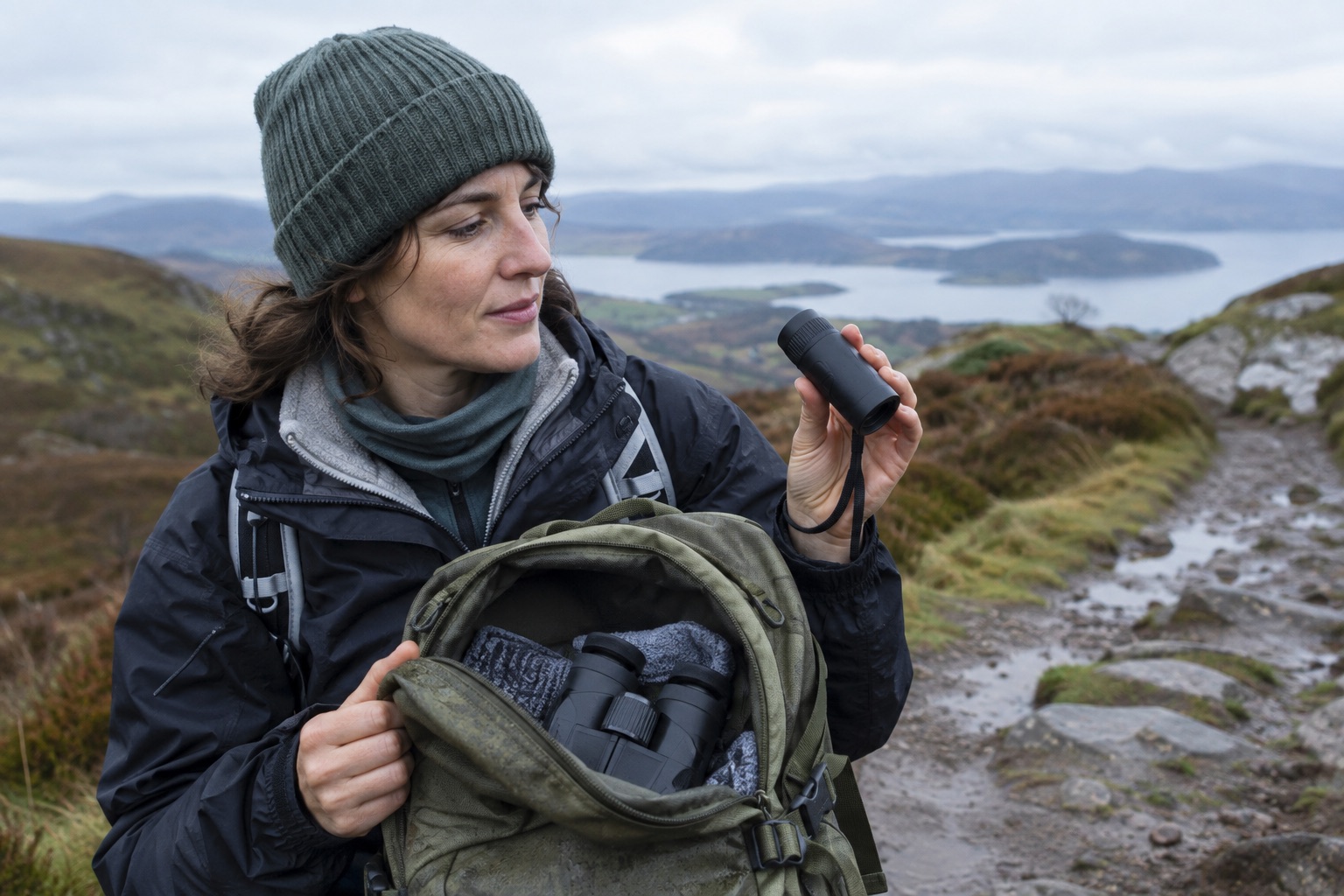
Compare like-for-like 8×25 models before judging size and weight.
One-eye viewing can be convenient for a quick look but tiring for long sessions.
Eyecup and glasses fit still matter with a monocular.
A monocular is the optic you are most likely to have with you when space is genuinely tight. A binocular is usually the better instrument once you stop to watch. That is the decision—not whether one format is inherently “professional”. Both can be made in 8×25, 8×42 or other sizes; the format changes how you acquire and sustain the view.
Swipe to compare both formats →
| Decision | Binocular | Monocular |
|---|---|---|
| Viewing | Both eyes | One eye |
| Carry | Larger, usually heavier | Smaller, usually lighter |
| Moving subjects | Easier to acquire and track | More practice needed |
| Long sessions | Usually more relaxed | Can feel tiring |
| Best fit | Regular wildlife watching | Occasional pocket viewing |
What a like-for-like 8×25 example shows
The Nikon SPORTSTAR EX II 8×25 binocular is listed at 310g, while the Vortex Solo 8×25 monocular is about 159g. Both are nominally eight-times power with 25mm objectives, so the roughly 151g weight gap illustrates why a monocular can disappear into a coat pocket. It does not establish that the Solo is optically half as capable or that the Nikon view is twice as bright. Their fields, eyecups, handling and optical designs differ. These are real products used to make the size decision concrete, not a lab-controlled comparison.
The one-eye format is especially useful when you want a quick check of a landmark, a garden visitor or a distant sign without a full neck strap. One-hand access may matter while the other hand holds a walking pole. But using one eye for several minutes can feel less restful, and keeping a moving bird inside the small view may take more practice.
Where binoculars repay their bulk
Two-eye viewing feels more natural to many people when scanning a wood, following flight or sorting distant waders. A binocular also gives a stereo impression at modest ranges, although that advantage diminishes for very distant subjects. More importantly, you can lift the instrument repeatedly without consciously closing one eye. A properly set interpupillary distance and eyecups are essential; poorly fitted binoculars can feel worse than a good monocular.
For a long reserve visit, 8×32 binoculars offer a middle ground: lighter than many 8×42s without shrinking the viewing experience as far as a pocket 8×25. If every gram matters, a monocular shortlist covers both pocket and larger one-eye options.
A useful shop-floor test
Aim both formats at a small, moving but safe target in daylight. Time how quickly you locate it, then hold the view for a minute. Repeat with your glasses if you wear them. The winner is the instrument you can actually use without fuss. If neither format provides enough detail at a distant estuary, a spotting scope is a different step, with a tripod and carrying cost.
Helpful products
A matched 8×25 size example
Nikon's SPORTSTAR EX II 8×25 binocular is listed at 310g; Vortex's Solo 8×25 monocular is about 159g. Their weight difference illustrates the carry choice, while two-eye versus one-eye comfort remains individual.

Nikon SPORTSTAR EX II 8x25
Best for: Travel and all-day carry
A genuinely pocketable 310g binocular with a wide 8.3-degree field and a waterproof, nitrogen-filled body.
What stands out
- Only 310g
- Wide 8.3-degree field
- Waterproof and nitrogen-filled
Keep in mind
- 25mm objectives are less forgiving at dusk
- Compact controls can be fiddlier with gloves
- 8×25
- 310g
- 8.3° field
- Waterproof

Vortex Solo 8x25 monocular
Best for: Daylight travel and casual birds
A waterproof 8×25 with a 7.2° field, 15mm eye relief and 5m close focus, sized for grab-and-go use.
What stands out
- About 126m field at 1,000m
- Waterproof and fogproof
- About 159g
Keep in mind
- 3.1mm exit pupil is less forgiving in shade
- 15mm eye relief requires a glasses fit check
- 8×25
- About 159g
- About 126m / 1,000m
- 15mm eye relief
Frequently asked questions
Binocular and monocular questions
Is a monocular as good as binoculars for birdwatching?
For brief identification it can be useful, particularly when pocket space is limited. Two-eye binoculars are generally easier for repeatedly finding and following birds over a long session.
Does a monocular give half the magnification?
No. An 8× monocular and an 8× binocular give the same nominal magnification; they differ in the number of viewing channels and their handling.
Will a monocular help if one eye cannot be used comfortably?
It may be a practical option, but focus, eye relief and eyecup position still need a personal fit check. An optician can advise on visual concerns.
Are two binocular lenses twice as bright as one monocular lens?
Not in a simple measurable way. Compare each instrument's objective size, transmission, fit and viewing conditions rather than doubling a brightness figure.