
Marine carry · Buying guide
Best floating binocular straps
Understand buoyancy, model-specific clips and safe marine use before buying a floating binocular strap.
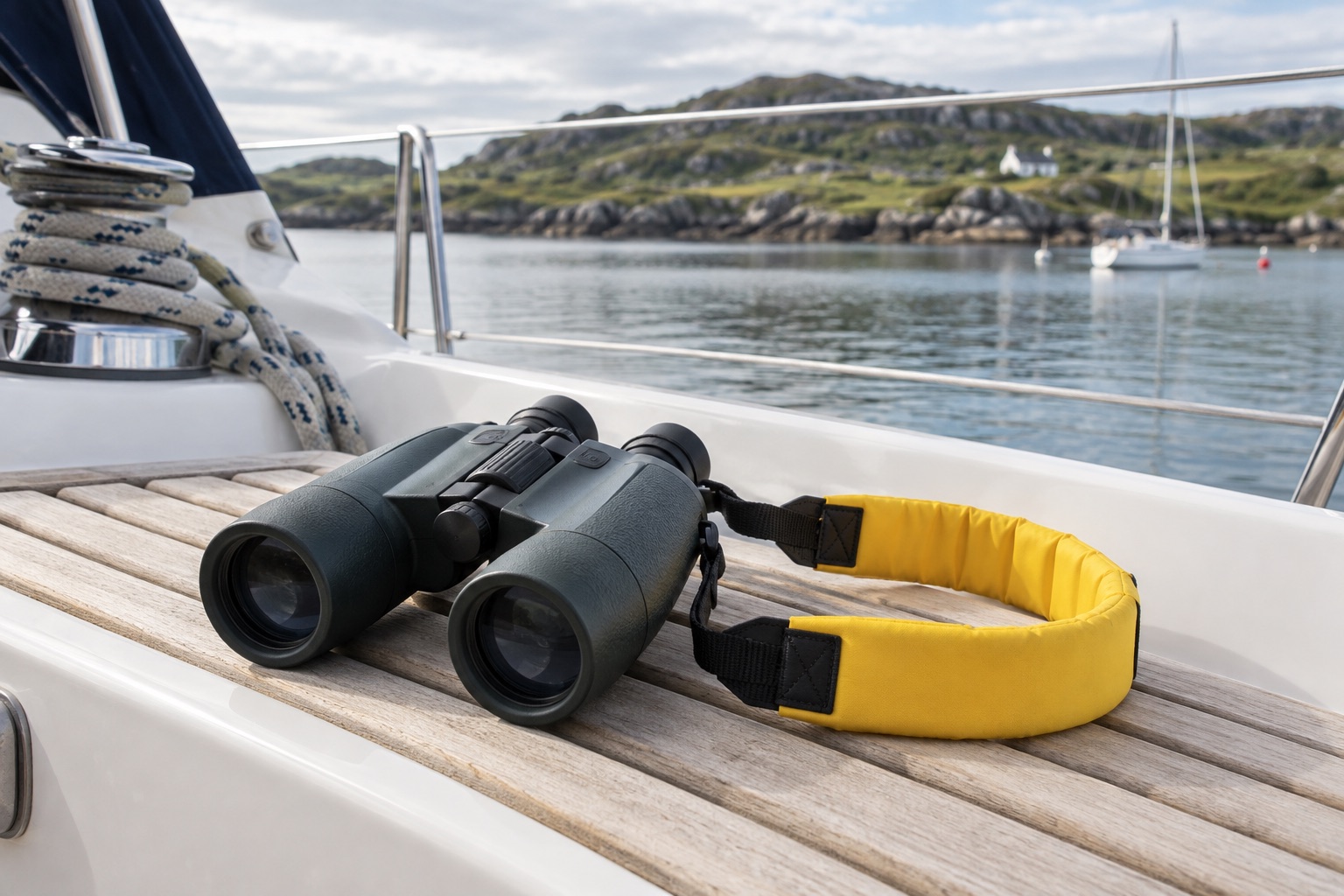
Confirm binocular model, connector generation and total weight.
A floating strap alone does not prove the complete kit will float.
Keep a secure grip; recovery is never worth personal risk.
Quick picks
Choose by the detail that matters most
Links open the matching Amazon UK listing. Prices and sellers can change, so confirm the model name and ASIN before buying.
Swipe to compare all details →
| Check | Why it matters | Action |
|---|---|---|
| Connector | ClicLoc does not fit ordinary lugs | Match exact generation |
| Instrument weight | Buoyancy varies | Use maker compatibility guidance |
| Condition | Worn clips may release | Inspect ashore |
The detailed shortlist
A model-specific marine example
This is intentionally not presented as a universal strap.

Steiner floating strap 76803 for 7×50 ClicLoc models
Best for: Specified Steiner marine binoculars
A buoyant strap with Steiner ClicLoc connectors for specified 7×50 marine binoculars.
What stands out
- Buoyant marine strap
- Quick ClicLoc attachment
- High-visibility colour
Keep in mind
- Not a universal lug strap
- Confirm exact binocular generation and weight
- Steiner 76803
- ClicLoc
- Specified 7×50 models
A floating strap is a recovery aid, not marine insurance. It has to remain attached, provide enough buoyancy for the whole instrument and be visible in the water. Those conditions depend on an exact model, not simply a yellow pad.
The Steiner 76803 example
Steiner lists 76803 for ClicLoc-equipped Navigator Pro 7×50, Commander 7×50 and Global Commander 7×50. It lists a separate 76804 version for the Navigator Pro 7×30. Those similar codes show why a generic search result is inadequate. An open-hinge binocular or older conventional strap-lug design may use another connector. Read the body label and maker's accessory chart before ordering.
Buoyancy is about the whole kit
A strap can float alone yet fail to support a heavy binocular. The manufacturer compatibility list is stronger evidence than a vague load claim. Waterlogged material, a loose clip or an added accessory can change the outcome. The strap does not prevent impact or salt damage, and does not make a binocular waterproof. Check the body specification separately in our marine binocular guide.
While observing from a stationary position, keep the binocular attached and controlled. Do not let a strap snag lines or moving equipment. Put the binocular away before deck tasks on a moving vessel and follow the skipper's directions. No attempt to retrieve dropped optics is worth personal risk.
After spray
Clean and dry the strap according to its maker's instructions. Follow the binocular maker's own saltwater care directions rather than assuming a sealed body can be rinsed under a tap. Inspect clips for grit and wear before the next trip. If moisture appears inside the instrument, seek qualified service. Our sea-spray care guide covers routine aftercare.
A purchase check for your exact boat binocular
Start with the model plate on the binocular, not a photograph of a similar-looking Navigator. Confirm whether it has ClicLoc fittings and which generation or size the accessory list names. A conventional strap lug cannot be treated as a ClicLoc point merely because the strap itself floats. If your binocular is not on the 76803 compatibility list, ask the manufacturer or retailer for the correct buoyant strap and connector; do not improvise a clip that only partly engages.
Next, consider the complete carried item. Attached caps, a compass-equipped body or a phone adapter alter the load and balance. Check that the published buoyancy applies to your actual binocular, rather than assuming a floating strap guarantees recovery of any instrument. Try the clip engagement and release over a safe surface before departure. A strap should sit where you can lift the binocular without dragging it across a rail, but it should not form a loose loop near winches or other moving gear.
When a floating strap is not the answer
For shore-based seawatching, a comfortable ordinary strap or harness may be more useful than buoyancy; there is no benefit to specialised marine clips that do not fit. On a moving boat, safe stowage and a secure grip remain the first line of protection. A floating strap is a mitigation for an accidental drop, not a reason to use optics during a manoeuvre or lean overboard. Keep viewing secondary to the crew's instructions.
Frequently asked questions
Floating strap questions
Will any floating strap keep binoculars afloat?
No. Buoyancy depends on binocular weight, strap design and condition. Use a maker-approved combination, not the strap colour as evidence.
Does Steiner 76803 fit all Steiner marine binoculars?
No. Steiner lists specific 7×50 ClicLoc models. Other sizes and connector systems need a different accessory.
Can I attach it to a standard 8×42?
Only if its maker confirms connector fit and flotation for that exact binocular. Steiner 76803 is not a universal 8×42 strap.
Can I test it by throwing binoculars overboard?
No. Seek manufacturer guidance and inspect the connections; do not deliberately risk the optics or your safety.