
Night-sky choice · 50mm binoculars
7×50 vs 10×50 binoculars for astronomy
Compare seven- and ten-times 50mm binoculars for star fields, sky glow, hand shake, pupil size and tripod use.
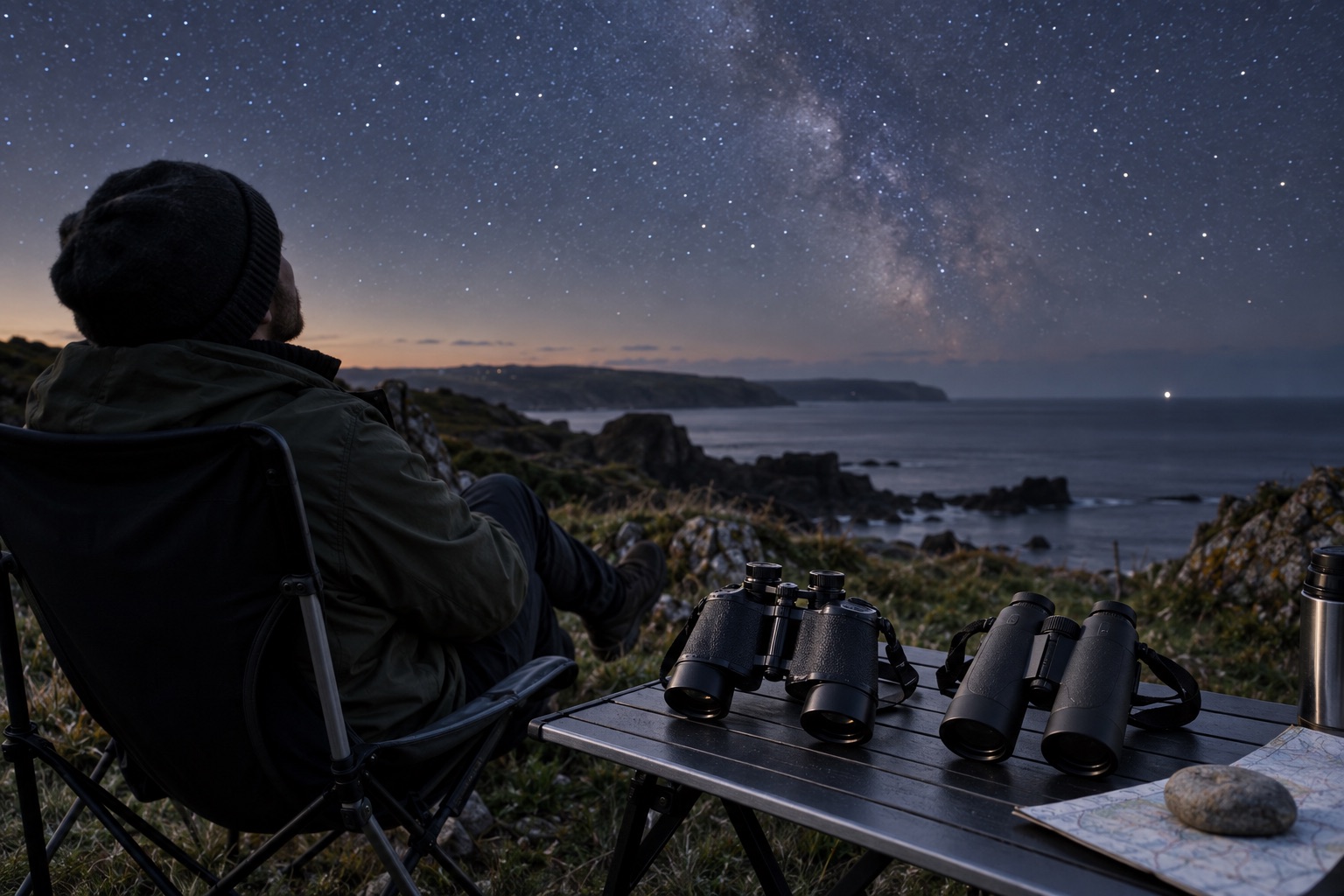
The same 50mm objectives do not make both views equally bright to every eye.
Ten-times power increases apparent scale and hand shake.
A 7×50 marine model may have individual focus; check that before buying for the sky.
Seven-times and ten-times 50mm binoculars share the same objective diameter but give different night-sky experiences. A 7×50 is easier to hold and generous at the eye. A 10×50 enlarges lunar features, star groups and brighter deep-sky objects more. Neither is the single best choice for every sky, eye and hand.
Swipe to compare both formats →
| Question | 7×50 | 10×50 |
|---|---|---|
| Magnification | 7× | 10× |
| Exit pupil | About 7.1mm | 5mm |
| Hand shake | Less apparent | More apparent |
| Target scale | Broad-field feel | Small targets larger |
| Good first trial | Dark-sky sweeping | Mixed skies and detailed targets |
What happens to the light beam?
Divide 50mm by the magnification: 7×50 sends about a 7.1mm beam from each eyepiece, while 10×50 sends a 5mm beam. If your eye pupil does not open past 5mm, part of the 7×50's beam falls outside it. That is why a larger exit pupil is not automatically a brighter seen image. Eye pupils vary by person and conditions; do not assume an age-based number for yourself.
The Nikon Action EX 7×50 and 10×50 specifications provide a useful matched counterexample to the idea that lower magnification always means a wider true field. Nikon lists 112m at 1,000m for the 7×50 and 114m for the 10×50—almost the same patch of sky. The 7×50's 7.1mm exit pupil is much larger, but its published apparent field is 42.7° versus 59.2° for the 10×50. That means a more generous light beam is not the same thing as a more expansive-looking eyepiece view. The two bodies are also close in mass, at 1,000g and 1,020g. These figures isolate a choice of viewing character within one range; they cannot establish which shows fainter stars to a particular observer.
Under a light-polluted sky, 7× can leave the background looking washed out. Ten-times power spreads the background light over a larger apparent area while making stars and small targets larger, although actual results depend on the specific optics and your steadiness. From a very dark site, 7×50 can make wide star fields wonderfully easy to scan. The best test is to compare the same region of sky from your normal observing place.
Handholding decides whether the extra power pays
Ten-times power magnifies your tremor. Sit, support your elbows or lean against a stable surface. If stars still dance, mount the binocular or return to a steadier 7× view. At 7×, the greater ease can make it more pleasant to learn constellations and pan the Milky Way. If you want to inspect a compact cluster or the Moon, 10× often has the edge when held steady. For more power, a supported 15×70 is a different carrying commitment.
Do not mistake marine features for astronomy advantages
Many 7×50 products, including Steiner's Navigator example, are made for boats. Their waterproofing and easier handling on moving water may be valuable, but a marine focus arrangement, compass or unusual eyecups can be unnecessary for stars. The Celestron Nature DX 10×50 is a centre-focus outdoor model. These two examples illustrate the format difference; their published figures do not establish which has better sharpness or light transmission.
For a first night-sky purchase, try a regular 10×50 if you can hold it comfortably and your site has some sky glow. Choose 7×50 when a wide, calm view is the priority and the model's focus and fit genuinely suit you. Our 10×50 astronomy guide covers exact choices. Never look at the Sun through binoculars, even briefly or during an eclipse.
Helpful products
Two 50mm examples with different purposes
Steiner Navigator 7×50 is a marine design; Celestron Nature DX 10×50 is a centre-focus outdoor binocular. These illustrate formats, not a like-for-like optical-quality contest.

Steiner Navigator 7x50
Best for: Serious boating without a compass
A purpose-built 7×50 marine binocular with individual eyepiece focus, a 7.1mm exit pupil and waterproofing to a stated 5m.
What stands out
- Waterproof to a stated 5m
- Approximately 140m field at 1,000m
- 20.2mm eye relief and individual focus
Keep in mind
- 20m close focus is unsuitable for nearby nature
- Individual focus is slower when subject distance changes often
- 7×50
- 754g
- 140m / 1,000m
- Waterproof to 5m
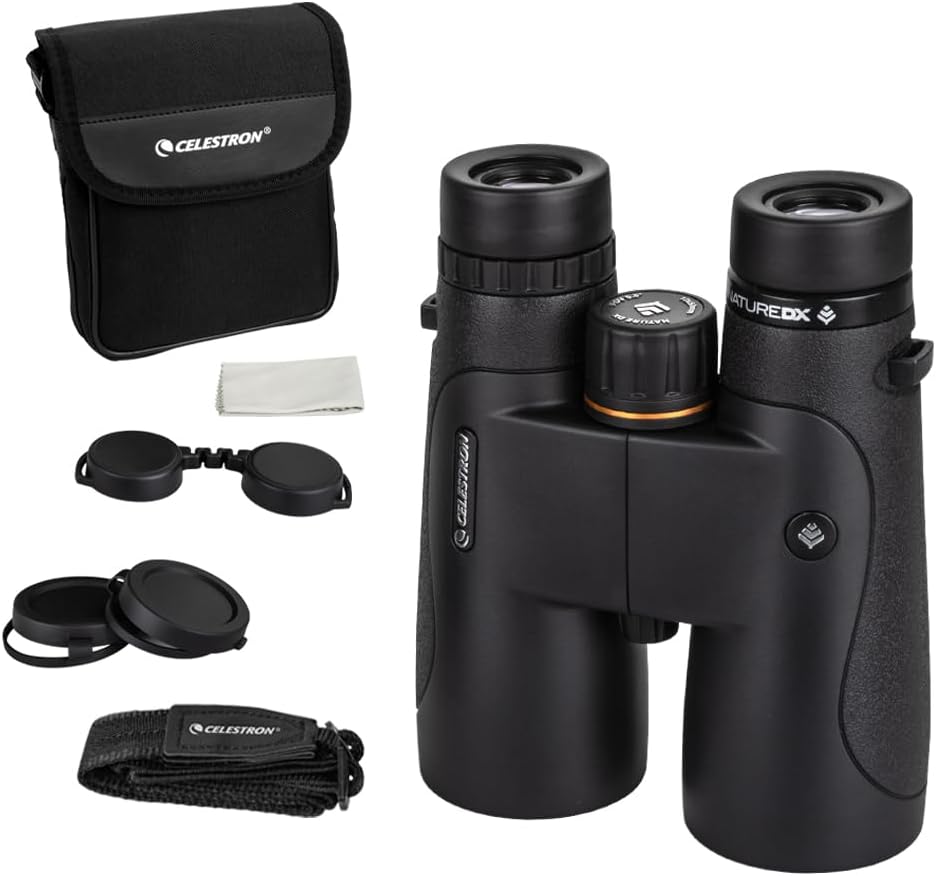
Celestron Nature DX 10x50
Best for: Wildlife and night-sky crossover
A 10×50 with waterproof nitrogen-filled construction, 17.5mm eye relief and an approximately 101m field at 1,000m.
What stands out
- 5mm exit pupil
- Waterproof and nitrogen filled
- 2.5m close focus
Keep in mind
- 806g is heavy for all-day carrying
- Field is narrower than the UpClose G2's
- 10×50
- 806g
- ≈101m / 1,000m
- 17.5mm eye relief
Frequently asked questions
7×50 and 10×50 astronomy questions
Is 7×50 brighter than 10×50?
It has a larger 7.1mm exit pupil, but the benefit depends on your dark-adapted pupil and sky brightness. A 5mm exit pupil can be more practical for many observers.
Which shows more stars?
It depends on sky conditions, optical quality and steadiness. Ten-times power often reveals smaller targets and darkens the background relative to 7×, but shake can erase that advantage.
Is 7×50 easier to handhold?
Usually: lower magnification shows less shake. Body weight, balance and observing posture still matter.
Can I view the Moon through either?
Yes, but never use either to look at or near the Sun. The Moon is safely bright for ordinary binocular viewing; a stable position improves detail.