
Buying guide · Close to home
Best binoculars for garden birds
Choose binoculars for birds close to a UK window or feeder by close focus, field width and comfortable eye placement.
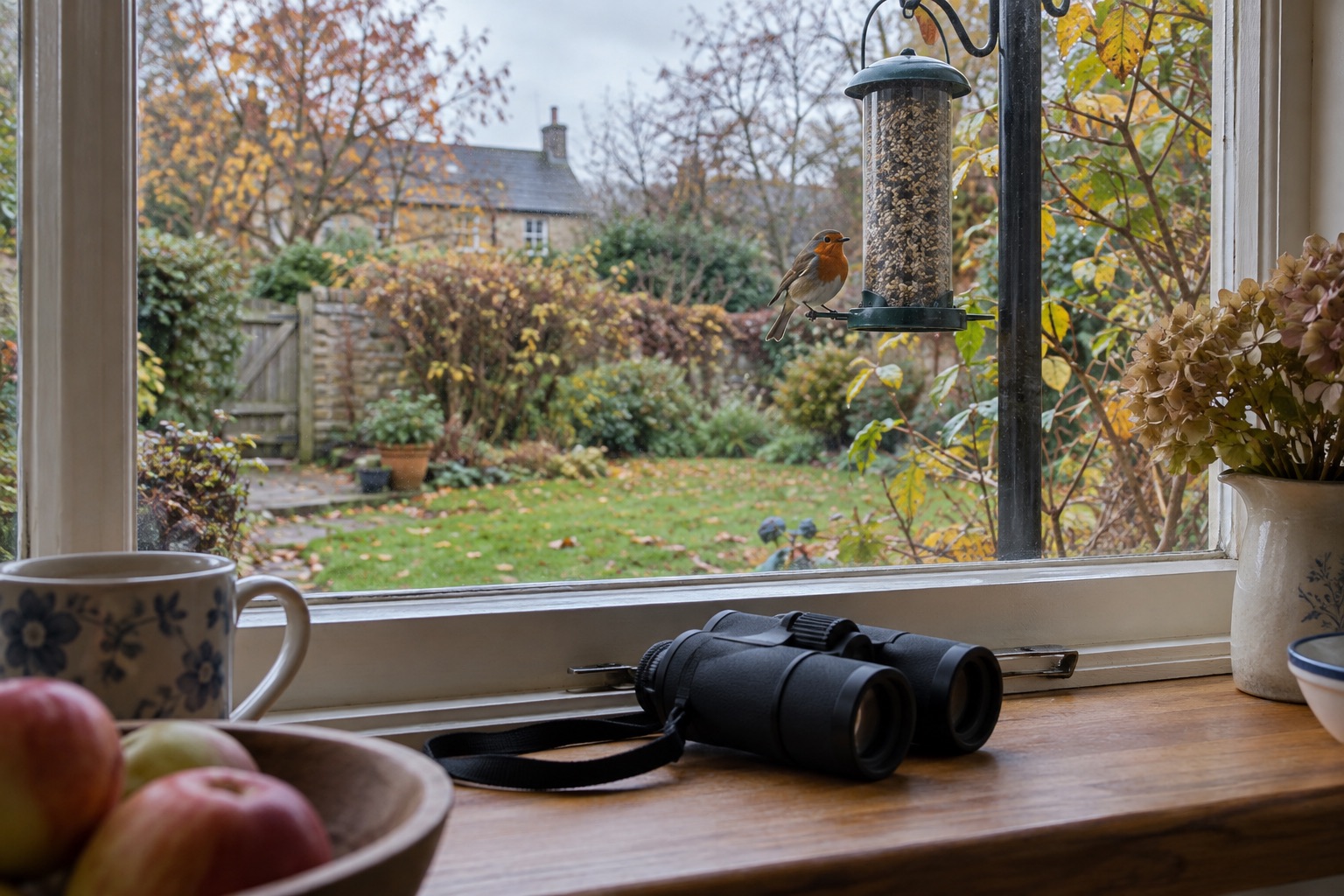
Measure the closest bird you really want to watch.
A wide 8× field helps reacquire birds moving between branches.
Check the full field through glazing and with your own glasses.
Quick picks
Choose by the detail that matters most
Links open the matching Amazon UK listing. Prices and sellers can change, so confirm the model name and ASIN before buying.
Swipe to compare all details →
| Model | Close focus | Field at 1km | Eye relief | Weight |
|---|---|---|---|---|
| Nature DX 8×42 | 2m | 129m | 17.5mm | 629g |
| Nature DX ED 8×42 | 2m | 129m | 17.8mm | 705g |
| PROSTAFF P7 8×42 | 3m | 126m | 20.2mm | 590g |
The detailed shortlist
Three exact 8×42 choices
Choose by the distance to your feeder, the width of the view and how comfortably you can see the whole field with your usual glasses.

Celestron Nature DX 8x42
Best for: First 8×42 and close garden viewing
A well-specified first birdwatching binocular with a wide 129m field, 2m close focus and phase-coated BaK-4 prisms without stepping up to ED-glass pricing.
What stands out
- 129m field of view at 1,000m
- 2m stated close focus
- Waterproof, nitrogen-filled body
Keep in mind
- 17.5mm eye relief offers less margin than the Nikon P7
- No ED glass in this standard Nature DX model
- 8×42
- 629g
- 129m / 1,000m
- 17.5mm eye relief

Celestron Nature DX ED 8x42
Best for: Birds, butterflies and nearby detail
An ED-glass 8x42 with a 129m field and 2m close focus, making its published specification especially relevant to mixed bird, butterfly and garden viewing.
What stands out
- 2m stated close focus
- ED objectives and phase-coated BaK-4 prisms
- 17.8mm eye relief with multi-stop eyecups
Keep in mind
- 705g is the heaviest body in this shortlist
- The useful ED-glass claim still does not replace an in-person view
- 8×42
- 705g
- 129m / 1,000m
- 2m close focus

Nikon PROSTAFF P7 8x42
Best for: Wide viewing with glasses
A 590g all-round 8x42 with a wide 126m field, long stated eye relief and a locking dioptre ring that helps preserve a personal focus setting.
What stands out
- 126m field of view at 1,000m
- 20.2mm stated eye relief
- 590g waterproof body with locking dioptre
Keep in mind
- 3m close focus is useful rather than class-leading
- No ED glass in the published specification
- 8×42
- 590g
- 126m / 1,000m
- 20.2mm eye relief
A garden puts birds unusually close. The distances from kitchen window to feeder, patio to hedge and upstairs room to tree are more useful than a theoretical far-horizon view. Before shopping, pace or measure your shortest likely viewing distance. A model that cannot focus there may be frustrating even if it is excellent on a reserve.
Near feeder: Celestron Nature DX 8×42
The standard Nature DX 8×42 reaches a stated 2m close focus and gives a 129m field at 1,000m. Those figures suit a feeder close to the house and the quick movement of tits or finches between cover. Phase-coated prisms and a sealed, nitrogen-filled body make it credible for outdoor use. Its 17.5mm eye relief deserves a try with glasses; a specification alone cannot tell whether your frames expose the full field.
Same distance, different glass: Nature DX ED
The ED 8×42 keeps the same 2m close focus and 129m published field. The step up is ED objective glass, useful for controlling coloured fringes on a dark bird against a bright sky. It is also heavier at 705g. It does not bring extra magnification, a wider field or a shorter close focus. The direct model comparison spells out when the upgrade is worth considering.
Glasses and long sessions: Nikon PROSTAFF P7 8×42
Nikon states 20.2mm eye relief and a 590g body for the P7 8×42, with a 126m field. That combination is compelling for a watcher who keeps glasses on and holds the binocular for longer garden sessions. The trade-off is 3m close focus. If the feeder is closer, move the viewing position back or prefer the Nature DX. The P7's locking dioptre helps preserve a shared household user's setting, but each viewer still needs to adjust hinge, eyecups and focus.
Make the garden easier to watch
Pick a stable seat, clear the window reflection and learn to focus on the perch before the bird arrives. A window mount is built for parked vehicle glass, not a normal domestic window, so do not buy one on assumption. If the garden is shaded, a full-size 8×42 will generally be less fussy about eye placement than a pocket 8×25. For broader habitats, see best binoculars for birdwatching.
Measure from the eye, not from the house wall
A feeder mounted two metres outside a window may be farther from the seat where you actually hold the binocular. Conversely, a bird on the sill can be nearer than the focus limit of every model on this shortlist. Measure roughly from your eye position to the closest perch you intend to watch. If it falls inside a model's stated minimum, moving the chair back may be simpler than buying a specialised pair. The limit also matters for butterflies or insects on patio plants; long-distance magnification is not the difficult part of that task.
Window glass adds its own variables. Move close enough to reduce reflections without pressing the objectives into the pane. Try a clean section of glass and compare the view through an open window when safe; soft detail may come from glare or glazing rather than the binocular. Keep loose straps away from cups and plants on a sill. If you share the binocular with another household member, each person should reset hinge spacing and eyecups, and use the dioptre only as the maker instructs.
Garden watching can also be a long, seated activity. Check whether the focus wheel falls naturally under your finger and whether a 705g ED body remains comfortable through repeated lifts. A 2m focus number is valuable when you need it, but it does not automatically outweigh the P7's glasses fit or lower stated weight for a more distant garden. The best choice follows the actual seat, subject distance and viewer.
Frequently asked questions
Garden bird binocular questions
Do I need 10× for birds in the garden?
Usually not. An 8× view is easier to aim and follow when a bird hops between nearby branches.
Can I use binoculars through a window?
Yes, but reflections, dirty glass or double glazing can soften the view. Move close to clean glass and avoid bright reflections.
What if my feeder is only two metres away?
Choose a model whose stated close focus reaches that distance, then allow for where you actually sit. A published minimum is not a comfort guarantee.
Is ED glass essential for garden birds?
No. ED glass can reduce colour fringing on bright branches, but fit, focus and field width often matter more for a first garden pair.