
Compact choice · Carry and comfort
25mm vs 32mm compact binoculars
Compare 8×25 and 8×32 binoculars for pocketability, daylight brightness, eye placement, glasses fit and walking.
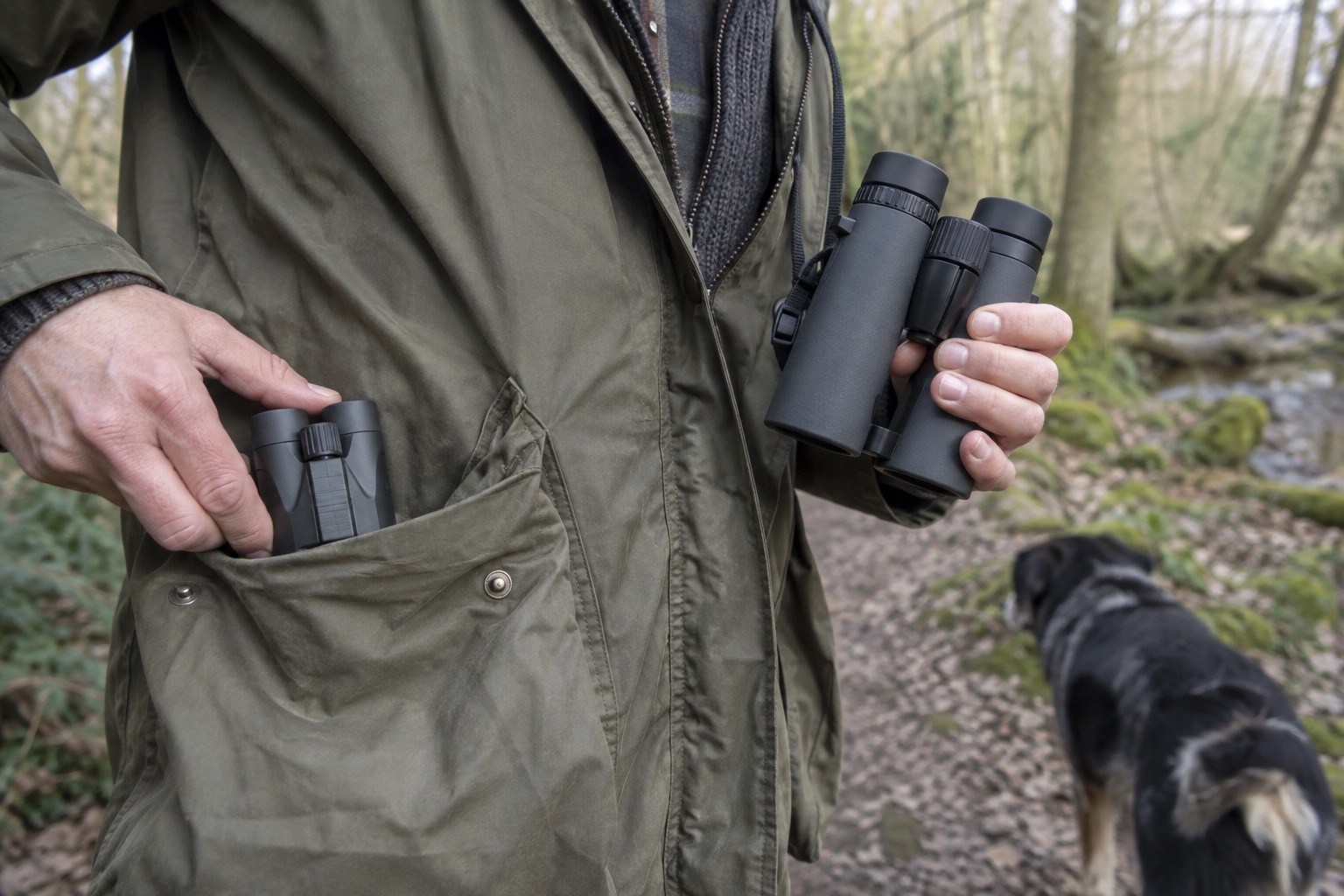
Hold magnification at 8× to isolate the objective-size decision.
Check folded dimensions as well as grams: not every 25mm fits a pocket.
Field width and eye relief come from the exact model, not the 25/32 label.
“Compact” can mean anything from a folding coat-pocket 8×25 to a small but full-grip 8×32. The strongest reason to buy a 25mm model is that it accompanies you on days when a larger binocular stays at home. The strongest reason for 32mm is that it remains comfortable and forgiving when you actually stop to watch.
Swipe to compare both sizes →
| Factor | 8×25 | 8×32 |
|---|---|---|
| Magnification | 8× | 8× |
| Exit pupil | 3.125mm | 4mm |
| Packed size | Potentially coat-pocket | Usually daypack or strap |
| Eye placement | More exacting | More forgiving |
| Best fit | Travel and opportunistic views | Regular daylight birdwatching |
The size difference is more than 7mm
At equal magnification, the 32mm objective has roughly 64% more geometric collecting area than a 25mm objective. That is not a promise of 64% more perceived brightness: optical transmission and eye pupil still matter. The practical difference is often the 4mm versus 3.125mm exit pupil. The larger beam gives your eye more room to move and can keep the view comfortable when light is flat. A 25mm model remains capable in bright daylight, where the eye pupil may be smaller than either beam.
Two actual products make the carrying trade visible. Nikon's SPORTSTAR EX II 8×25 is listed at 310g and folds compactly. Vortex's Diamondback HD 8×32 weighs about 451g. The 141g difference can decide whether you pack it in a jacket or wear it on a strap. Yet the Nikon's 8.3° angular field is slightly wider than the Vortex's 8.1°. The 32mm Vortex instead offers 16mm versus 10mm stated eye relief and 1.5m versus 2.5m close focus. Those are more concrete reasons to accept its bulk than assuming that 32mm automatically brings a wider view. Because these models come from different ranges, this is a carry-and-fit comparison, not an image-quality ranking.
Fit is not simply aperture
Pocket optics often have smaller eyecups and require careful placement. If you wear glasses, test whether you can see the complete field with the eyecups down. Compare eye relief and the physical eyecup shape. Likewise, a wider objective does not guarantee a wider field of view; the Nikon 8×25 has an 8.3° stated field, and model design can offset size expectations.
For a concert, city break or occasional walk, the 25mm pair can be the right purchase precisely because it is unobtrusive. For woodland birds, all-day reserve visits and dull UK weather, 32mm is usually the stronger small binocular. If carrying 32mm is already easy, ask whether an 8×42 would better serve dawn or dusk. Our best compact binoculars compares exact model choices across all three portable sizes.
Helpful products
One pocket and one mid-size example
Nikon SPORTSTAR EX II 8×25 is listed at 310g; Vortex Diamondback HD 8×32 at 451g. Their optical designs differ, so treat them as carry examples, not a sharpness contest.

Nikon SPORTSTAR EX II 8x25
Best for: Travel and all-day carry
A genuinely pocketable 310g binocular with a wide 8.3-degree field and a waterproof, nitrogen-filled body.
What stands out
- Only 310g
- Wide 8.3-degree field
- Waterproof and nitrogen-filled
Keep in mind
- 25mm objectives are less forgiving at dusk
- Compact controls can be fiddlier with gloves
- 8×25
- 310g
- 8.3° field
- Waterproof

Vortex Diamondback HD 8x32
Best for: Walks, travel and close viewing
A compact weather-sealed 8×32 that combines a 451g carry weight with a very wide 142m field and 1.5m close focus.
What stands out
- Approximately 451g
- Approximately 142m field of view at 1,000m
- Waterproof, fogproof and 1.5m close focus
Keep in mind
- 16mm eye relief may be marginal with some glasses
- Smaller 32mm objectives give up some low-light ease to 42mm models
- 8×32
- 451g
- 142m / 1,000m
- 16mm eye relief
Frequently asked questions
25mm and 32mm binocular questions
Is 8×32 more powerful than 8×25?
No. Both magnify eight times. The larger second number describes objective diameter, affecting light and usually body size.
Is 25mm enough for birdwatching?
It can work well in good daylight for occasional birds. For long sessions, dull woodland or winter afternoons, 32mm is usually more forgiving.
Which is better with glasses?
Neither size guarantees fit. Check actual eye relief and eyecups; a pocket 25mm may be harder to position, but some 32mm models also have short usable relief.
Does 32mm always have a wider field?
No. Field width is an eyepiece-design specification. Compare metres at 1,000m on the exact models.