
Buying decision · Variable magnification
Are zoom binoculars any good?
Decide whether variable-power binoculars suit your viewing, and what to test at both ends of the zoom range before buying.
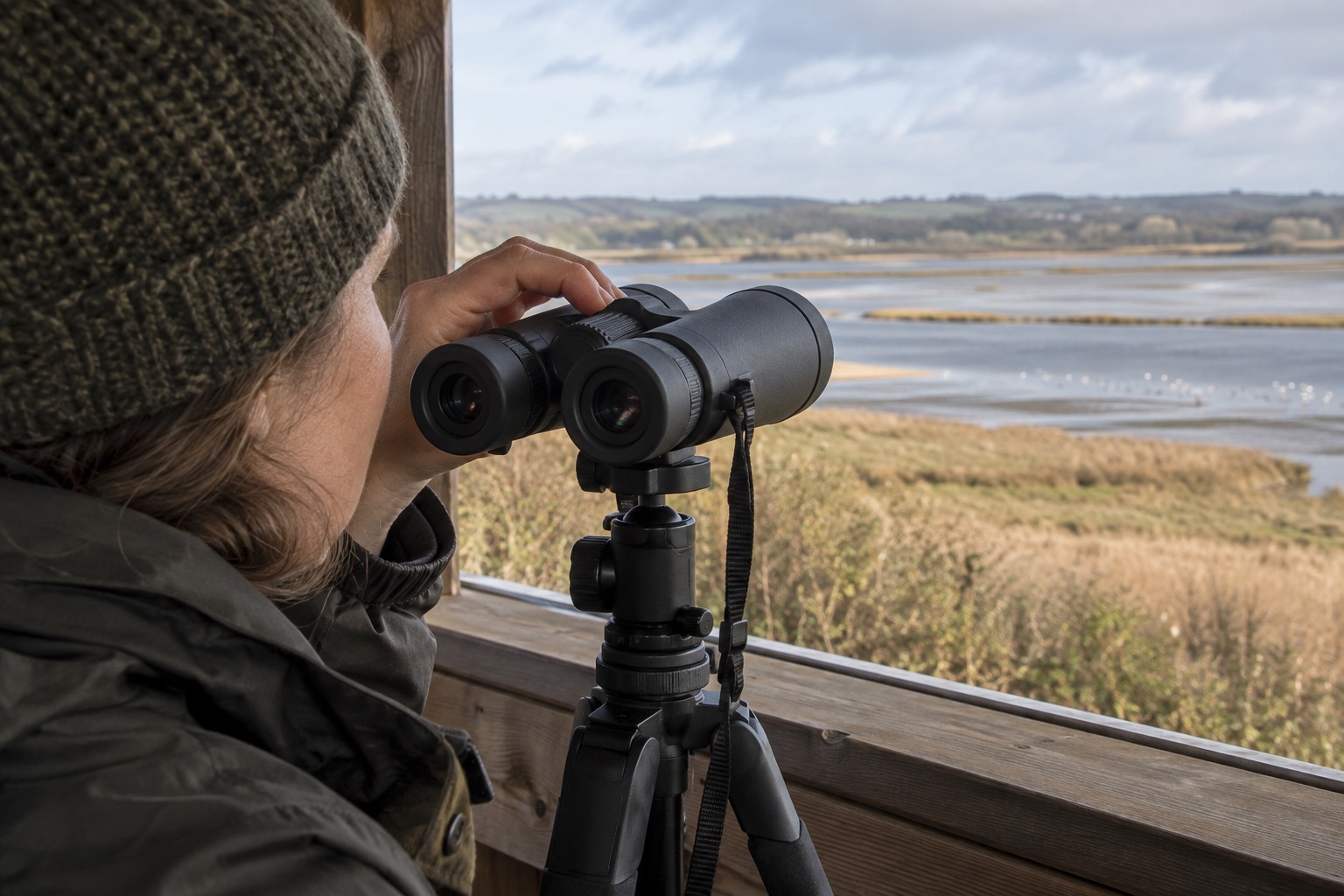
Test image alignment, focus and field width at both the lowest and highest settings.
A printed 8–24× range says nothing by itself about the quality of the high-power view.
Do not point any zoom binocular at the Sun.
A zoom binocular promises the convenience of one instrument for scanning and inspecting. The promise is real: you can start at a lower power and turn a control for more apparent reach. The question is whether the view at the power you will actually use remains wide, bright, steady and comfortable. A dramatic number on the body is not an answer to that question.
What changes as you turn the zoom
Magnification rises while the objective lenses stay the same size. The calculated exit pupil therefore gets smaller. An 8–24×25, for example, gives approximately 3.1mm at 8× and just 1.0mm at 24×. That does not make the high setting unusable in bright light, but it makes eye placement less forgiving and gives you less light at dusk. Higher power also enlarges apparent hand movement. Many designs have a noticeably narrower field at the long end, making a bird or aircraft harder to find again after changing power.
These are consequences of power and aperture, not proof that every zoom binocular is badly made. The quality of the zoom mechanism, eyepieces and barrel alignment still matters. Nikon's buying guidance cautions that very high binocular powers can give a narrow, unstable view; use that warning as a prompt to test, not as a substitute for examining a particular pair.
The decision by how you observe
Swipe to compare viewing choices →
| Your priority | Usually start with | Why |
|---|---|---|
| Walking and moving birds | Fixed 8× | Easy aiming and a consistently usable field |
| Occasional power changes from a seat | Try a zoom pair | Variable reach may justify the handling trade-off |
| Long views of distant, mostly still subjects | Spotting scope and tripod | Purpose-built high power and stable support |
At a racecourse, viewpoint or garden window, a zoom may be enjoyable because you can pause, brace your arms and change power. On a woodland path, time spent operating the zoom while a bird moves can cost the sighting. A fixed 8× or 10× lets you learn one field width and one steady handling pattern. Our binocular-versus-scope guide helps if the subject is simply too distant for handheld use.
A shop test that can save a poor purchase
Choose a safe detailed target—never the Sun—and inspect it at the lowest, middle and highest powers. Check whether both eyes still combine into one relaxed image, whether you can refocus promptly, and whether the edges become distracting. Move the target towards the edge and back; see how much landscape remains at maximum zoom. Repeat with your glasses if you wear them. Hold the pair as you would outdoors, then brace it and compare the detail you can truly resolve.
If the high end is too shaky or cramped to use, do not pay for its advertised number. Select a fixed-power pair for everyday viewing, or budget for a scope and stable tripod when high magnification is the point. A variable-power binocular is worth buying only after you have checked its view across the zoom range yourself.
Frequently asked questions
Zoom-binocular questions
Are zoom binoculars good for birdwatching?
They can work from a fixed position, but a fixed 8× or 10× pair generally makes finding and following moving birds simpler. Try the zoom at both ends before choosing it for field use.
Why does the view get darker when I zoom in?
With the same objective diameter, exit pupil shrinks as magnification rises. An 8–24×25 changes from about 3.1mm at 8× to about 1.0mm at 24×, before considering transmission losses.
Do zoom binoculars need a tripod?
Not at every setting, but high magnification makes hand movement much more obvious. Support becomes increasingly valuable as the zoom rises.
Is a zoom binocular better than a spotting scope?
For a portable two-eyed view, a zoom binocular may suit occasional use. For sustained distant observation at high power, a tripod-mounted scope is usually the more purposeful format.