
Travel · Practical guide
Binoculars in hand luggage
How to pack binoculars for cabin travel from the UK, with airline-size, airport-security, cleaning-liquid and tripod checks.
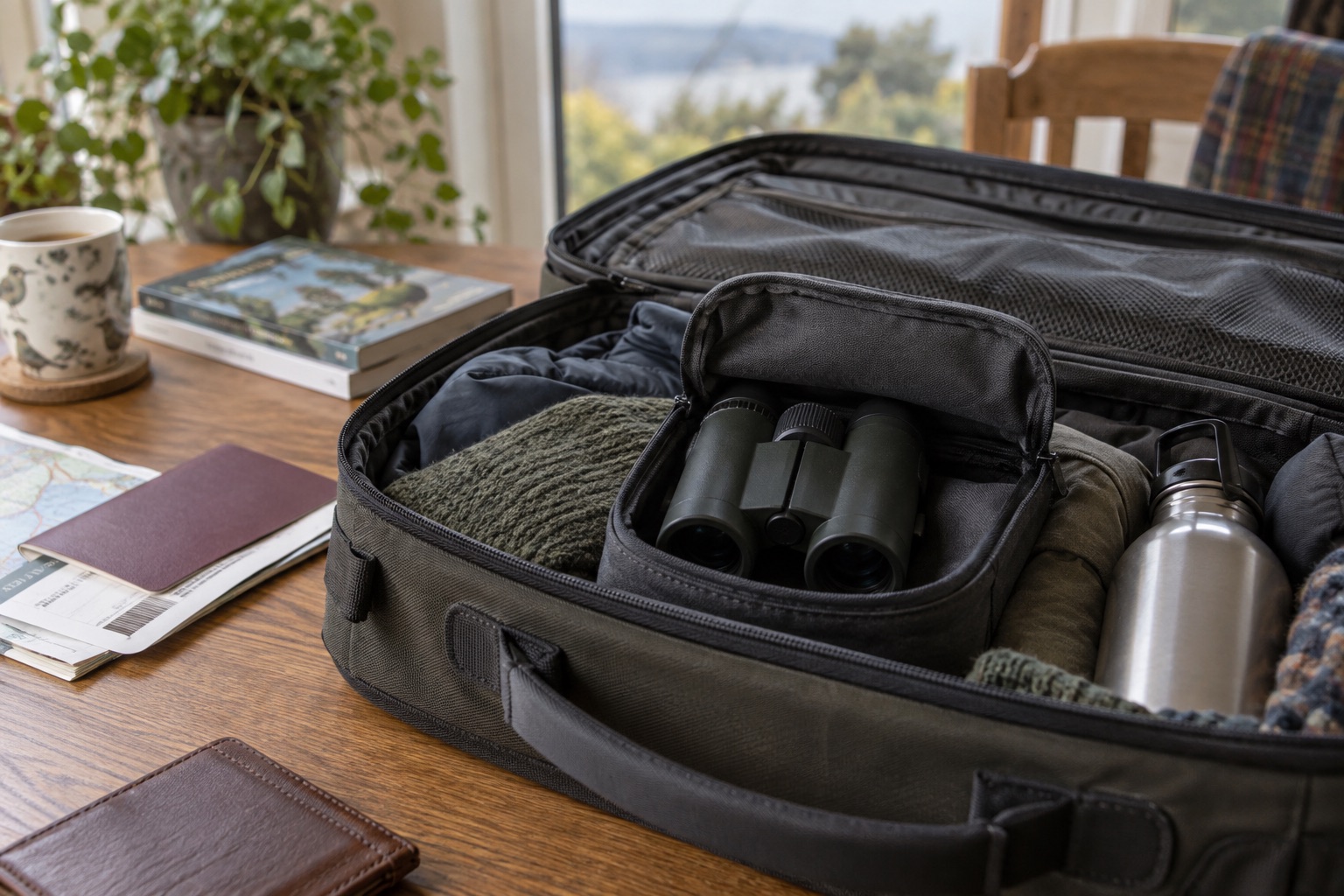
Check the airline's current cabin-bag dimensions and item count.
Cushion binoculars so lenses, focus wheel and eyecups cannot be crushed.
Check security rules separately for liquids, tools and tripod components.
For most trips, the cabin bag is a sensible place for binoculars: they remain under your control and away from routine hold-baggage handling. The important caveat is that baggage and screening rules belong to the airline and airports on your particular journey. Ordinary passive binoculars are not themselves a special travel document, but an individual security officer may ask to inspect them.
Before packing: three separate checks
First, check your airline's current number, dimensions and weight of cabin bags. A binocular case does not necessarily count as a free additional item. A large chest harness worn under a coat can still be treated as an extra personal item at the gate; pack it inside your permitted bag unless the airline says otherwise.
Second, check the departure and connecting airports' screening instructions. GOV.UK's hand-luggage guidance notes that security staff may refuse an item even when it is not on a prohibited list. Follow the instructions given at the checkpoint and leave the optics accessible for inspection.
Third, check other equipment independently. Liquid restrictions vary with airport screening arrangements and can apply to bottled lens-cleaning solution. A dry microfibre cloth is simpler. Sharp tools, disassembly tools, long tripod sections or spiked feet may be assessed differently from the binocular itself. Check the carrier and airport for your exact support. If using image-stabilised binoculars, check the airline's current battery and spare-battery policy by battery chemistry and size.
Protect the optics without overpacking
Use the binocular's caps and a padded, correctly fitting case. Place it where a laptop, metal bottle or hard charger cannot press on the eyecups and focus wheel. A soft pouch protects against rubbing but not a heavy crush; a structured bag compartment may be better. If you carry a tripod adapter, remove it if the protruding bracket would put pressure on the binocular bridge. Keep small screws contained.
After a cold flight, let the closed case warm gradually before opening in a humid destination; surface fog can appear during temperature changes. If the binocular or case becomes damp, dry both before long-term storage. Do not leave optics inside a hot parked vehicle. Our travel binocular guide covers the size and format choice before departure.
This is practical packing guidance, not a guarantee of admission through security. Recheck the route shortly before you travel, particularly if you change airline, airport or equipment.
Frequently asked questions
Air-travel binocular questions
Can I take binoculars in a cabin bag?
Ordinary passive binoculars are generally carried in cabin baggage, but check your airline, departure airport and any connecting airport. Security staff have final discretion.
Should I remove binoculars at security?
Follow the airport staff and scanner instructions on the day. Keep them easy to reach if your bag needs separate inspection.
Can lens-cleaning fluid travel with them?
Cleaning fluid is subject to the departure airport's current liquids rules. Check its container size and airport instructions; a dry microfibre cloth avoids that issue.
Can I carry a tripod too?
Check the airline and airport for the exact tripod, packed size and any pointed components. Do not assume it is treated like the binocular body.
Do image-stabilised binoculars need battery checks?
Yes. Check the airline's current battery policy for the precise battery type and whether spare batteries need separate protection.