
Optical design · Prism types
Roof-prism vs Porro-prism binoculars
Understand the body shape, optical coatings, sealing, handling and value differences between roof and Porro binoculars without assuming either design always wins.
Look at the actual waterproof and fogproof claims; prism type alone does not prove sealing.
Phase-correction and reflective coatings matter particularly in many roof designs.
Compare field, eye relief, weight and feel—not only the prism label.
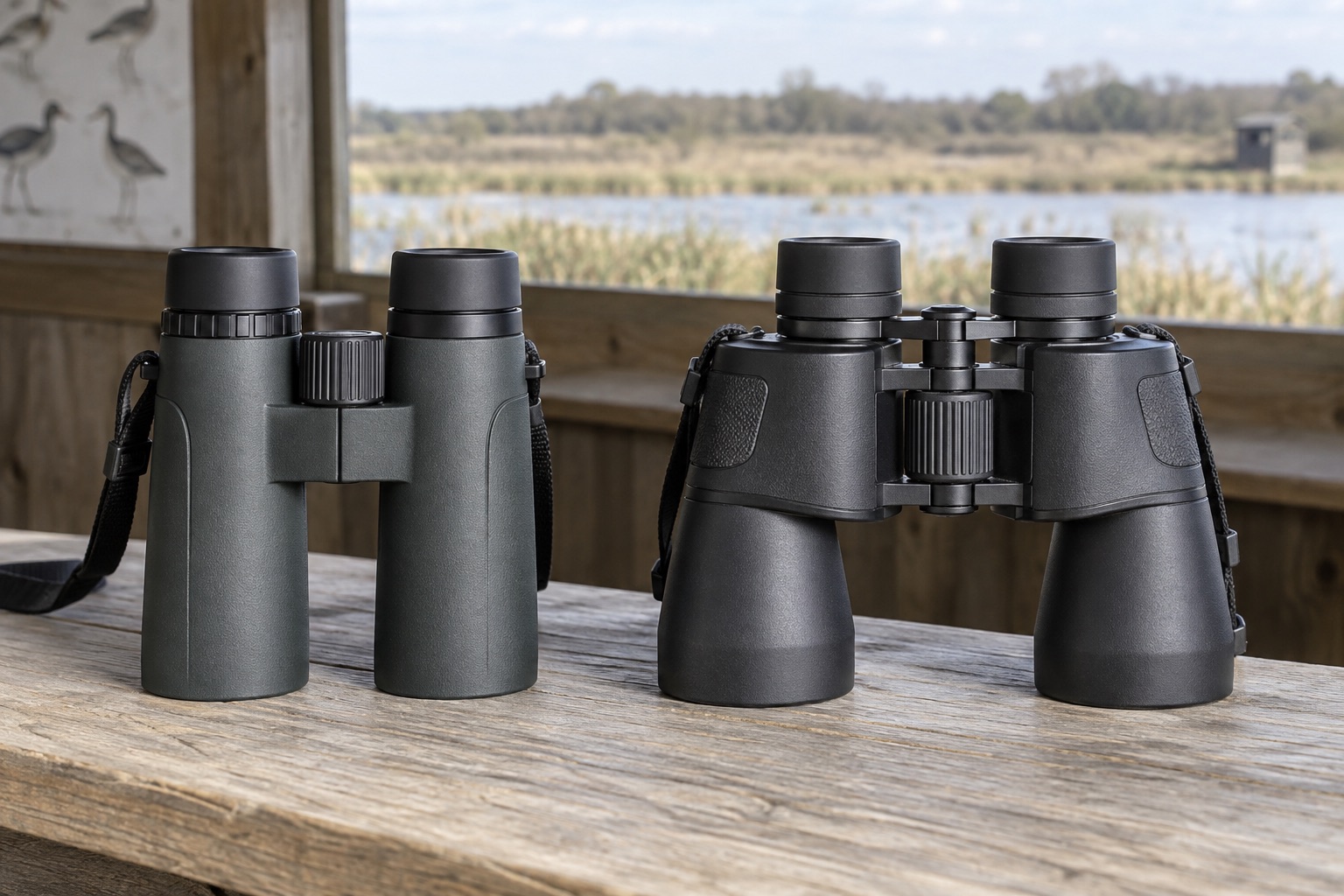
The easiest visual clue is barrel shape. A typical roof-prism binocular has two nearly straight barrels. A classic Porro-prism binocular offsets the objective lenses from the eyepieces, giving a stepped, wider stance. Both fold the light path to make a handheld instrument practical; neither shape alone tells you what the view will look like.
Where the roof design earns its place
A slim roof body is easier to pack close to your chest or slide into a smaller case. Many current birdwatching models also combine weather sealing, nitrogen or argon purging, central focus and twist-up eyecups in this form. The Celestron Nature DX 8×42 is one example with phase-coated BaK-4 prisms and waterproof nitrogen-filled construction.
Roof prisms require careful manufacture. Phase-correction coatings improve contrast and resolution in designs affected by phase differences, while reflective coatings matter where the light path needs a mirror surface. A cheap straight-barrel body without clear coating details is not automatically superior to a thoughtfully built Porro.
What a Porro can offer
The offset form can be comfortable for some hands and can provide good optical value at a given spending level. An OM System 8×40 S is a conventional daytime Porro alternative to compact roofs. A much larger Celestron SkyMaster 15×70 uses a Porro layout too, but its weight and magnification make a tripod sensible. The shared prism category does not make those two instruments interchangeable.
Porro bodies are often broader in a bag. Some entry models offer only water resistance, but that is a model choice, not a law of Porro optics. Check the exact waterproof claim before field use.
The comparison that actually matters
Hold two similarly sized, similarly priced models and check the complete view. Can you see the edges with glasses? How broad is the field? Does the centre focus smoothly from near to far? Does the body balance in your hands and case? For ordinary birdwatching, an 8×42 roof often makes a convenient weather-ready default. For a constrained budget or a stationary wide-body instrument, do not dismiss a good Porro merely because its shape looks old-fashioned.
Whatever the prism, avoid pointing at the Sun. The design does not change the risk of permanent eye injury.
Helpful products
Real roof and Porro examples
These examples illustrate different jobs: a portable 8×42 roof, a bulkier 8×40 Porro and a large mounted 15×70 Porro.

Celestron Nature DX 8x42
Best for: First 8×42 and close garden viewing
A well-specified first birdwatching binocular with a wide 129m field, 2m close focus and phase-coated BaK-4 prisms without stepping up to ED-glass pricing.
What stands out
- 129m field of view at 1,000m
- 2m stated close focus
- Waterproof, nitrogen-filled body
Keep in mind
- 17.5mm eye relief offers less margin than the Nikon P7
- No ED glass in this standard Nature DX model
- 8×42
- 629g
- 129m / 1,000m
- 17.5mm eye relief

OM SYSTEM 8x40 S
Best for: Broad daytime views
A traditional Porro-prism 8×40 with an exceptionally broad 143m field and a substantial, easy-to-grip body.
What stands out
- 143m field of view at 1,000m
- Large focus wheel and rubber grip
- 5mm exit pupil
Keep in mind
- 12mm eye relief is a poor starting point for glasses
- 715g Porro body takes more bag space
- 8×40
- 715g
- 143m / 1,000m
- 12mm eye relief

Celestron SkyMaster 15x70
Best for: Tripod-based deep-sky scanning
A large 15×70 astronomy Porro with 77m field and included tripod adaptor.
What stands out
- 70mm objectives
- Tripod adaptor included
- 18mm eye relief
Keep in mind
- 1,361g makes handheld use impractical
- Water resistant only; not nitrogen filled
- 15×70
- 1,361g
- 77m / 1,000m
- 18mm eye relief
Frequently asked questions
Prism questions
Are roof-prism binoculars better?
Not inherently. They are often slimmer and easier to seal, but optical quality depends on glass, coatings, manufacture and alignment.
Are Porro binoculars brighter?
A well-made Porro can offer excellent value and transmission, but no prism label guarantees brightness. Compare complete instruments in the same format.
Can Porro binoculars be waterproof?
Yes, some are. Check the specific manufacturer's sealing and purging claim rather than assuming an offset body is water-resistant only.
Why do roof prisms need phase correction?
The roof geometry can separate light-wave phases, reducing contrast and resolution. Phase-correction coatings address that effect in many roof designs.