
Handling guide · One hand
Monoculars for one-handed use
Choose a monocular for one-handed use by focus control, grip, tether, viewing position and a real handling test.
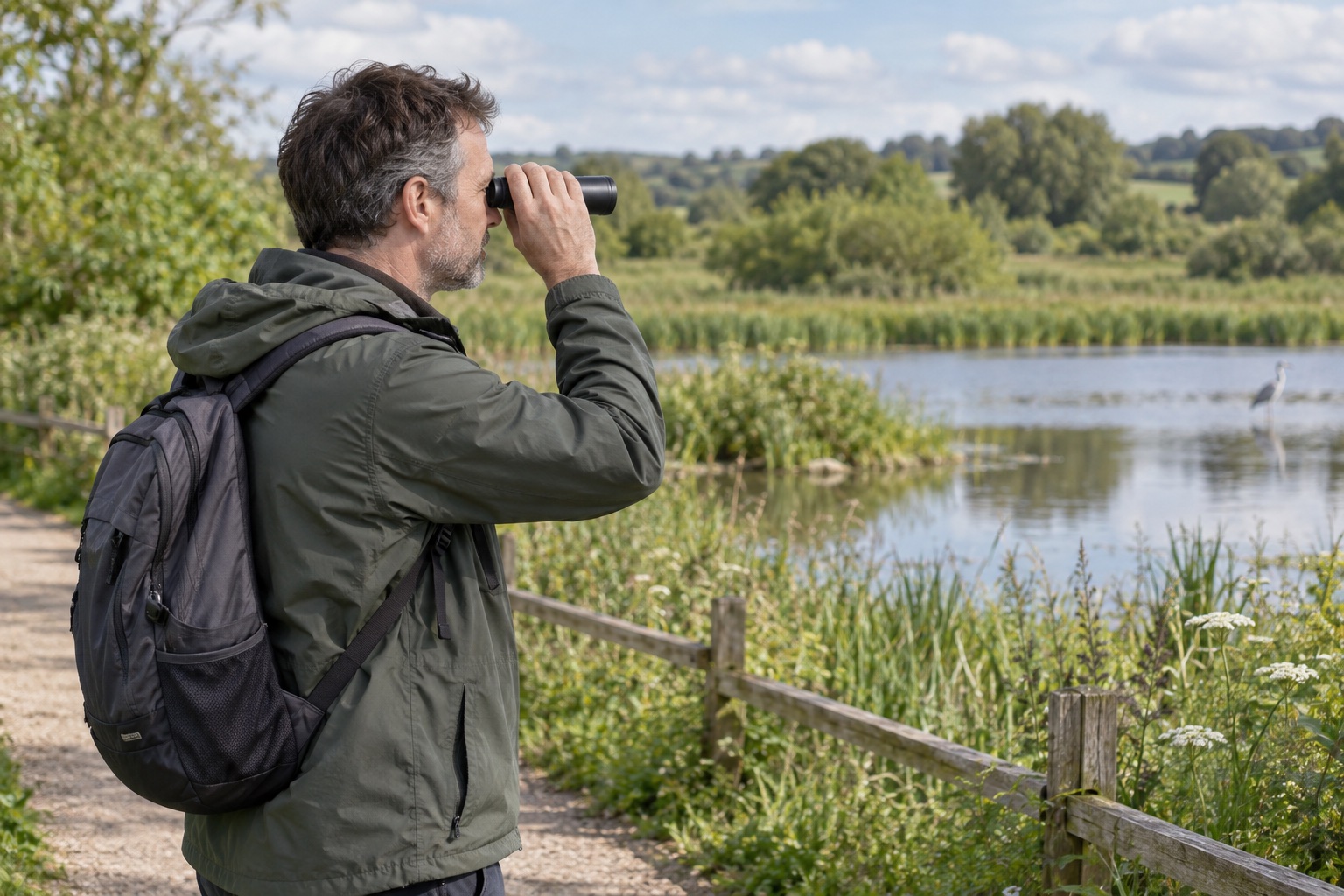
Try the entire raise–focus–lower sequence with one hand in a safe seated or standing position.
A focus control that moves without twisting the whole body is more important than a low weight alone.
A wrist loop or secure pocket can prevent a drop; check the exact supplied fittings.
The appeal of a monocular for one-handed viewing is obvious: one tube, one eye, no hinge to set. The harder question is whether you can raise, aim, focus and put it away without needing the other hand. That cannot be answered by a product title or weight alone. The control must sit where your fingers can reach it, and the body must stay steady while you move it.
Check the focus mechanism before the glass
Some compact monoculars use an eyepiece or body ring. Others put a larger focus control where a finger can turn it. A stiff ring that requires one hand to hold the body and another to rotate may defeat the purpose for you. Test a distant sign, then a nearer object, and return to distance. Can you focus smoothly without the monocular rolling away from your eye? Can you use the eyecup and caps without balancing the instrument precariously? There is no reliable shortcut for this handling test.
At about 159g, the Vortex Solo 8×25 is a sensible weight reference for pocket carry. The Opticron Explorer WA ED-R 8×42 is about 329g and provides a larger grip and exit pupil. A larger body may actually be easier to position, although it requires more support over a long view. Neither model's specifications can tell you whether its focus travel and resistance suit your hand size and range of movement. If a retailer allows a trial, bring the glove or sleeve you normally wear.
Set yourself up for a steadier view
Stop on level ground. Bring your elbow towards your body or rest it on a secure surface; avoid leaning on an unstable fence. Raise the monocular to your preferred eye after finding the subject with the naked eye. Use 8× as a starting power, because the narrower field and extra apparent movement of a tiny 10×25 can make one-handed aiming harder. A wrist loop or carefully placed pouch can reduce drop risk, but check that it will not snag on a wheelchair, walking aid, branch or door handle.
A purchase test with a clear pass or fail
Perform the complete sequence three times: remove from pocket or case, raise to the eye, focus near and far, lower and put away. Note any need to brace against your face or pinch a tiny ring. Repeat seated if you will use it seated, and in the light conditions you expect. If you cannot complete the sequence comfortably, a more supportive viewing setup may be better than a different monocular badge. A window-mounted binocular or tripod-mounted scope may help from a fixed place, but those have their own setup demands.
Our monocular-use guide covers eye position and aiming; the general monocular comparison covers the wider format choice. For an individual access need, prioritise an in-person trial over a remote “best” ranking.
Handling matters more than a one-hand label
An optic may be light on a scale but difficult to focus with the same hand that holds it. Try the exact sequence with the hand you intend to use, and note whether the focus control can be reached without loosening your grip. If you use a walking aid or wheelchair, test from your normal seated or standing posture while stationary. A wrist loop should not catch on controls, clothing or the aid itself. An accessible case opening may matter more than a marginally smaller body.
The small 8×25 options make sense for very brief bright-day views; a fuller 8×42 can give easier eye placement but asks more from one hand over time. Test how long you can hold each steady before deciding. Bracing an elbow on a solid surface can help without increasing magnification. If you cannot lift an optic comfortably to your eye, a supported setup may be more useful, but account for the support's weight, setup and where you can use it. No model on a list can guarantee a particular person's comfort or dexterity, so a returnable in-person fit trial is especially valuable here.
Helpful products
Two differently sized handling candidates
These two body sizes give a useful handling comparison. Check whether each exact focus control and grip works with your hand before buying.

Vortex Solo 8x25 monocular
Best for: Daylight travel and casual birds
A waterproof 8×25 with a 7.2° field, 15mm eye relief and 5m close focus, sized for grab-and-go use.
What stands out
- About 126m field at 1,000m
- Waterproof and fogproof
- About 159g
Keep in mind
- 3.1mm exit pupil is less forgiving in shade
- 15mm eye relief requires a glasses fit check
- 8×25
- About 159g
- About 126m / 1,000m
- 15mm eye relief

Opticron Explorer WA ED-R 8x42 monocular
Best for: Birds and close nature
A one-eye 8×42 with ED glass, a generous published field and 1.9m close focus for birds and nearby nature.
What stands out
- 8×42 exit pupil is forgiving
- About 131m field at 1,000m
- 1.9m close focus and ED glass
Keep in mind
- Larger than 8×25 pocket models
- One-eye viewing remains less restful than binoculars
- 8×42
- About 329g
- About 131m / 1,000m
- 17mm eye relief
Frequently asked questions
One-handed monocular questions
Can any monocular be focused with one hand?
No universal claim is safe. Focus-ring position, resistance, hand size and grip strength vary. Try the specific model while supporting it as you would outdoors.
Is the lightest model always easiest?
No. A slightly larger, grippier body may be easier to hold and keep at the eye even though it weighs more.
Is 10× better if I can only use one hand?
Usually start at 8×. Ten-times power reveals more hand movement and gives a tighter aiming window in a small monocular.
Can a lanyard make one-handed use safer?
It can reduce drop risk if correctly fitted and kept clear of snagging hazards, but it does not replace a stable posture or a secure grip.