
Field technique · One-eye viewing
How to use a monocular
Set the eyecup, find a subject with the naked eye, focus a monocular and avoid blackouts and shaky views.
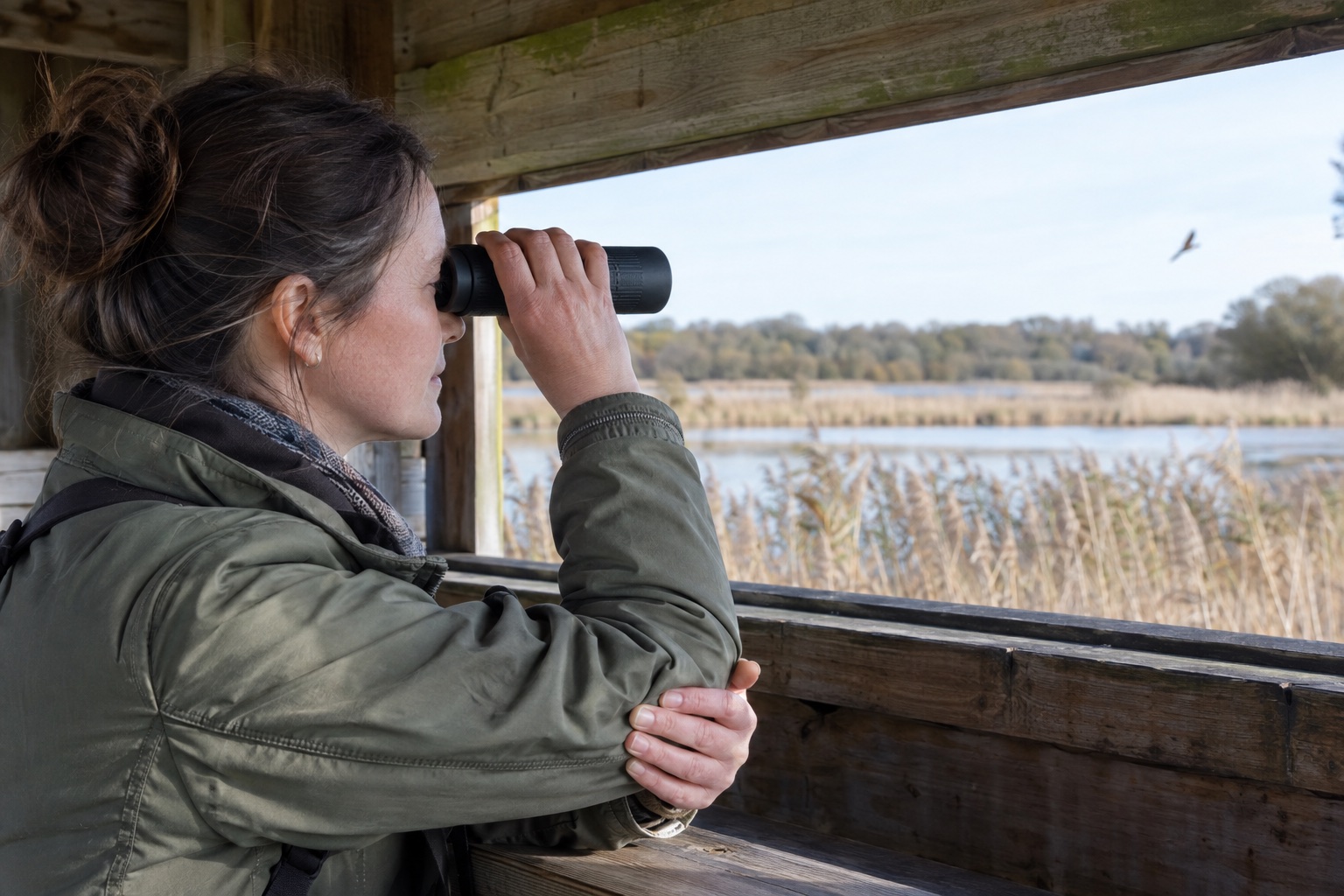
Keep your other eye open if it helps awareness, but never view while walking.
Move the optic slightly in and out to find a complete circular field.
Never point a monocular at the Sun.
A monocular is simple to carry but can be surprisingly awkward to aim at first. The key is to keep your eye on the subject before bringing the optic up. Looking down through a magnified, narrow field and then sweeping blindly is slower and more frustrating than a three-step routine.
Prepare the eye position
Remove the lens caps and check the glass is clear. If you wear spectacles, start with the eyecup retracted; without them, extend it if the model allows. Hold the eyepiece—the smaller rear viewing end—to your preferred eye. Adjust its distance until you see one clean circular field, not a small bright disc surrounded by black or dark crescents. Your face and frames determine the exact position. If the eye cannot reach the full field with glasses, the model may not have enough usable eye relief.
Find, raise and focus
Choose a safe stationary target such as a sign, tree or distant building. Never choose the Sun. Find it with both eyes normally, keep your gaze directed at it and lift the monocular into that line. Only then turn the focus control slowly until fine edges are clear. If the subject moves, lower the optic briefly, reacquire it unaided and raise it again. This avoids wandering across a narrow magnified field.
Focus systems differ: some turn an eyepiece ring, others use a body control. Learn which part moves on your own model before going outside. If one eye focuses differently from the other, switch eyes only after refocusing; a monocular does not have a binocular-style dioptre setting for two barrels.
Make the small view steadier
Use a relaxed grip rather than squeezing. Bring the viewing-side elbow towards your ribs, or rest it on a firm hide shelf while keeping the optic clear of the surface. Wind and fatigue may make a tiny 10× harder than a steadier 8×. If the image jumps when you turn the focus ring, practise the motion seated. Our one-handed handling guide explains what to test before choosing a model for that use.
Do not look through any magnifying optic while walking, cycling, driving or balancing near an edge. Lower it to check your surroundings, then move. Keep enough distance from wildlife that your viewing does not change its behaviour.
If the view still seems wrong
Dark arcs that move as your head moves are often eye-position blackouts, not a focus fault. Our monocular-blackouts checklist separates eye distance, eyecup setting and light level. If the picture remains blurry through the centre at every focus position, check caps and visible surface dirt without rubbing grit across the glass. Persistent internal haze, a damaged focus control or a view that cannot be made sharp deserves retailer or manufacturer advice, not dismantling at home.
Frequently asked questions
Using a monocular
Which eye should I use?
Start with the eye that feels most comfortable and gives the clearest view. You may switch eyes, but refocus if their prescriptions differ.
Should my other eye stay open?
Either approach can work. Some people keep it open for awareness and comfort; others close it briefly. Do not use the optic while moving.
Why can I not find the bird through the monocular?
Find it with the naked eye first, keep looking at that point and lift the monocular into the same line of sight. Start at 8× with a wider field.
How do I stop the image shaking?
Hold the barrel gently, bring your elbow toward your body, lean on a stable support if available and avoid high power in a tiny body.