
Fit guide · Glasses
Monoculars for glasses wearers
Find a monocular that shows its full field with spectacles by checking eye relief, eyecups and real eye position.
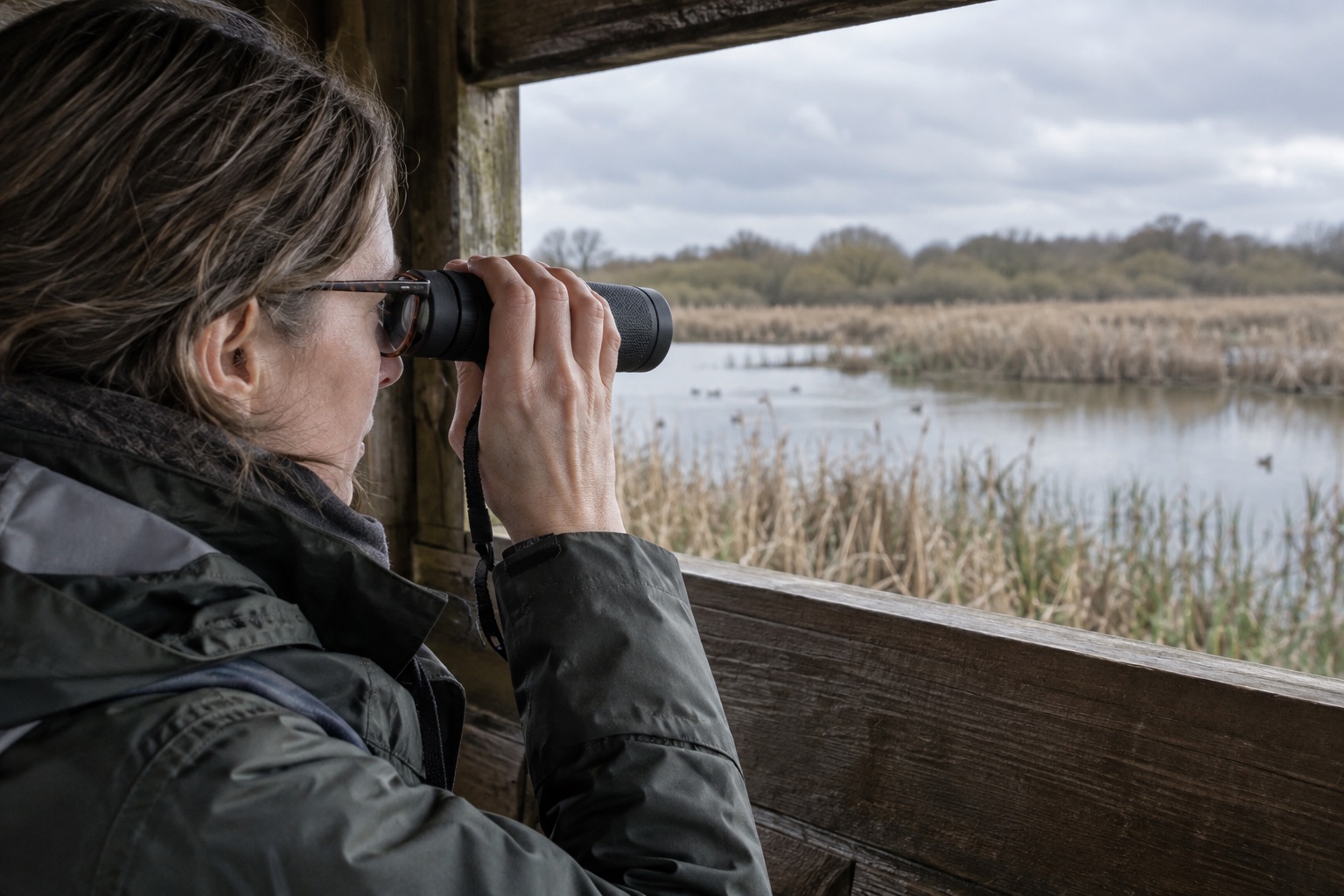
Retract the eyecup when wearing glasses, then check every edge of the field.
Your frame, lens thickness and face shape can defeat a promising number.
Do not press glass lenses against a hard eyecup to recover lost field.
A monocular can be an appealing alternative if a binocular's two eyepieces are awkward with spectacles. It removes the hinge-spacing problem, but does not remove the eye-relief problem. The eye still has to sit at the right distance and angle behind a single eyepiece to see the entire field.
Read the number, then test the circle
Eye relief is the stated distance behind the eyepiece at which the full image forms. Your spectacle lens occupies some of that distance. A headline 17mm may be comfortable for one frame and restrictive for another, depending on lens thickness, nose bridge, eyecup rim and how closely the spectacles sit. Start with the eyecup fully retracted, look at a safe distant target and move the monocular gently until the field is one complete circle. Check the top, bottom and sides without rolling your eye around. Never look towards the Sun.
The Opticron Explorer WA ED-R 8×42 lists 17mm eye relief and a 131m field at 1,000m. Its larger body and 5.25mm exit pupil can make positioning less exacting than with a pocket optic. It is the strongest starting point of the three models compared here, not a guaranteed fit. The Vortex Solo 8×25 lists 15mm and is about 159g: attractive for a coat pocket, but the full-field test becomes essential. Hawke's 8×25 lists 13mm; if you need glasses on throughout a walk, do not buy it solely because its ED glass sounds appealing.
The test to do before paying
Use the glasses you will wear outdoors. With the eyecup down, view a sign or tree line. Can you see the whole scene without dark crescents while holding a relaxed posture? Can you refocus from near to far without losing eye position? Try both your usual viewing eye and the other eye if you might switch. Look for hard plastic that could contact and mark a spectacle lens; do not force the eyecup into your frames.
If the field is cut off, pull the monocular slightly away, then closer, and try a different eyecup setting. A shifting blackout often indicates position rather than a defective optical path; our monocular-blackouts guide gives the full check. If you cannot obtain a comfortable whole circle, choose another model—even one with a larger printed eye-relief number may have a better eyecup shape.
When a different optic is kinder to use
For sustained birdwatching, an appropriately fitted glasses-friendly binocular may feel more restful than holding a monocular to one eye. If you need high power from a fixed position, a scope with a compatible long-eye-relief eyepiece is another route. The choice is not an eye-relief contest on paper: it is the complete field you can actually see, in the position you will use.
Compare the full field, not only the relief number
The Opticron 8×42's longer published relief gives a promising starting point, but its eyecup shape and the distance from your spectacle lens to your eye still decide the fit. The Vortex 8×25's 15mm may be usable for some frames; Hawke's 13mm is a tougher prospect. Neither difference can be turned into a universal yes/no rule. Aim at a safe detailed scene and see whether the field edge stays visible without pushing the glasses into your face. A clear centre surrounded by black is not the whole advertised view.
If you use varifocals, try the head angle you naturally use while scanning, then compare with a fixed object. An awkward chin position can be tiring even when the optics focus well. Practise lifting and lowering the monocular several times: a workable eye position should be easy to find again, not a one-off alignment. If two models both show the full field, consider the one with the focus control you can operate without disturbing the eyecup. The eye-relief explainer covers the underlying measurement, while this guide is about the actual one-eye fit.
Helpful products
One strong fit candidate and a smaller conditional option
Opticron's 17mm figure is more promising for spectacles. The Vortex 15mm pocket option is included for a shop fit test, not as an equally certain glasses recommendation.

Opticron Explorer WA ED-R 8x42 monocular
Best for: Birds and close nature
A one-eye 8×42 with ED glass, a generous published field and 1.9m close focus for birds and nearby nature.
What stands out
- 8×42 exit pupil is forgiving
- About 131m field at 1,000m
- 1.9m close focus and ED glass
Keep in mind
- Larger than 8×25 pocket models
- One-eye viewing remains less restful than binoculars
- 8×42
- About 329g
- About 131m / 1,000m
- 17mm eye relief

Vortex Solo 8x25 monocular
Best for: Daylight travel and casual birds
A waterproof 8×25 with a 7.2° field, 15mm eye relief and 5m close focus, sized for grab-and-go use.
What stands out
- About 126m field at 1,000m
- Waterproof and fogproof
- About 159g
Keep in mind
- 3.1mm exit pupil is less forgiving in shade
- 15mm eye relief requires a glasses fit check
- 8×25
- About 159g
- About 126m / 1,000m
- 15mm eye relief
Frequently asked questions
Glasses and monoculars
How much eye relief do I need with glasses?
There is no guaranteed threshold because frames and facial fit vary. Around 17mm or more is a useful starting point, but only a full-field test with your own glasses decides.
Should I twist the eyecup in or out with glasses?
Usually retract or fold it down so your spectacle lens can get closer to the eyepiece without force. Adjust gradually for a clean full circle.
Can I remove my glasses instead?
Sometimes, if the monocular's focus range compensates for your prescription. Astigmatism and other corrections may still make glasses preferable; judge the actual view and comfort.
Why do I see a black rim even with 17mm eye relief?
Your eye may still be too far from the exit pupil, off-axis, or at the wrong eyecup position. Try the fit check before treating the number as a guarantee.