
Scope fit · Spectacles
Spotting scopes for glasses wearers
Choose a spotting scope that gives a full comfortable field with glasses by checking eye relief across zoom and tripod position.
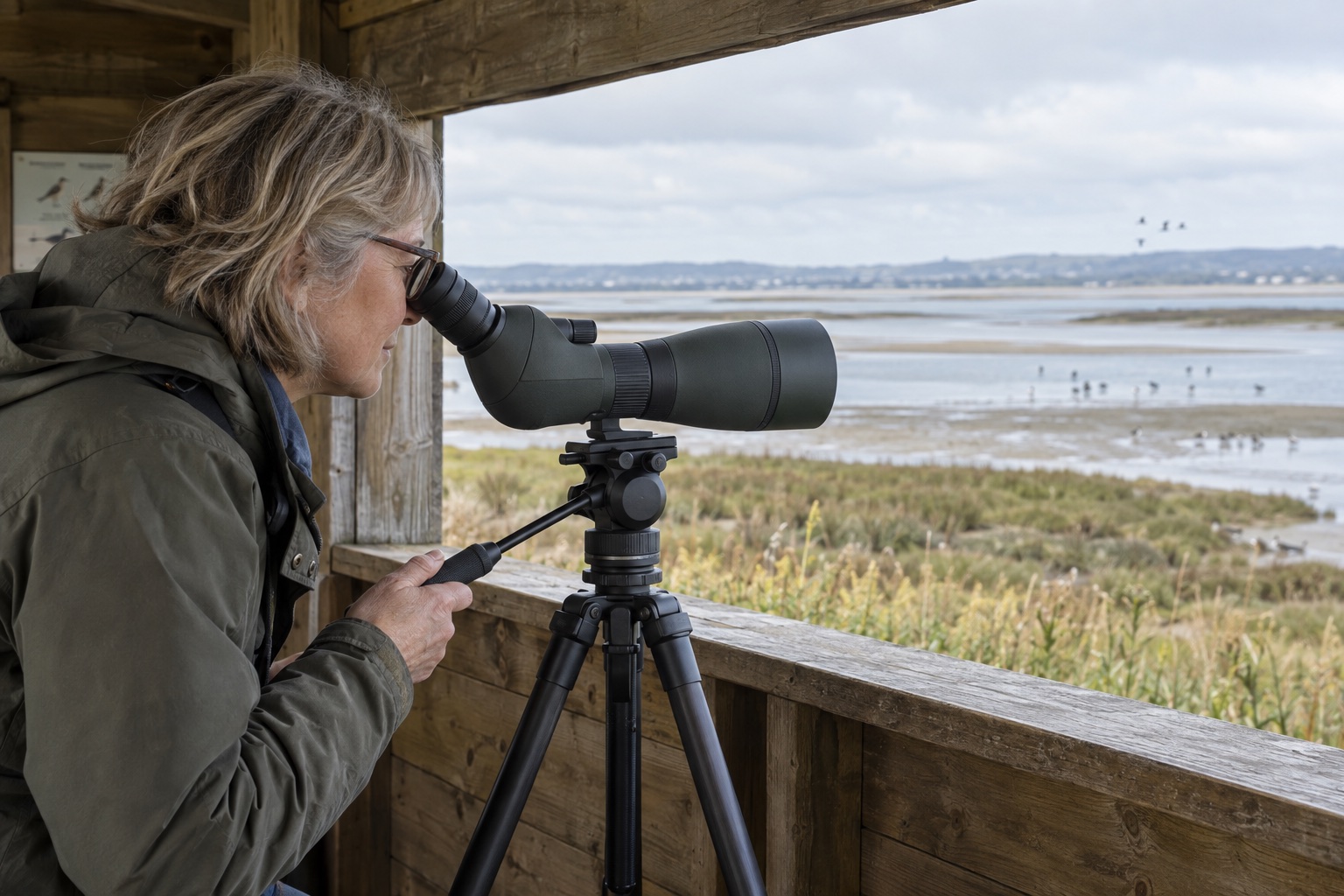
Compare eye relief for the included eyepiece, not just the scope body.
Test low, middle and high zoom with your normal glasses.
Set tripod height and scope angle so you do not crane your neck or press on your frames.
Glasses wearers often encounter a scope that looks sharp through the centre but hides the outer field behind a dark ring. The problem is usually not the objective size or ED glass. It is the distance between your eye and the scope's eyepiece, plus the way the scope and tripod position your head.
Start at the eyepiece, not the body
Spotting scopes may include a zoom eyepiece or accept a separate one. The relevant eye-relief figure belongs to that exact eyepiece and, for a zoom, may change with magnification. A figure quoted only at the low end is not a guarantee at the high end. Our scope eye-relief explainer covers the measurement in detail; this page helps you select and test a complete setup.
Hawke's Nature-Trek Compact 9–27×56 lists 20mm eye relief and a body around 575g. That makes it a plausible light-carry starting point for someone who wears glasses, though the smaller objective is not ideal for pushing magnification in dim light. Celestron's Regal M2 16–48×65 ED lists 20mm at 16× for its included zoom. Celestron gives 1,337g without the eyepiece and 1,649g with it, before support; the latter is the useful carrying figure for this complete viewing setup. Ask how the specific eyepiece behaves at your preferred middle and high settings; do not infer constant 20mm relief from its low-end specification.
A proper glasses fit trial
Wear the frames you use outdoors. Retract the eyecup, centre your eye and view a safe detailed scene at the lowest zoom. Check whether you can see the full circle and its edges while relaxed. Repeat in the middle and at the top. If you must press the spectacle lens against a hard rim or crane your neck, that is a poor fit even if the printed number looks generous. If you wear varifocals, try the head position you would naturally hold for several minutes.
Set the tripod to the observer rather than bending the observer to the scope. An angled body can let different-height people share a lower tripod; a straight body may be easier for some eye lines. Neither angle improves eye relief. Our angled-versus-straight guide and tripod guide cover those separate choices.
Do not buy a headline number alone
If a scope with a published 20mm figure still cuts off the field, try another eyecup or eyepiece only if the maker confirms compatibility. A 1.25-inch barrel size does not prove every eyepiece will reach focus or seal correctly on every scope. Conversely, a well-fitting lower-power eyepiece may give a more useful view than an uncomfortable zoom at its maximum. Bring the complete scope, tripod and glasses together for the decision; comfort over ten minutes matters more than a specification you cannot use.
Decide at the power you will use
A zoom eyepiece can change its stated or usable eye relief through the magnification range. If you will spend most of a wetland session at a middle setting, test there rather than only at the lowest power where acquisition is easiest. A full circle that disappears as you zoom is a meaningful limitation even if the central image stays sharp. Try with the same glasses, lens coating and frame position you use outdoors; moving the frames up the nose solely for a shop trial is not a realistic fit.
Consider the entire posture. If the tripod is too low, you may lean in and press your spectacles against a hard eyecup, misting or marking the lens. If too high, maintaining the eye position can strain your neck. Adjust the tripod before rejecting the optics. A comfortable lower-power view often reveals more usable detail than a high-power view seen through a narrow tunnel. If you cannot try the complete instrument, ask about the exact eyepiece included with the listing rather than relying on a body-only eye-relief figure.
Helpful products
Two contrasting glasses-fit starting points
These published eye-relief figures justify a fit trial; they are not guarantees. The Hawke is a light compact scope, while the Regal M2 is a larger ED-glass system with a different eyepiece arrangement.

Hawke Nature-Trek Compact 9–27×56 spotting scope
Best for: Long walks and travel
A roughly 575g, short 56mm angled scope for daypacks and lower-zoom viewing from a compact support.
What stands out
- About 575g scope weight
- 9× low end helps locate birds
- 20mm published eye relief
Keep in mind
- Smaller 56mm objective limits higher-zoom dusk use
- A monopod or tripod remains useful at 27×
- 9–27×56
- About 575g
- 20mm eye relief
- Compact angled body

Celestron Regal M2 16–48×65 ED angled spotting scope
Best for: High-contrast birds and glasses checks
A 65mm ED scope with a 20mm stated eye relief at 16× and interchangeable 1.25-inch eyepiece mount.
What stands out
- ED objective glass
- 20mm eye relief at 16×
- Dual-speed focus and 1.25-inch eyepiece compatibility
Keep in mind
- 1,649g with included zoom, before tripod
- Eye relief at other zoom settings needs an in-person check
- 16–48×65
- 1,649g with zoom
- 43–23m / 1,000m
- 20mm eye relief at 16×
Frequently asked questions
Glasses and scopes
How much scope eye relief is enough for glasses?
A published figure near 18–20mm is a useful shortlist starting point, but eyecup geometry and your frames decide whether the whole field is visible.
Does eye relief change as I zoom?
It can. Ask for figures across the included zoom range and test the lowest, middle and highest settings rather than relying on one number.
Should the eyecup be folded down with glasses?
Usually yes. Retract it and then adjust position until you see a clean full circle without forcing your spectacle lens into the rim.
Is an angled scope automatically better with glasses?
No. Angled versus straight affects posture and aiming, not the eyepiece's inherent eye relief. The right tripod height and eyepiece fit both matter.