
Compact scope choice · Objective size
50mm vs 60mm spotting scopes
Compare compact 50mm and 60mm spotting scopes by light-gathering geometry, exit pupil, carrying setup and sensible zoom.
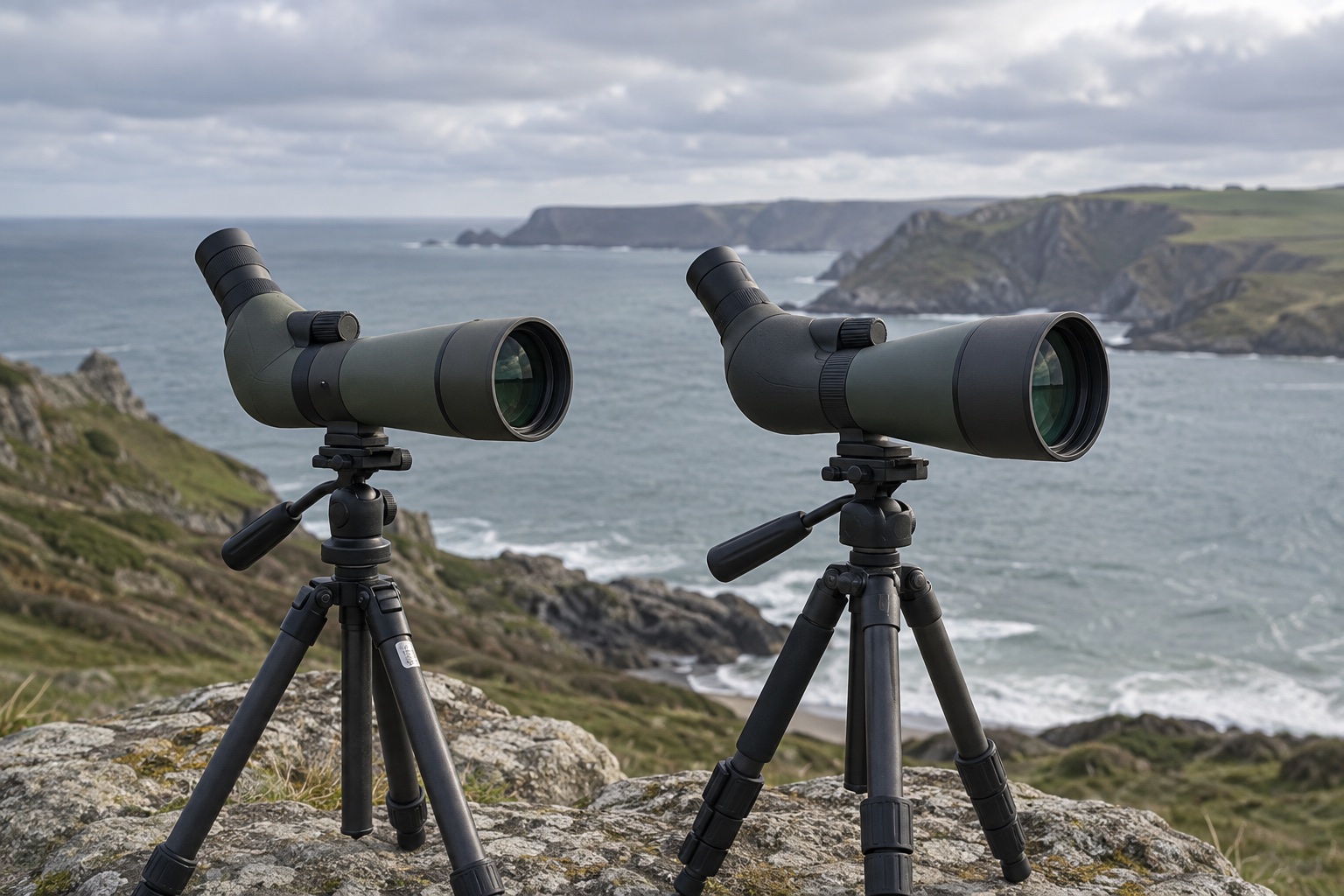
Keep magnification and eyepiece design comparable when judging aperture.
At 20×, exit pupil is 2.5mm for 50mm and 3mm for 60mm.
A smaller scope still needs support if you want a stable high-power view.
A 50mm and a 60mm spotting scope are both compact by field-scope standards. The difference matters most when you use the scope in cloud, at dusk or at the upper part of a zoom range—not when you are carrying it in a bag. The 50mm can be easier to pack; the 60mm gives an optical designer more aperture to work with, but a comparison between two unlike products is never controlled by diameter alone.
What ten millimetres really changes
Lens collecting area grows with the square of diameter. On geometry alone, 60² ÷ 50² = 1.44, so a 60mm front lens has 44% more area than a 50mm one. At 20×, exit pupil is 2.5mm for 50mm and 3mm for 60mm; at 30×, it is about 1.7mm versus 2mm. Geometry describes aperture and exit pupil, while coatings, internal baffling, eyepiece design, atmospheric haze and your own pupil affect what you actually see.
Swipe to compare compact sizes →
| Question | 50mm | 60mm |
|---|---|---|
| Main attraction | Smaller travel kit | More light-gathering area |
| Exit pupil at 20× | 2.5mm | 3mm |
| Exit pupil at 30× | About 1.7mm | 2mm |
| Likely priority | Daylight walks | Duller, longer stops |
Count the whole kit
The number on the objective is not the weight on your shoulder. Ask for scope-body mass, included eyepiece, stay-on case and the support needed at the power you plan to use. A very light 50mm body mounted on a shaky travel tripod may show less detail than a slightly larger scope on a stable one. A 60mm scope can require only a modest support increase—or a noticeable one—depending on its construction and balance. Compare actual lengths, tripod heads and packed dimensions on the exact candidates. The compact-scope guide includes a 56mm middle-ground example, while tripod choices cover the support.
Which should you take to the field?
Choose 50mm if the scope is an occasional addition to a walking kit, mostly in good daylight, and you value a setup that you will actually bring. Choose 60mm if you regularly stop for extended views in mixed weather and the carried difference remains acceptable. If you mostly observe from a hide, the 65mm versus 80mm guide may describe a more suitable size range.
Use the format maths to narrow the choice, then check the exact models' eyepieces, field widths, eye relief, sealed weight and compatible support. A nearby 56mm size is a middle ground, not a substitute for comparing two specific 50mm and 60mm designs on equal terms.
Frequently asked questions
50mm and 60mm scope questions
Is a 60mm scope 20% brighter than a 50mm scope?
The diameter is 20% greater and geometric lens area 44% greater, but perceived brightness depends on magnification, coatings, eye pupil and conditions.
Can I handhold a 50mm spotting scope?
Brief low-power use may be possible with some designs, but even a compact scope benefits from a stable monopod or tripod, especially as power rises.
Does 60mm mean better image quality?
Not by itself. A well-made 50mm scope can outperform a poorer 60mm design in contrast and sharpness. Compare exact models and eyepieces.
Should I choose 65mm instead?
If most viewing is from a hide and you can carry a larger support, 65mm can be a useful next step. For walking, the complete weight may decide otherwise.