
Optical basics · Close focus
Binocular close focus explained
Learn how minimum focus distance affects birds, butterflies and garden viewing, why published metres are only a start, and when a close-focus binocular pays off.
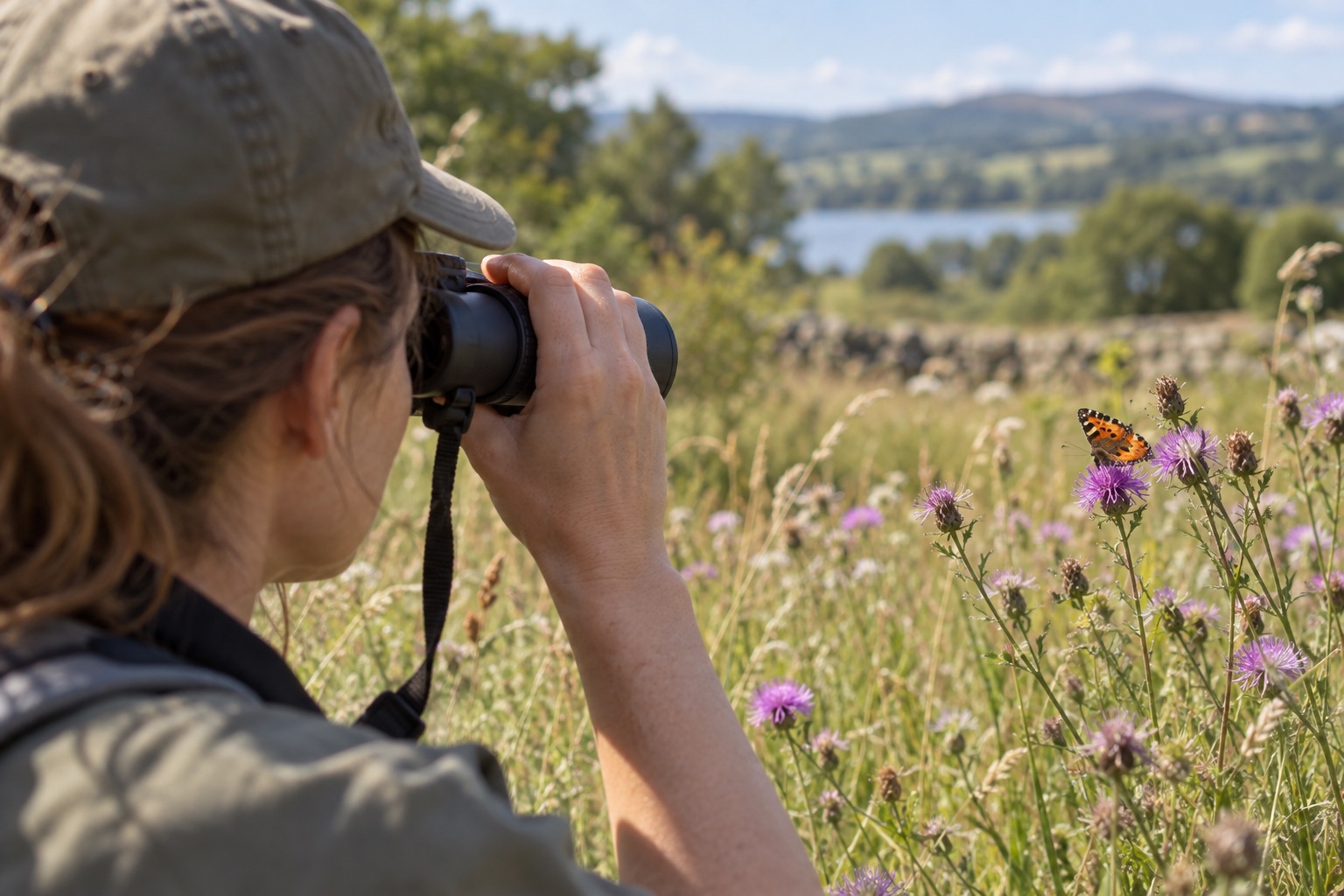
Published close focus is usually measured from the objective end, not your eye.
One person's minimum usable distance may differ with eyesight and focusing technique.
A close number does not guarantee comfortable two-eye viewing at arm's length.
Close focus is the nearest subject a binocular can bring into sharp focus. It matters when a bird lands beside a hide window, a butterfly settles just beyond the path or a feeder sits near your kitchen window. It does not tell you how sharp the image is overall.
What counts as close?
Around 1.5–2m is notably versatile for a full-size binocular. The Vortex Diamondback HD 8×42 publishes 1.5m, while the Celestron Nature DX 8×42 lists 2m. The Nikon PROSTAFF P7 8×42 lists 3m. That is entirely workable for most birds, but may make a tiny garden or nearby insects frustrating.
Five metres and beyond is not automatically a flaw in a marine or astronomy binocular, where distant subjects dominate. It is a poor match for close garden nature. Think about where you actually stand: if the feeder is 2.5m from your preferred seat, a published 3m minimum may be too restrictive.
The distance is only one part of the experience
At close range, each barrel sees a slightly different angle. Some people find very near two-eye views tiring or difficult to merge even when both barrels focus sharply. The focus wheel also needs enough usable travel and grip to move between a nearby flower and a distant bird without fumbling. A figure on a box cannot tell you how that transition feels.
Wear glasses? Eye relief and eyecup shape still govern the usable field at close range. A narrow field can make it hard to acquire a small moving insect despite excellent minimum focus. See field of view explained for that separate measure.
A practical garden test
Measure or pace the distance to your nearest common subject. Focus on a high-contrast leaf or sign at roughly that distance, then on something farther away. Does the wheel reach a clean, relaxed view without being forced to its stop? Can both eyes merge the image? Repeat with your glasses if relevant. Never point an optic at the Sun while doing this.
If you mainly watch birds beyond a few metres, do not sacrifice broad field or comfortable eye position for a headline 1.5m close-focus figure. If you split time between birds, butterflies and flowers, it can be one of the most useful specifications on the page. Our best 8×42 guide sets close focus alongside weight, field and eye relief rather than treating it as a single-number winner.
Helpful products
Three different close-focus choices
Compare an unusually near 1.5m binocular with practical 2m and 3m alternatives, then weigh field and fit as well.

Vortex Diamondback HD 8x42
Best for: All-weather wildlife walks
A weather-sealed 8x42 with a broad published field, 17mm eye relief and an included harness, giving it a practical ready-to-carry package.
What stands out
- Wide 7.5-degree published field
- GlassPak harness included
- Waterproof, fogproof roof-prism body
Keep in mind
- 17mm eye relief may not suit every glasses wearer
- HD naming alone does not mean ED objective glass
- 8×42
- 618g
- 7.5° field
- 1.5m close focus

Celestron Nature DX 8x42
Best for: First 8×42 and close garden viewing
A well-specified first birdwatching binocular with a wide 129m field, 2m close focus and phase-coated BaK-4 prisms without stepping up to ED-glass pricing.
What stands out
- 129m field of view at 1,000m
- 2m stated close focus
- Waterproof, nitrogen-filled body
Keep in mind
- 17.5mm eye relief offers less margin than the Nikon P7
- No ED glass in this standard Nature DX model
- 8×42
- 629g
- 129m / 1,000m
- 17.5mm eye relief

Nikon PROSTAFF P7 8x42
Best for: Wide viewing with glasses
A 590g all-round 8x42 with a wide 126m field, long stated eye relief and a locking dioptre ring that helps preserve a personal focus setting.
What stands out
- 126m field of view at 1,000m
- 20.2mm stated eye relief
- 590g waterproof body with locking dioptre
Keep in mind
- 3m close focus is useful rather than class-leading
- No ED glass in the published specification
- 8×42
- 590g
- 126m / 1,000m
- 20.2mm eye relief
Frequently asked questions
Close-focus questions
Is 2m close focus good for birdwatching?
Yes. It is especially useful in gardens and hides, and gives room for insects and flowers. Many bird encounters happen farther away.
Do I need the shortest possible close focus?
Only if nearby nature is a regular part of your use. A slightly longer minimum may be a good trade for a wider field, lower weight or better eye fit.
Why can my binocular focus closer than its specification?
Minimum focus can vary with eyesight and the precise focus-wheel travel. Treat the published figure as a comparison point, not a universal personal limit.
Is close focus the same as sharpness?
No. It is the minimum distance at which focus can be achieved. Resolution and contrast at that distance depend on the optical design and alignment.