
Optical choice · Objective diameter
Binocular objective size explained
Choose a useful binocular objective diameter by light, magnification, carrying weight and observing style—not simply the largest front lens.
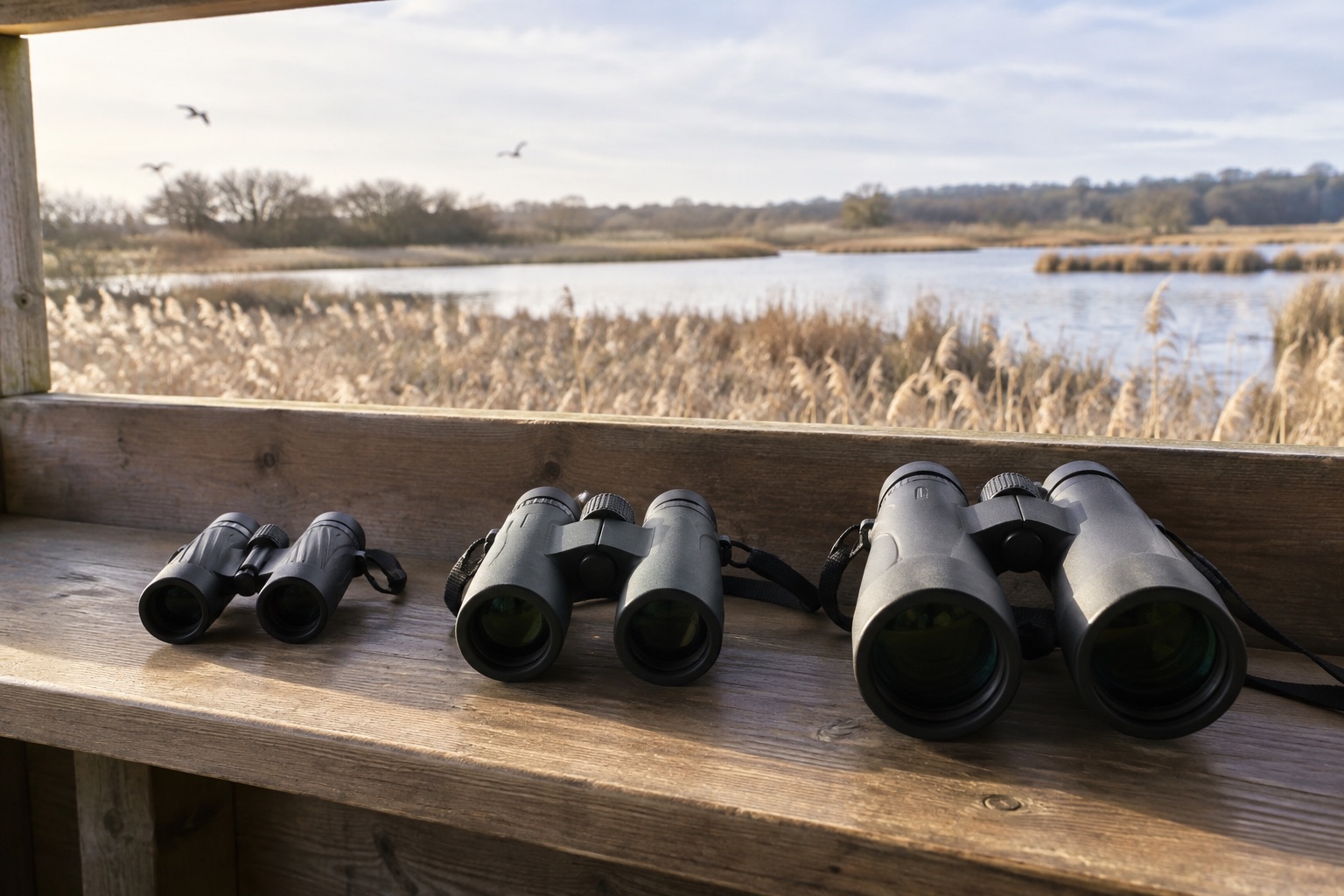
Compare objective size while holding magnification as constant as possible.
Check exit pupil, field, eye relief and total weight too.
A larger lens cannot compensate for shake, poor fit or weak optical design.
The objective lenses sit at the front of a binocular. Their effective diameter is the second number in the format name: an 8×42 has two 42mm objectives. The number is useful when comparing the same magnification, but it is not a brightness score or a reason to buy the biggest body you can afford.
A size for each kind of outing
A 25mm objective is a deliberate portability choice. It can make an 8×25 small enough for a coat pocket or cabin bag. On a bright city break, daytime walk or occasional sports visit, that convenience may outweigh its fussier eye placement. A 30–32mm model suits a walker who wants proper binocular handling without the bulk of a full-size pair. The 25mm versus 32mm guide isolates that specific choice.
A 42mm objective is a practical all-round compromise. At 8×, it yields a 5.25mm calculated exit pupil and a generally comfortable daylight-to-dusk field setup without the mass of most 50mm designs. It is not always necessary: for someone who never takes 42mm out of the cupboard, a smaller pair is better. 50mm becomes appealing for 10× night-sky viewing, long fixed observations or low-light use, but the extra glass can turn a short walk into a carry chore.
Swipe to compare objective sizes →
| Size | Primary gain | Main cost | Likely use |
|---|---|---|---|
| 25mm | Pocket carry | Exact eye placement | Bright short trips |
| 30–32mm | Carry/view balance | Less dusk latitude than 42mm | Long walks |
| 42mm | Forgiving all-round view | More weight | Mixed wildlife |
| 50mm | More light at equal power | Bulk and support needs | Stationary and night use |
Light collection is not the same as light used
At identical magnification, geometric collecting area scales with diameter squared. A 50mm objective has about 42% more area than a 42mm one. That is a geometry statement, not a measured 42% visual improvement. Coatings, prisms, stray-light control and your own pupil determine the result. If your eye pupil is only 3mm in daylight, a larger exit beam mostly falls outside it. At dusk, the larger beam can be valuable. Our exit-pupil guide explains the arithmetic and limitations.
A wider objective also does not guarantee a wider field. Eyepiece design determines that. Nor does it make a 10× binocular steadier: the added weight may damp small tremor for one person and fatigue another. Try a model at the time of day you will really use it, with glasses if relevant.
Choose the second number only after the first
Magnification changes exit pupil too. An 8×42 gives 5.25mm; a 10×42 gives 4.2mm. A 10×50 restores a 5mm beam but remains ten-times power, with more visible hand movement. First decide whether 8× or 10× helps your actual subjects; then choose the objective size you will carry. The how-to-choose guide brings magnification, field, eye relief and weather protection back together. Never use any ordinary binocular, whatever its diameter, to look at the Sun.
Helpful products
Four real size references
These models show the span from pocket 8×25 through 8×32 and 8×42 to 10×50. They illustrate different sizes rather than a like-for-like ranking.

Nikon SPORTSTAR EX II 8x25
Best for: Travel and all-day carry
A genuinely pocketable 310g binocular with a wide 8.3-degree field and a waterproof, nitrogen-filled body.
What stands out
- Only 310g
- Wide 8.3-degree field
- Waterproof and nitrogen-filled
Keep in mind
- 25mm objectives are less forgiving at dusk
- Compact controls can be fiddlier with gloves
- 8×25
- 310g
- 8.3° field
- Waterproof

Vortex Diamondback HD 8x32
Best for: Walks, travel and close viewing
A compact weather-sealed 8×32 that combines a 451g carry weight with a very wide 142m field and 1.5m close focus.
What stands out
- Approximately 451g
- Approximately 142m field of view at 1,000m
- Waterproof, fogproof and 1.5m close focus
Keep in mind
- 16mm eye relief may be marginal with some glasses
- Smaller 32mm objectives give up some low-light ease to 42mm models
- 8×32
- 451g
- 142m / 1,000m
- 16mm eye relief

Nikon PROSTAFF P7 8x42
Best for: Wide viewing with glasses
A 590g all-round 8x42 with a wide 126m field, long stated eye relief and a locking dioptre ring that helps preserve a personal focus setting.
What stands out
- 126m field of view at 1,000m
- 20.2mm stated eye relief
- 590g waterproof body with locking dioptre
Keep in mind
- 3m close focus is useful rather than class-leading
- No ED glass in the published specification
- 8×42
- 590g
- 126m / 1,000m
- 20.2mm eye relief
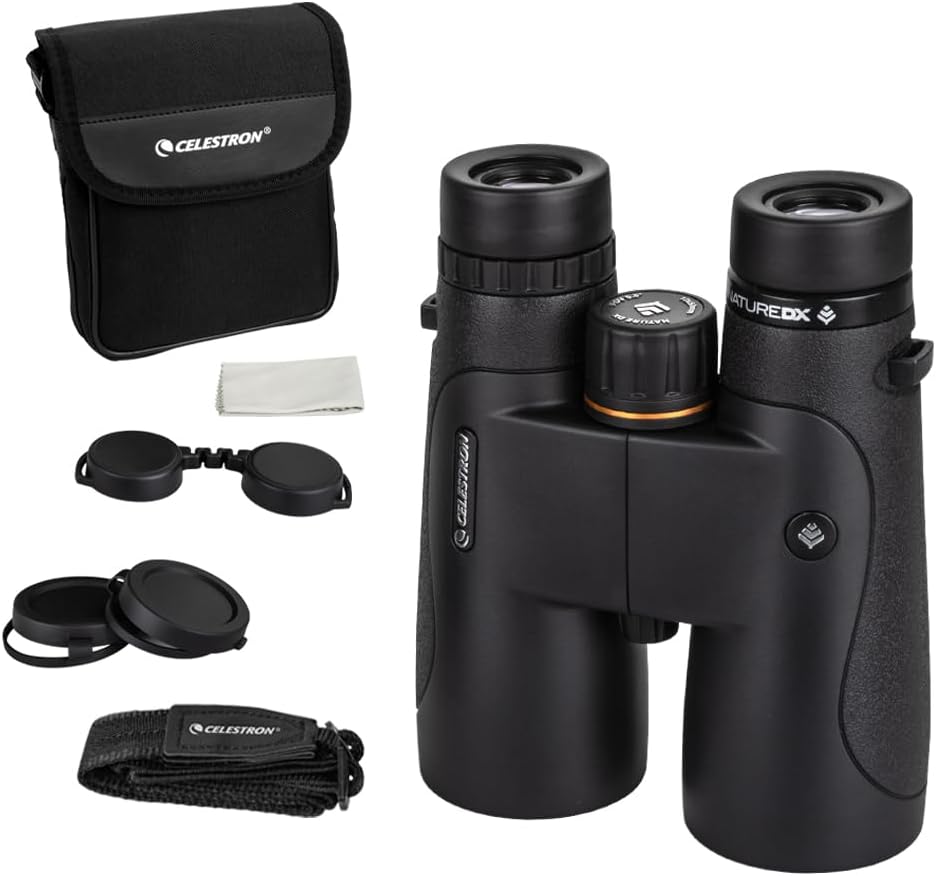
Celestron Nature DX 10x50
Best for: Wildlife and night-sky crossover
A 10×50 with waterproof nitrogen-filled construction, 17.5mm eye relief and an approximately 101m field at 1,000m.
What stands out
- 5mm exit pupil
- Waterproof and nitrogen filled
- 2.5m close focus
Keep in mind
- 806g is heavy for all-day carrying
- Field is narrower than the UpClose G2's
- 10×50
- 806g
- ≈101m / 1,000m
- 17.5mm eye relief
Frequently asked questions
Objective-size questions
What does the 42 mean in 8×42?
It is the effective diameter in millimetres of each front objective lens. The 8 is magnification.
Are 50mm binoculars always brighter than 42mm?
At the same power they can deliver a larger exit pupil and collect more light, but the visible benefit depends on your eye pupil, coatings, optical design and conditions.
What objective size is best for walking?
Many walkers favour 25mm for pocket carry or 30–32mm for a fuller but still compact view. A light 42mm can work if low-light viewing matters.
Does a larger objective make subjects appear bigger?
No. Magnification controls apparent size. Objective diameter affects light collection and usually body size.