
Optical basics · Personal focus
What is a binocular dioptre?
Understand why binoculars have a dioptre adjustment, how to set it for your eyes, and when a locking ring matters.
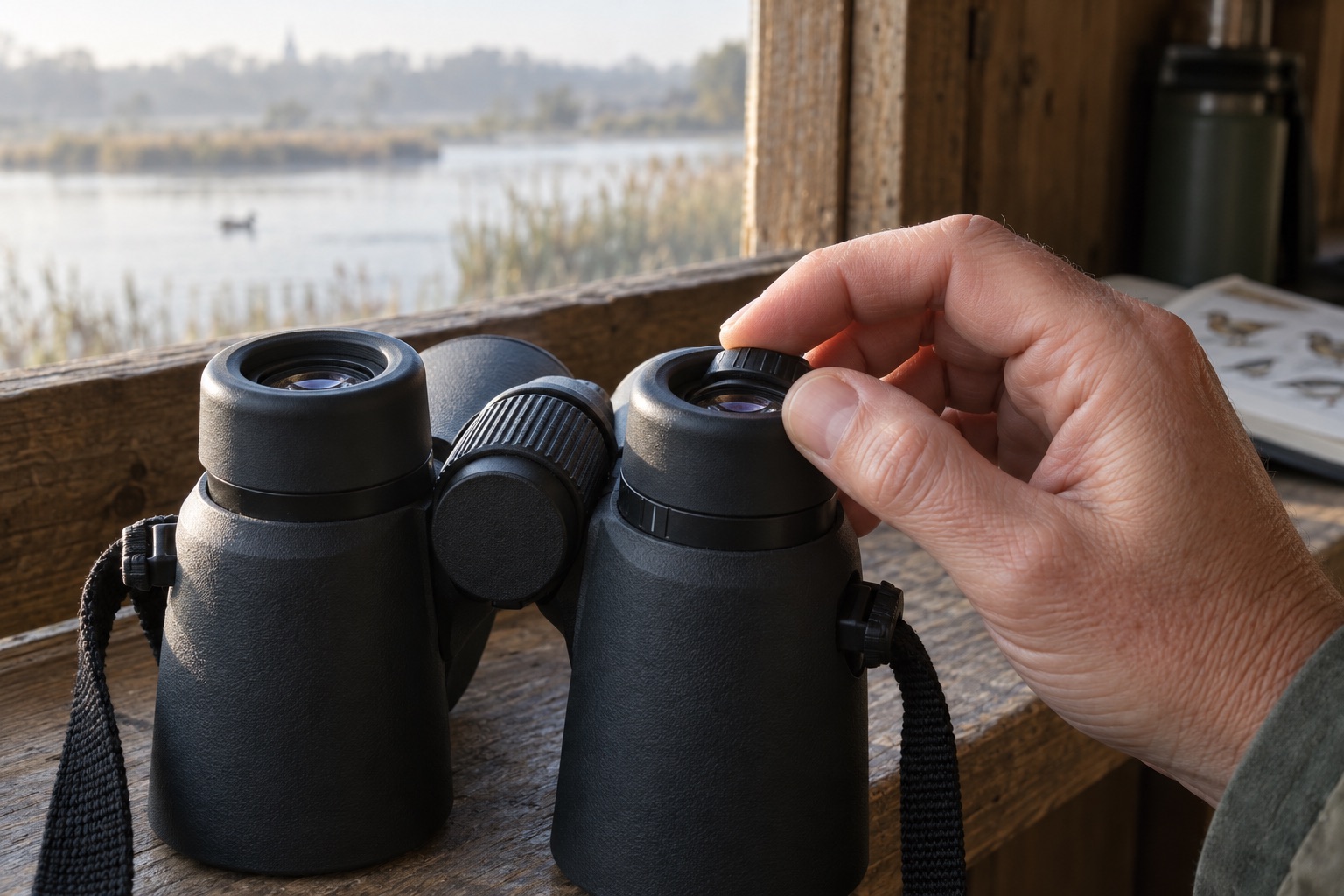
The dioptre is usually on one eyepiece, commonly the right, but check your model.
Focus one eye with the centre wheel, then the other with the dioptre.
A locking ring helps prevent accidental changes; it does not improve optics.
A binocular has two optical paths, but your eyes rarely focus identically. The dioptre adjustment offsets one barrel to compensate. Once set, the central wheel can move both sides together as you switch from a nearby tree to a distant bird. If the dioptre is wrong, one side can look soft even when the other is crisp.
Set it step by step
- Set the interpupillary distance until you see one comfortable circle, and position the eyecups for your glasses or bare eyes.
- Choose a detailed, stationary subject at a sensible distance. Never use the Sun.
- Close or cover the eye on the dioptre side. Use the central focus wheel until the other eye sees a sharp image.
- Keep the centre wheel still. Close the first eye, open the dioptre-side eye and turn the dioptre ring until that image is sharp.
- Open both eyes. Fine-tune once if needed, then note or lock the dioptre setting.
Manufacturers differ in which side adjusts and whether the ring must be lifted before it turns. Check the actual model rather than forcing a stiff ring. If you share binoculars, mark or remember your own setting and reset it after another user.
Is a locking dioptre worth paying for?
The Nikon PROSTAFF P3 8×42 provides the essential adjustment. The PROSTAFF P7 8×42 adds a locking dioptre so a strap, case or fingers are less likely to disturb your setting. The MONARCH M7 8×42 also locks it. That is a convenience for frequent use, not a reason by itself to ignore differences in field, weight, eye relief or cost.
Common setup mistakes
Do not turn the centre wheel while adjusting the dioptre side; doing so moves both barrels and defeats the separation. Do not strain to force a blurred eye into focus. Keep both eyes relaxed and use a crisp target rather than a uniform wall or sky. If you wear glasses, perform the setup with your normal viewing glasses and eyecups in their intended position.
A correctly set dioptre does not cure double images, black crescents or an eyecup that blocks part of the field. Those suggest alignment or eye-relief issues. For the wider buying decision, use how to choose binoculars.
Helpful products
Standard and locking-dioptre examples
The P3 has the basic adjustment; P7 and M7 add a lock that is useful when the binocular is carried or shared.

Nikon PROSTAFF P3 8x42
Best for: Beginners and glasses wearers
A relatively light 8×42 with 20.2mm eye relief, a 126m field and a waterproof, fog-free body.
What stands out
- 20.2mm stated eye relief
- 575g is light for an 8×42
- Waterproof and fog-free
Keep in mind
- 3m close focus is useful rather than exceptional
- No locking dioptre ring like the P7
- 8×42
- 575g
- 126m / 1,000m
- 20.2mm eye relief

Nikon PROSTAFF P7 8x42
Best for: Wide viewing with glasses
A 590g all-round 8x42 with a wide 126m field, long stated eye relief and a locking dioptre ring that helps preserve a personal focus setting.
What stands out
- 126m field of view at 1,000m
- 20.2mm stated eye relief
- 590g waterproof body with locking dioptre
Keep in mind
- 3m close focus is useful rather than class-leading
- No ED glass in the published specification
- 8×42
- 590g
- 126m / 1,000m
- 20.2mm eye relief

Nikon MONARCH M7 8x42
Best for: Finding and following moving birds
A step-up ED-glass 8x42 whose key distinction is an expansive 145m field, alongside a locking dioptre and protective external lens coatings.
What stands out
- 145m field of view at 1,000m
- ED glass and dielectric prism coating
- Locking dioptre and oil-repellent external coating
Keep in mind
- Costs materially more than capable starting models
- 17.1mm eye relief gives less margin than the PROSTAFF P7
- 8×42
- 670g
- 145m / 1,000m
- 17.1mm eye relief
Frequently asked questions
Dioptre questions
Is a binocular dioptre the same as central focus?
No. The dioptre balances your eyes against each other. The central wheel then focuses both barrels on subjects at different distances.
Should I reset the dioptre every time?
Usually not for one regular user. Reset it if the ring moved, another person used the binocular, or your vision correction changed.
Do glasses wearers still need the dioptre?
Yes, if their two eyes require different focus after wearing their usual correction. Set the binocular while using it exactly as you normally would.
What if both eyes never look sharp together?
Repeat the setup carefully with a detailed distant target. If the problem persists, check eye alignment, eyecups and your vision; a misaligned instrument may need service.