
Walking guide · One-eye optics
Best monoculars for walking
Choose a walking monocular by carried weight, weather protection, field width and usable grip rather than magnification alone.
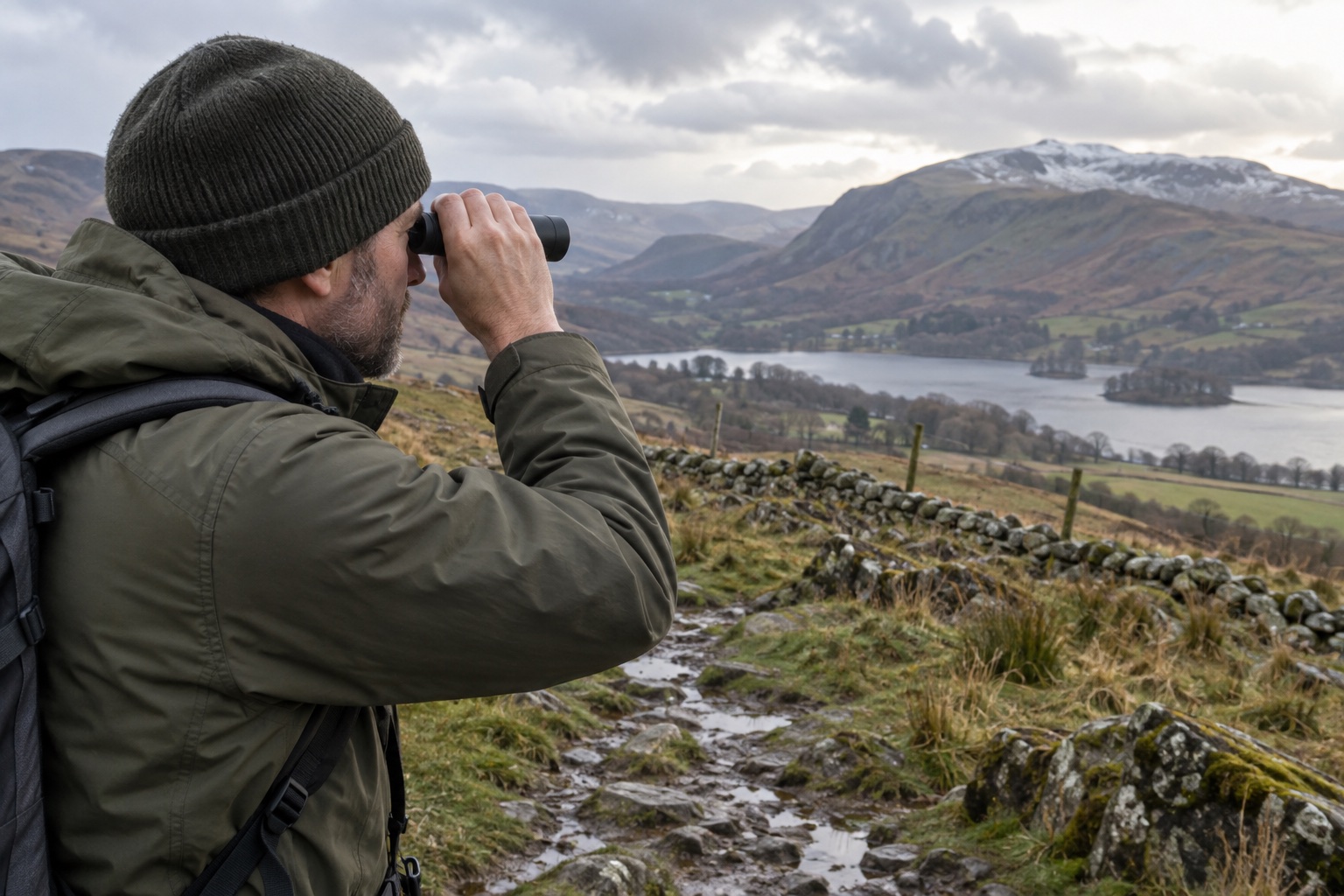
Choose 8× for a steadier, easier-to-find view than a tiny 10×25.
Check waterproof construction and a secure lanyard or pouch for wet paths.
Stop safely before raising the optic, especially near edges or traffic.
A walking monocular earns its place by being close to hand when something appears. If it lives at the bottom of a rucksack, its weight advantage is wasted. The best choice depends on whether you want quick views on a bright trail or plan to spend real time watching from shaded or windy stops.
A pocket pair and a fuller-view alternative
Hawke lists the Endurance ED 8×25 at 150g, with a 119m field at 1,000m, waterproof nitrogen-purged construction and 13mm eye relief. Its dioptre-style focus is compact, but the short eye-relief figure calls for care if you wear glasses. Vortex lists the Solo 8×25 at about 159g, a wider stated 126m field and 15mm eye relief. Both are more plausible day-walk companions than a 10×25 chosen only for its higher number: 8× is generally easier to steady and acquire quickly.
Opticron's Explorer WA ED-R 8×42 is a different compromise. At about 329g it is no longer a tiny pocket optic, but 42mm at 8× yields a 5.25mm exit pupil instead of the 3.1mm of an 8×25. On a dull afternoon or under trees, that larger beam can make eye placement easier. Its stated 17mm eye relief is also a better starting point for a glasses fit check. These are different formats, not a claim that one brand's glass was tested against another's.
Swipe to compare walking choices →
| Model | Carry | Eye relief | Best reason to choose |
|---|---|---|---|
| Hawke 8×25 | 150g | 13mm | Lowest listed weight |
| Vortex 8×25 | About 159g | 15mm | Broad pocket view |
| Opticron 8×42 | About 329g | 17mm | Shadier, longer stops |
What the path changes
On a coastal path, rain resistance, a tether and secure pocket matter as much as ED glass. A waterproof specification is not permission to leave any optic soaked inside a closed case; dry the outside after use. On a long hill day, test whether a lanyard swings and whether the focus ring can be reached with cold fingers. In woodland, a small exit pupil may make the view feel fussy just as a bird moves into shade. Our pocket-monocular guide isolates minimum carry; the how-to-use guide covers aiming and focus.
Stop on firm ground before viewing. A monocular takes one eye away from your surroundings and magnifies the apparent movement of the scene. If wildlife observation is the main purpose of the walk rather than an occasional bonus, compare a lightweight 8×32 binocular as well. Two-eyed viewing may justify the extra space.
Choose by the route, not by pocket dimensions alone
On a short dry path with broad views, either 8×25 can be carried in a secure outer pocket for a few quick stops. On a rain-exposed ridge, consider where you will put the wet optic between sightings; a waterproof body still needs exterior drying before it is shut into a pouch. If you usually pause beneath a dark woodland canopy to identify birds, the 8×42 Opticron has a stronger case despite occupying more room. The pocket guide is about the smallest packed item; this choice is about whether the instrument works on the route you take.
With cold hands, a narrow focus control and smooth body can be awkward. Check that you can focus and retain a secure grip while wearing your normal gloves, and that a wrist tether or case attachment does not catch on poles or backpack straps. Do a dry run in the clothes you actually walk in. An optic that can be reached without removing the rucksack is more likely to see use, but it should not swing freely when you step over a stile.
Plan a safe stop
Move fully clear of traffic, cyclists and a path edge before lifting the monocular. Pick a landmark with unaided eyes, then bring the optic up without stepping forward. Lower it before moving again. This routine matters more for walking than a marginal weight difference between two 8×25 models. If your outings become primarily long sessions at a hide, reconsider whether a two-eyed binocular would be less tiring than repeatedly peering through a small monocular.
Helpful products
Three walking formats worth comparing
The two 8×25 models prioritise very light carry; the 8×42 prioritises a more forgiving view. Compare the handling and eyecup, not just grams.

Hawke Endurance ED 8x25 monocular
Best for: Short daytime walks
A 150g waterproof pocket monocular with ED glass, a 119m field and 5m close focus; its eye relief is only 13mm.
What stands out
- 150g carry weight
- ED glass and phase-corrected prism
- Waterproof and nitrogen purged
Keep in mind
- 13mm eye relief may frustrate glasses wearers
- 3.1mm exit pupil is daylight-first
- 8×25
- 150g
- 119m / 1,000m
- 13mm eye relief

Vortex Solo 8x25 monocular
Best for: Daylight travel and casual birds
A waterproof 8×25 with a 7.2° field, 15mm eye relief and 5m close focus, sized for grab-and-go use.
What stands out
- About 126m field at 1,000m
- Waterproof and fogproof
- About 159g
Keep in mind
- 3.1mm exit pupil is less forgiving in shade
- 15mm eye relief requires a glasses fit check
- 8×25
- About 159g
- About 126m / 1,000m
- 15mm eye relief

Opticron Explorer WA ED-R 8x42 monocular
Best for: Birds and close nature
A one-eye 8×42 with ED glass, a generous published field and 1.9m close focus for birds and nearby nature.
What stands out
- 8×42 exit pupil is forgiving
- About 131m field at 1,000m
- 1.9m close focus and ED glass
Keep in mind
- Larger than 8×25 pocket models
- One-eye viewing remains less restful than binoculars
- 8×42
- About 329g
- About 131m / 1,000m
- 17mm eye relief
Frequently asked questions
Walking-monocular questions
What magnification is best for a walking monocular?
Eight-times is a sensible default. It gives useful detail without making shake and aiming as difficult as 10× in a tiny body.
Is an 8×25 monocular enough for woodland?
It works in good light, but its 3.1mm exit pupil needs more precise eye placement than an 8×42 and offers less latitude under a dark canopy.
Can I use a monocular while walking?
Stop first. Magnification narrows awareness of steps, slopes, traffic and people around you.
Should I take a monocular or binoculars on a long walk?
A monocular saves space and weight for occasional views; binoculars are usually more comfortable for extended wildlife watching. Choose the instrument you will actually carry.