
Pocket guide · Small optics
Best pocket monoculars
Choose a genuinely pocketable monocular by dimensions, 8× versus 10× handling, eye relief and bright-day use.
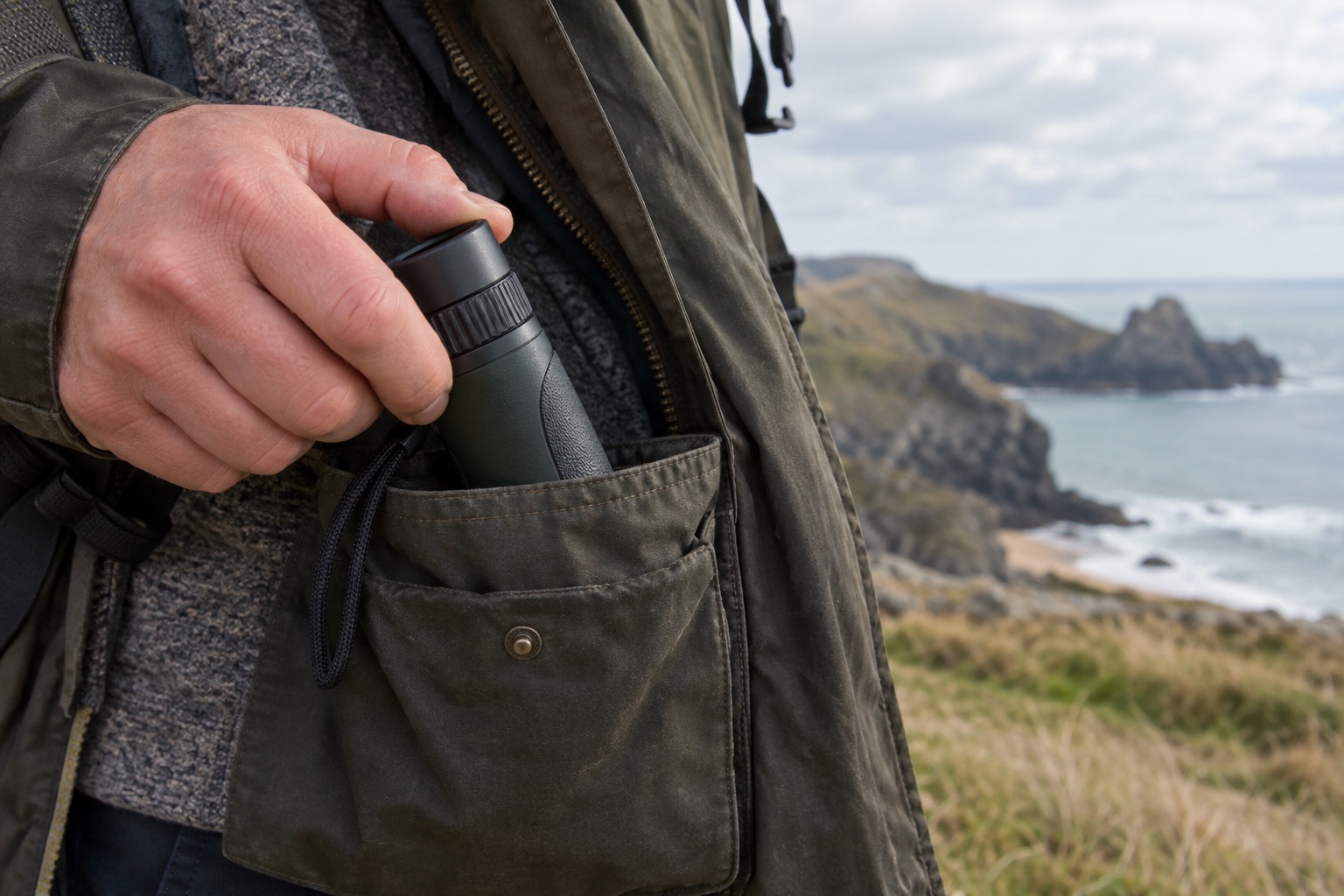
Measure packed length and pouch bulk, not only body weight.
8×25 yields a 3.1mm exit pupil; 10×25 yields 2.5mm.
Pocket optics suit short daytime views more than prolonged dusk watching.
“Pocket” is a promise about carry, not just a 25mm objective. A short optic with a bulky case may still be uncomfortable in slim trousers. Think of the pocket, weather layer and use first: a compact monocular is most rewarding when you want occasional daytime looks without a strap around your neck.
The 8×25 baseline
Hawke's Endurance ED 8×25 is listed at 150g with a 119m field at 1,000m and 13mm eye relief. Vortex Solo 8×25 is about 159g, with a stated 126m field and 15mm eye relief. Both are sealed outdoor formats. Vortex gives a little more listed field and eye relief; Hawke is slightly lighter on their published figures. Neither measurement says how the focus ring will feel in your hand or whether its case fits your pocket. Check both with your normal coat and gloves.
The 8×25 format produces a calculated 3.125mm exit pupil. In good daylight that can be enough, though eye placement is more exacting than with a larger 8×42. If you keep spectacles on, neither 13mm nor 15mm is a guaranteed full-field fit; our glasses guide gives the test.
When 10×25 earns its place
Celestron Nature 10×25 is listed at 170g, 93m field at 1,000m and 14mm eye relief. Ten-times power can help with a distant static subject, but at 25mm it gives a 2.5mm exit pupil. The narrower field makes finding a moving bird harder, and the extra power exposes hand shake. It is a deliberate specialist pocket choice, not a straightforward upgrade on 8×25. Hold it on a sign or distant roofline for a minute and see how much detail remains truly steady.
Swipe to compare pocket choices →
| Model | Field at 1km | Eye relief | Trade-off |
|---|---|---|---|
| Hawke 8×25 | 119m | 13mm | Lightest; short relief |
| Vortex 8×25 | About 126m | 15mm | Wider listed view |
| Celestron 10×25 | 93m | 14mm | More reach; narrower view |
Treat pocket protection as part of the purchase
Caps, a pouch and a wrist tether can be more useful than an extra coating claim if the optic lives beside keys, grit or crumbs. Keep the pocket dry after rain and do not seal a wet monocular in its case. If the best use is not a quick glance but a half-hour at a bird hide, consider the larger models in best monoculars UK or ask whether binoculars would be more comfortable. Never use any ordinary pocket monocular to look at the Sun.
A real pocket test
Measure the monocular with its caps and pouch, not only the bare tube in a manufacturer's product photograph. Slip a similar-sized object into the intended jacket or trouser pocket, then sit, climb a step and bend as you would on a normal outing. If it presses against you or requires both hands to retrieve, it may be a small bag optic rather than a comfortable pocket one. Check whether a focus ring can be moved one-handed without dropping the body and whether the eyecup reaches a useful position with your glasses.
For very brief looks from a bright pavement or station platform, minimum bulk may be the deciding factor. If your pocket is generous but you spend longer tracking moving birds, the Vortex's stated wider field could be useful even though it is slightly heavier than the Hawke. The 10×25 Celestron is better reserved for a fairly still, distant subject when you accept narrower framing and visible shake. None of these is a promise of all-day comfortable viewing; a larger optic or two-eyed binocular may be the honest choice for that job.
Avoid a purchase based on mass alone
A difference of a few grams can be swamped by the case, lanyard and what else you carry. Try the complete item at eye height and check how quickly you find a subject from your natural grip. If the image blacks out unless your eye sits in one exact place, reconsider the format before comparing tiny weight differences. The walking monocular guide adds route, weather and safe-stopping considerations; this page is about fit in the pocket and a usable quick view.
Helpful products
Three real pocket formats
The Hawke and Vortex keep magnification at 8×; the Celestron trades some aiming ease for 10× reach. Exact field and eye-relief figures differ.

Hawke Endurance ED 8x25 monocular
Best for: Short daytime walks
A 150g waterproof pocket monocular with ED glass, a 119m field and 5m close focus; its eye relief is only 13mm.
What stands out
- 150g carry weight
- ED glass and phase-corrected prism
- Waterproof and nitrogen purged
Keep in mind
- 13mm eye relief may frustrate glasses wearers
- 3.1mm exit pupil is daylight-first
- 8×25
- 150g
- 119m / 1,000m
- 13mm eye relief

Vortex Solo 8x25 monocular
Best for: Daylight travel and casual birds
A waterproof 8×25 with a 7.2° field, 15mm eye relief and 5m close focus, sized for grab-and-go use.
What stands out
- About 126m field at 1,000m
- Waterproof and fogproof
- About 159g
Keep in mind
- 3.1mm exit pupil is less forgiving in shade
- 15mm eye relief requires a glasses fit check
- 8×25
- About 159g
- About 126m / 1,000m
- 15mm eye relief

Celestron Nature 10x25 monocular
Best for: Distant subjects in bright light
A waterproof 170g 10×25 for bright-day distant detail, with a narrow 93m field, 14mm eye relief and 5.5m close focus.
What stands out
- 170g pocket carry
- Waterproof nitrogen-filled construction
- 10× apparent reach
Keep in mind
- 2.5mm exit pupil is unforgiving
- 93m field and 10× shake challenge moving birds
- 10×25
- 170g
- 93m / 1,000m
- 14mm eye relief
Frequently asked questions
Pocket-monocular questions
Is 10×25 better than 8×25?
Not automatically. It enlarges distant subjects but makes hand shake more obvious, often narrows the view and gives a smaller exit pupil at the same 25mm aperture.
Will an 8×25 fit a trouser pocket?
That depends on its body dimensions, case and your pocket. Test the actual packed item; a jacket pocket is often more comfortable.
Are pocket monoculars good at dusk?
They are primarily daytime tools. A 25mm objective can feel demanding as light falls; consider a larger 8×42 format for regular low-light use.
Can I leave a pocket monocular loose with keys?
Use its case or a dedicated pocket so grit and metal objects do not scratch the eyepiece or objective.