
Optical basics · Magnification
Binocular magnification explained
What binocular magnification changes, why 10× is not always more useful than 8×, and how to choose power for birds, sport, coast and stars.
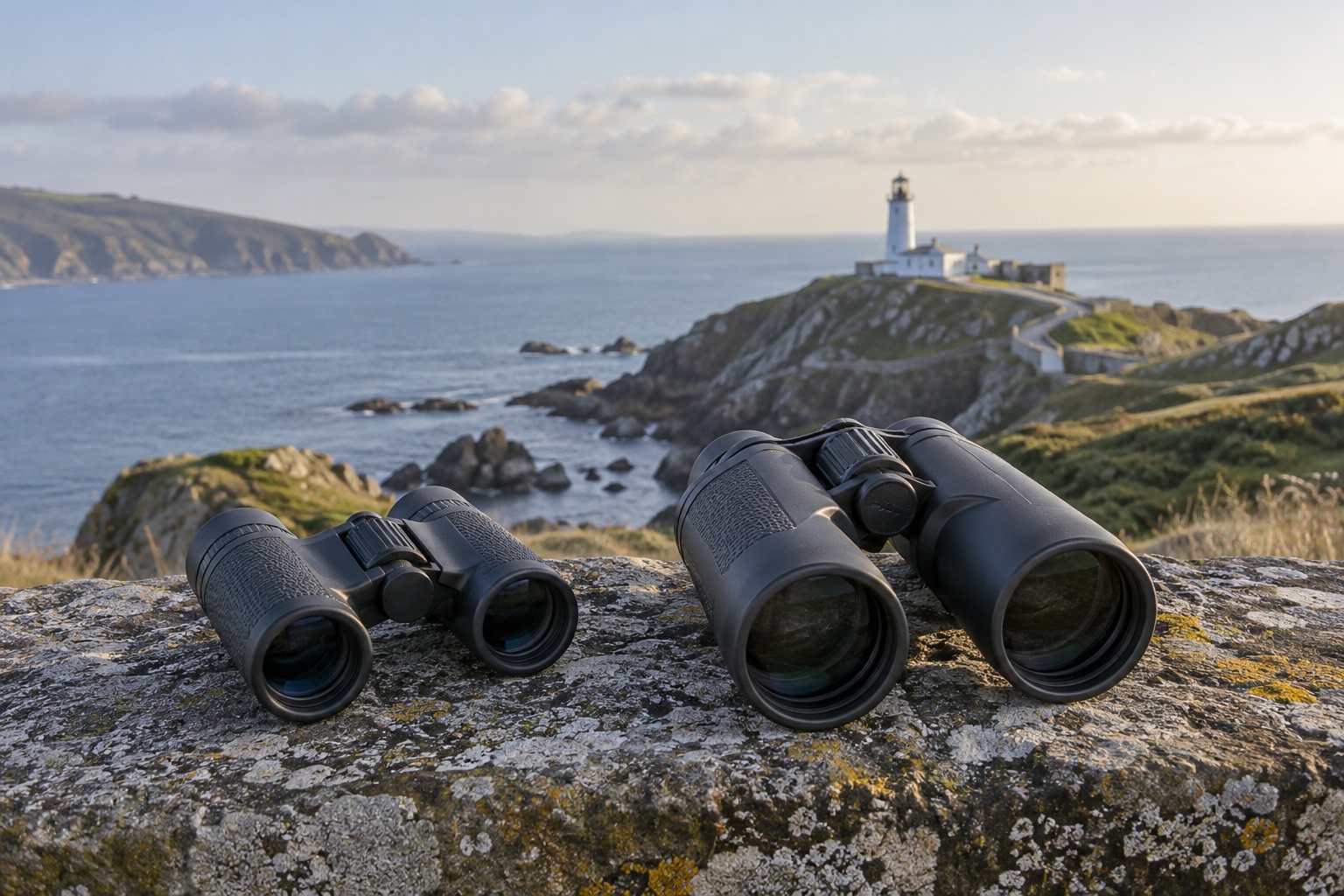
Power is the first number in 8×42; 42mm is objective diameter.
More power helps only when the view is steady enough to reveal the extra detail.
Compare full model specifications, not just 8× versus 10× labels.
The first number on a binocular is its magnification. In 8×42, the instrument enlarges the subject's apparent angular size eightfold; the second number is the 42mm objective diameter. That description is useful but incomplete. If the image wobbles, the view is too narrow to find the subject, or your eye cannot see the whole field, extra power may show less usable detail.
What changes when you go from 8× to 10×?
The same distant bird occupies more of the view. This can reveal plumage or shape on an open mudflat, provided you can hold the image still. Your hand movement is enlarged too. The field often narrows, so finding and following a bird in flight becomes harder. If both instruments have 42mm objectives, the calculated exit pupil changes from 5.25mm at 8× to 4.2mm at 10×.
Do not assume every 10×42 has a narrower published field than every 8×42. Optical design matters: the Nikon P7 10×42 lists 122m at 1,000m, while the M5 8×42 lists 112m. But when comparing two powers within one range, the 8× model usually gives more room to scan. Our 8×42 versus 10×42 guide applies that trade-off directly.
Match power to the job
For woodland birds, garden wildlife and walking while scanning, start at 8×. You can acquire a subject quickly, hold it longer and tolerate unsteady footing. For estuaries, distant hillside mammals or a fixed seat at sport, 10× may repay the extra effort. At sea, wind and movement make a steady, broad view especially valuable; a 7×50 marine binocular is built around that principle.
At night, 10×50 is a classic handheld sky format, but an 8×42 may be easier for a beginner to keep steady. Very high powers and large objectives can show more with a mount. Stargazing binoculars separates those jobs.
Why 12× and “high power” need caution
Twelve-times magnification does not create information from poor glass, low contrast or atmospheric haze. It amplifies shake, narrows the aiming window and often demands a tripod or image stabilisation. A small pocket optic advertising 30× or more without credible dimensions and a manufacturer specification deserves particular scepticism. The laws of aperture, exit pupil and hand stability still apply.
The PROSTAFF P7 8×42 and P7 10×42 make a useful same-range comparison. The 8× gives a 5.25mm exit pupil and 20.2mm eye relief; the 10× has a 4.2mm exit pupil and 15.7mm eye relief. The latter's extra reach therefore comes with a potentially important glasses-fit cost.
Test for usable detail, not apparent size
From a safe observation position, view the same textured distant target with both powers. Rest your elbows, then try unsupported. Can you read or separate more stable detail at 10×, or does the image jump? Repeat in dull light and with your glasses if you wear them. That simple exercise is more decisive than an abstract power ranking. A wide field of view and secure eye position can win the real-world comparison.
Helpful products
Compare real 8× and 10× formats
These model-level cards show how power interacts with field, weight and eye relief; they are not a claim that one number suits everyone.

Nikon PROSTAFF P7 8x42
Best for: Wide viewing with glasses
A 590g all-round 8x42 with a wide 126m field, long stated eye relief and a locking dioptre ring that helps preserve a personal focus setting.
What stands out
- 126m field of view at 1,000m
- 20.2mm stated eye relief
- 590g waterproof body with locking dioptre
Keep in mind
- 3m close focus is useful rather than class-leading
- No ED glass in the published specification
- 8×42
- 590g
- 126m / 1,000m
- 20.2mm eye relief

Nikon PROSTAFF P7 10x42
Best for: Estuaries and open-country distance
A 600g 10×42 with a notably wide 122m field, 15.7mm eye relief and a locking dioptre for repeatable long-distance viewing.
What stands out
- 122m field is wide for a 10×42
- 600g waterproof body
- Locking dioptre and protective lens coating
Keep in mind
- 15.7mm eye relief offers limited margin for some glasses
- 10× shake is more visible than with 8×
- 10×42
- 600g
- 122m / 1,000m
- 15.7mm eye relief

Nikon MONARCH M5 10x42
Best for: Steady, settled 10× observation
An ED-glass 10×42 with 18.4mm eye relief and 2.5m close focus, but a comparatively narrow 98m field.
What stands out
- ED objectives
- 18.4mm stated eye relief
- 2.5m close focus
Keep in mind
- 98m field makes moving subjects harder to find
- 640g and 10× need a steady hold
- 10×42
- 640g
- 98m / 1,000m
- 18.4mm eye relief
Frequently asked questions
Magnification questions
What does 8× magnification actually mean?
A subject appears about eight times larger in angular size than it does unaided. It does not make the subject physically eight times closer.
Is 10× better for birdwatching?
It can help with distant, settled birds in open habitat. Eight-times power is usually easier for finding, following and holding a moving bird.
Is 12× practical without a tripod?
Some users manage short views, but shake and narrow field become harder to control. A brace, monopod, tripod or image stabilisation can help.
Does magnification make a binocular brighter?
No. With the same objective diameter, more magnification makes a smaller exit pupil. Coatings and optical design also affect transmission.